When the CEO Takes a Hit: EngineAI’s Bold Statement in Humanoid Robotics
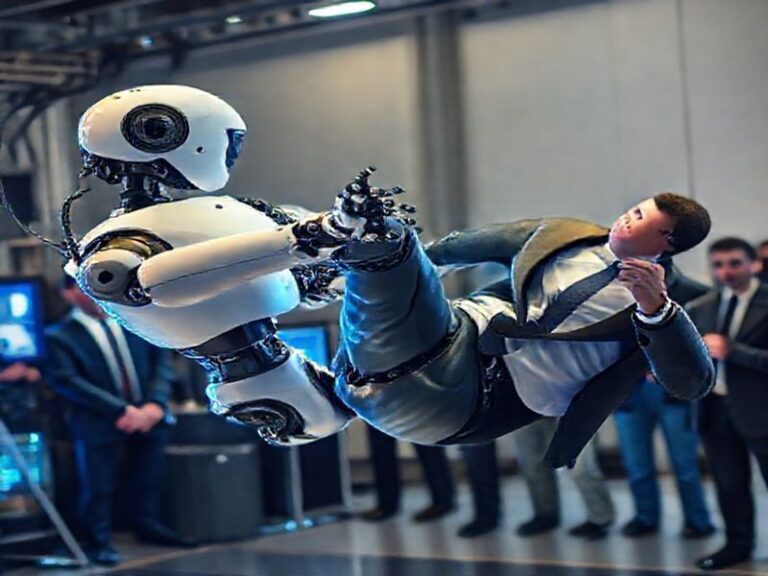
In a move that blurs the line between marketing stunt and engineering validation, EngineAI’s CEO recently took a chest kick from the company’s latest humanoid robot—the 165-pound, 29-degree-of-freedom T800. This unprecedented demonstration signals a dramatic shift from carefully choreographed robot demos to real-world durability tests, culminating in what’s perhaps the most unusual product launch event: a scheduled boxing match between human and machine.
The T800 isn’t just another humanoid robot entering an increasingly crowded market. It represents EngineAI’s audacious bet that the future of robotics lies not in perfecting dance routines or pre-programmed movements, but in creating machines that can genuinely interact with humans in unpredictable, physically demanding scenarios.
The T800: Engineering Marvel or Marketing Phenomenon?
Standing at 5’11” and weighing 165 pounds, the T800 cuts an imposing figure that deliberately evokes its cinematic namesake. But beyond the pop culture reference lies serious engineering innovation. The robot’s 29 degrees of freedom provide an unprecedented range of natural motion, while its advanced AI systems enable real-time adaptation to environmental changes and human interaction.
Breaking Down the Technical Specifications
The T800’s capabilities extend far beyond what typical demonstration videos reveal:
- Advanced Force Feedback Systems: The robot can modulate its strength output based on the resistance it encounters, preventing accidental injury during human interaction
- Predictive Balance Algorithms: Using a combination of gyroscopic sensors and machine learning, the T800 maintains stability even when subjected to unexpected forces
- Real-time Motion Planning: The AI can calculate and execute complex movement sequences in milliseconds, enabling fluid, natural motion
- Multi-modal Sensor Fusion: Cameras, lidar, and tactile sensors work together to create a comprehensive understanding of the robot’s environment
Why a CEO Taking a Kick Matters for the Industry
The robotics industry has long struggled with what insiders call the “demo effect”—robots that perform flawlessly in controlled environments but fail spectacularly in real-world conditions. By subjecting both the robot and themselves to unscripted physical interaction, EngineAI is making a powerful statement about their confidence in the T800’s capabilities.
This approach addresses a fundamental challenge in humanoid robotics: building trust. As Dr. Sarah Chen, robotics researcher at MIT, explains: “When we see a robot carefully navigating predetermined tasks, we subconsciously understand it’s essentially following a script. But when that same robot can adapt to chaotic, unpredictable human behavior, it fundamentally changes our perception of what machines can do.”
The Psychology of Robot-Human Interaction
The chest-kick demonstration taps into deep psychological factors that influence how humans perceive and interact with robots:
- Vulnerability Demonstration: By putting themselves in harm’s way, the CEO signals absolute confidence in the robot’s control systems
- Shared Risk: The mutual vulnerability creates a sense of partnership rather than master-servant relationship
- Breaking the Uncanny Valley: The robot’s ability to engage in rough, human-like interaction makes it seem more natural and less unsettling
Industry Implications: Beyond the Spectacle
The T800’s development and demonstration strategy represents several significant shifts in the robotics industry:
1. Moving Past Choreographed Demos
For years, robotics companies have relied on carefully scripted demonstrations that showcase idealized capabilities. The T800’s approach of embracing unpredictability and even potential failure marks a maturation of the industry. This transparency about limitations while highlighting genuine capabilities could accelerate adoption in critical applications.
2. Safety Standards Evolution
The willingness to engage in physical human-robot interaction suggests EngineAI has solved fundamental safety challenges that have limited humanoid robot deployment. If the T800 can safely spar with humans in a boxing match, it can likely handle less intense industrial or service applications.
3. AI Integration Breakthroughs
The real-time adaptation required for safe human-robot physical interaction represents significant advances in AI systems. The T800’s ability to process sensory input, predict human movement, and adjust its own actions accordingly pushes the boundaries of what’s possible with current AI technology.
Future Possibilities: From Boxing Rings to Real-World Applications
While a boxing match makes for compelling viewing, the underlying technology has profound implications across multiple sectors:
Industrial Manufacturing
The T800’s durability and adaptive capabilities could revolutionize manufacturing environments where human-robot collaboration is essential. Unlike traditional industrial robots that operate in cages for safety, T800-class robots could work alongside humans, adapting to changing production needs without extensive reprogramming.
Emergency Response
Robots capable of navigating chaotic environments and physical interaction could prove invaluable in disaster response scenarios. The ability to safely move debris, assist injured humans, or navigate unstable structures while maintaining balance and control could save countless lives.
Healthcare and Elder Care
The gentle touch required for safe human interaction, combined with the strength needed for lifting and moving patients, positions humanoid robots like the T800 as potential solutions to healthcare staffing shortages. The psychological comfort of interacting with a robot that moves naturally and responds appropriately to human behavior cannot be understated.
Challenges and Considerations
Despite the impressive demonstration, significant challenges remain before humanoid robots like the T800 achieve widespread adoption:
- Power Management: Current battery technology limits operational time, with most humanoid robots requiring frequent recharging
- Cost Considerations: The advanced sensors, actuators, and computing power required for this level of performance currently price these robots beyond most applications
- Regulatory Framework: Existing safety regulations struggle to address robots capable of autonomous physical interaction with humans
- Ethical Implications: As robots become more capable of human-like interaction, questions about rights, responsibilities, and the nature of consciousness become increasingly relevant
Conclusion: A Punch Heard ‘Round the Tech World
Whether viewed as a brilliant marketing move or a genuine technological breakthrough, EngineAI’s chest-kick demonstration and upcoming boxing match have succeeded in capturing global attention. More importantly, they’ve shifted the conversation about humanoid robots from “what might be possible someday” to “what’s happening right now.”
The T800 represents more than just another entry in the humanoid robot race—it embodies a fundamental shift toward transparent, real-world validation of AI and robotics capabilities. As the boxing match approaches, the technology industry watches with bated breath, knowing that regardless of the outcome, the boundaries between human and machine capabilities continue to blur in ways that will reshape our world.
In taking that kick to the chest, EngineAI’s CEO didn’t just prove their robot is real—they kicked open the door to a future where human-robot interaction moves beyond careful choreography into the messy, unpredictable reality of everyday life. Whether that future arrives with a whisper or a punch remains to be seen, but one thing is certain: the robots are no longer just dancing—they’re ready to fight.