The Uncanny Valley of Holiday Marketing: McDonald’s AI Christmas Ad Debacle
The holiday season is supposed to be about warmth, nostalgia, and human connection. So when McDonald’s unveiled its AI-generated Christmas advertisement in December 2024, the fast-food giant expected to spread festive cheer. Instead, they unleashed a digital nightmare that sent shivers down viewers’ spines and became a cautionary tale for brands rushing to embrace artificial intelligence in creative campaigns.
When Algorithms Meet Eggnog: The Campaign That Went Wrong
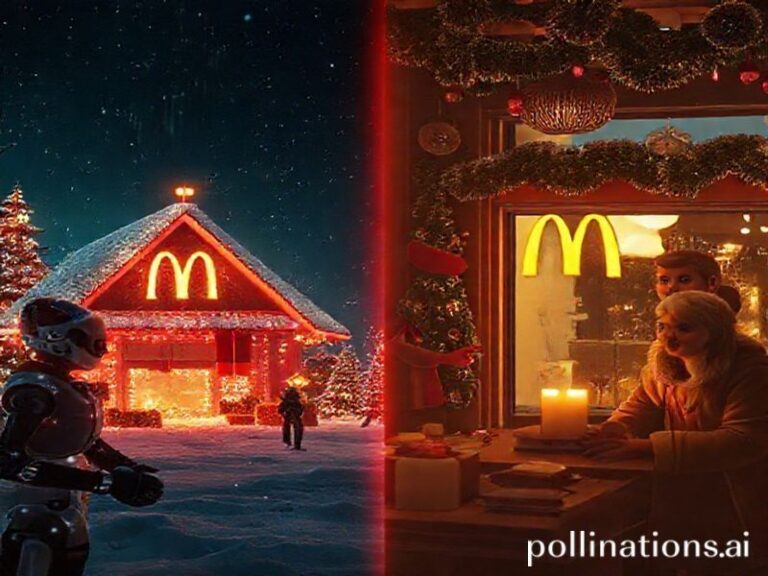
McDonald’s AI-generated Christmas ad featured what should have been heartwarming scenes: families gathering around golden arches, children unwrapping Happy Meals with glowing smiles, and Santa himself enjoying a Big Mac. But something was fundamentally off. The human characters moved with jerky, unnatural motions. Their eyes seemed to stare through the screen with vacant, soulless expressions. The snow fell in perfect, mathematically precise patterns that felt too sterile for the chaotic beauty of real winter weather.
Within hours of its release on social media, the ad went viral—for all the wrong reasons. Twitter users dubbed it the “McNightmare before Christmas,” while TikTok creators made reaction videos showing themselves recoiling from the screen. The hashtag #UncannyMcDonald’s trended globally as viewers shared timestamps of the most unsettling moments.
The Technical Breakdown: What Went Wrong Behind the Scenes
The AI Tools That Created the Horror
According to industry insiders, McDonald’s creative team employed a combination of cutting-edge AI tools:
- Runway ML Gen-3 for video generation and character animation
- Stable Diffusion XL for background and environmental imagery
- ElevenLabs for voice synthesis and holiday music generation
- Custom fine-tuned models trained on decades of McDonald’s archival footage
The problem wasn’t the technology itself—it was the absence of human oversight in the creative process. The AI models, trained on thousands of hours of existing commercials, learned to replicate surface-level aesthetics without understanding the subtle emotional nuances that make holiday advertising effective.
The Uncanny Valley Effect in Marketing
Dr. Sarah Chen, a cognitive scientist at MIT, explains the phenomenon: “The uncanny valley is particularly pronounced in holiday content because our emotional expectations are so high. We’re primed for genuine human warmth and nostalgia. When AI-generated content falls short—even by 5%—our brains immediately flag it as threatening or unsettling.”
Industry Implications: A Wake-Up Call for AI-Driven Creativity
The Financial Fallout
McDonald’s pulled the ad after just 48 hours, but the damage was done. The company’s stock dipped 3.2% following the controversy, and marketing analysts estimate the failed campaign cost approximately $15 million in direct expenses and lost holiday season revenue. More significantly, it sparked a broader conversation about the limits of AI in creative industries.
Competitor Responses and Market Shifts
Major brands quickly distanced themselves from fully AI-generated content. Coca-Cola, which had been experimenting with similar technology for its own holiday campaign, immediately pivoted back to human-directed advertisements. Burger King released a statement emphasizing their commitment to “authentic, human storytelling” (while subtly taking a jab at their competitor’s misstep).
Industry organizations responded by establishing new guidelines:
- The Creative AI Ethics Pledge – requiring disclosure when AI tools are used in advertising
- Human-in-the-Loop Mandates – ensuring creative professionals maintain oversight of AI-generated content
- Quality Assurance Protocols – implementing psychological testing to identify potentially unsettling content before release
The Future of AI in Advertising: Lessons Learned and Paths Forward
Hybrid Approaches Show Promise
Forward-thinking agencies are developing collaborative AI workflows that enhance rather than replace human creativity. These approaches include:
- Using AI for initial concept generation and storyboard creation
- Employing machine learning for color grading and technical optimization
- Leveraging AI-powered tools for localization and personalization while maintaining human-directed core content
Technical Improvements on the Horizon
The McDonald’s debacle has accelerated research into more sophisticated AI models that better understand human emotional responses. Companies like OpenAI and Google are developing new architectures that incorporate:
- Emotional intelligence modules trained on psychological response data
- Temporal consistency algorithms to prevent the jerky, unnatural motion that plagued the McDonald’s ad
- Micro-expression synthesis for more believable human facial animations
The Human Element Remains Irreplaceable
Perhaps the most important lesson from this incident is that authenticity cannot be algorithmically generated. The most successful holiday campaigns tap into shared human experiences—childhood wonder, family traditions, the bittersweet passage of time—that remain beyond the reach of current AI technology.
As we move forward, the most promising path lies not in replacing human creativity but in augmenting it. AI tools can handle technical tasks, generate variations, and optimize distribution, while human creatives focus on the emotional storytelling that truly connects with audiences.
Looking Ahead: A More Thoughtful Integration of AI in Marketing
The McDonald’s Christmas ad debacle will likely be remembered as a turning point in the advertising industry’s relationship with AI. It demonstrated that while the technology has made remarkable strides, the human element remains irreplaceable in creating content that resonates on an emotional level.
Brands that succeed in the future will be those that view AI not as a creative replacement but as a powerful tool that, when wielded by skilled human hands, can enhance rather than diminish the authentic connections that great advertising creates. The lesson is clear: in the quest for efficiency and innovation, we must not lose sight of the human heart that beats at the center of all meaningful communication.
As we enter 2025, the advertising industry finds itself at a crossroads. The path forward requires a delicate balance—embracing AI’s incredible capabilities while preserving the human touch that transforms mere advertisements into cultural moments that bring us together, especially during the holiday season.