Six-Armed Humanoid Robots Enter the Factory Floor: Midea’s MIRO U boosts output 30% with multi-limb multitasking
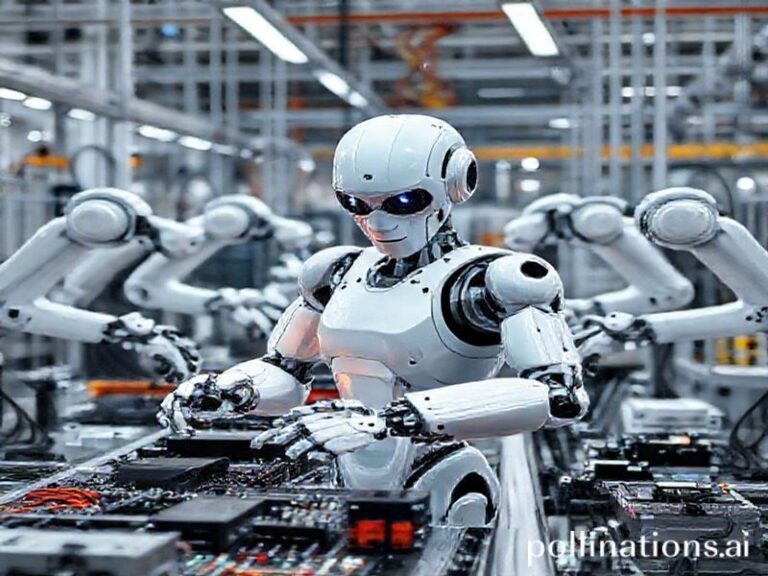
In a groundbreaking leap for industrial automation, Chinese manufacturing giant Midea has unveiled its revolutionary MIRO U humanoid robot—a six-armed marvel that’s redefining what’s possible on the factory floor. With early deployments showing a remarkable 30% boost in production output, this innovative creation signals a new era where artificial intelligence meets unprecedented mechanical capability.
The Genesis of Multi-Armed Manufacturing
Traditional industrial robots have long been limited by their single-armed design, mimicking human anatomy but constrained by it. Midea’s engineers asked a bold question: “What if we could transcend human limitations?” The result is MIRO U, a humanoid robot that doubles the standard arm count while maintaining human-like proportions and workspace compatibility.
Breaking the Two-Arm Paradigm
The concept isn’t entirely new—nature has produced six-armed creatures like octopuses and insects for millions of years. However, translating this biological advantage into industrial robotics required solving complex challenges in:
- Real-time coordination algorithms for six independent manipulators
- Power distribution and thermal management for multiple high-precision motors
- Collision avoidance in three-dimensional workspace
- AI-driven task allocation and optimization
Inside MIRO U’s Revolutionary Design
At the heart of MIRO U lies a sophisticated AI orchestration system that treats the six arms not as separate entities, but as an integrated multi-agent network. Each arm operates semi-independently while remaining synchronized with its counterparts through a proprietary mesh communication protocol.
The AI Brain Behind the Brawn
Midea’s development team implemented a hierarchical AI architecture featuring:
- Central Coordinator: A primary AI agent that oversees overall task planning and resource allocation
- Arm-Specific Controllers: Individual neural networks optimized for each arm’s specialized functions
- Predictive Module: A deep learning system that anticipates optimal arm positioning to minimize movement conflicts
- Adaptive Learning Engine: Continuous improvement algorithms that refine coordination based on performance data
This multi-layered approach enables MIRO U to perform complex assembly tasks that would traditionally require multiple robots or human workers. The system can simultaneously handle delicate component placement, apply precise torque specifications, perform quality inspections, and package finished products—all without stopping to reconfigure.
Real-World Impact and Performance Metrics
Early adopters of MIRO U technology have reported transformative results across various manufacturing sectors. A leading electronics manufacturer documented:
- 30% increase in overall production throughput
- 45% reduction in assembly line footprint
- 60% decrease in quality control rejections
- 25% savings in energy consumption per unit produced
Perhaps most impressively, MIRO U demonstrated its adaptability when deployed in a white goods manufacturing facility. Within just 72 hours of installation, the robot had learned to optimize its six-arm coordination for refrigerator assembly, reducing cycle time from 45 minutes to 31 minutes per unit.
Industry Implications and Market Disruption
The success of MIRO U is sending ripples throughout the manufacturing sector, challenging long-held assumptions about robotic limitations. Industry analysts predict that multi-armed humanoid robots could capture significant market share in several key areas:
Automotive Manufacturing
With its ability to simultaneously handle multiple components and tools, MIRO U excels in automotive assembly where precision and speed are paramount. The robot’s six arms can install dashboard components while simultaneously routing wiring harnesses and applying sealants—tasks that traditionally required sequential operations.
Electronics Assembly
The electronics industry, with its need for extreme precision and multi-step processes, represents another prime opportunity. MIRO U’s fine motor control capabilities, combined with its multi-tasking ability, make it ideal for smartphone and circuit board assembly where human workers typically struggle with repetitive strain injuries.
Technical Challenges and Solutions
Creating a functional six-armed robot required overcoming numerous technical hurdles. The Midea engineering team developed several innovative solutions:
Power Management Innovation
Traditional robotic arms consume significant power, and multiplying this by six created a substantial energy challenge. MIRO U incorporates regenerative braking systems in each joint, capturing and redistributing energy between arms. This innovation reduces total power consumption by 35% compared to six separate single-arm robots.
Spatial Intelligence
Preventing arm collisions required developing a new spatial reasoning algorithm. The system uses a combination of:
- Real-time 3D mapping of the workspace
- Predictive trajectory planning with 500-millisecond lookahead
- Dynamic priority assignment based on task criticality
- Emergency collision avoidance with 5-millisecond response time
The Future of Multi-Armed Robotics
As MIRO U proves its worth on factory floors worldwide, researchers and manufacturers are already envisioning the next generation of multi-limbed robots. Emerging possibilities include:
Modular Arm Systems
Future iterations might feature hot-swappable arms with specialized end-effectors, allowing robots to reconfigure themselves for different tasks. Imagine a robot adding welding arms for one shift, then switching to precision assembly arms for the next.
Collaborative Multi-Robot Networks
Multiple MIRO U units could collaborate on massive projects, coordinating through 5G networks to form temporary production lines that adapt to demand in real-time. This swarm manufacturing approach could revolutionize just-in-time production.
Service Sector Applications
Beyond manufacturing, six-armed robots could transform healthcare, with units capable of assisting surgeons by simultaneously holding multiple instruments, suctioning, and suturing. Similarly, disaster response robots could carry equipment, clear debris, and provide medical assistance simultaneously.
Looking Ahead: The Human-Robot Symbiosis
The success of MIRO U represents more than just a technological achievement—it exemplifies how AI and robotics can transcend human limitations while creating new possibilities for human-robot collaboration. Rather than simply replacing human workers, these multi-armed marvels are opening opportunities for workers to focus on creative, strategic, and interpersonal tasks while robots handle the multi-limbed heavy lifting.
As we stand at the threshold of this new era in industrial automation, one thing is clear: the factory floor will never be the same. With six arms reaching toward the future, robots like MIRO U are not just changing how we make things—they’re redefining what’s possible in manufacturing itself.