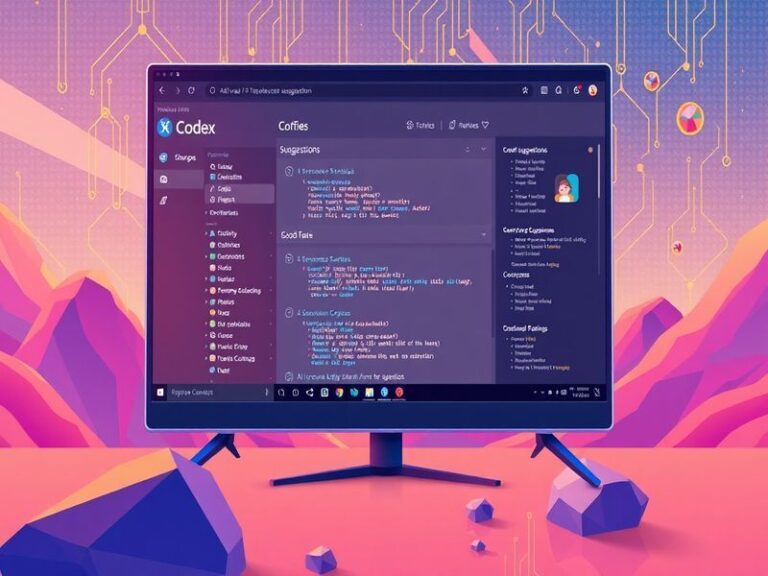
Codex Launches on Windows: OpenAI’s Coding Agent Expands Accessibility
In a significant move that could reshape the landscape of programming, OpenAI has launched Codex for Windows users, providing a native app experience that brings artificial intelligence-driven coding assistance to an even broader audience. This development not only enhances accessibility but also opens up new avenues for developers, businesses, and educational institutions. With Codex’s integration into the Windows environment, users can expect a smoother, more intuitive experience that taps into the power of machine learning and AI.
What is Codex?
Codex is OpenAI’s cutting-edge AI model designed to understand and generate code. Leveraging the capabilities of the GPT-3 architecture, Codex can interpret natural language prompts and translate them into functional code snippets across various programming languages. This technology has been a game-changer for developers seeking to streamline their workflows, reduce repetitive coding tasks, and even learn new programming paradigms.
Key Features of Codex on Windows
The native app experience for Codex on Windows comes with a host of features designed to enhance productivity:
- Natural Language Processing: Users can input queries in plain English, and Codex will generate the corresponding code, making programming more accessible, even for beginners.
- Multi-language Support: Codex supports a wide array of programming languages, including Python, JavaScript, TypeScript, and more, catering to diverse coding needs.
- Integrated Development Environment (IDE) Compatibility: The app can work seamlessly with popular IDEs like Visual Studio Code, providing context-aware code suggestions and auto-completions.
- Real-time Collaboration: Teams can collaborate in real-time, making it easier to brainstorm ideas and develop solutions together, regardless of geographical barriers.
Practical Insights
For individual developers and teams, the launch of Codex on Windows presents several practical benefits:
- Increased Efficiency: Codex can significantly cut down the time spent on routine coding tasks, allowing developers to focus on more complex challenges and creative solutions.
- Learning Aid: New programmers can use Codex to learn coding by example, understanding how to translate their ideas into code through guided suggestions.
- Customization: Developers can tailor Codex’s responses to fit their unique coding styles or project requirements, enhancing the overall coding experience.
Industry Implications
The implications of Codex’s launch on Windows extend beyond individual developers. Its presence in the Windows ecosystem has the potential to disrupt several industries:
- Software Development: Companies can significantly reduce development times and costs, leading to faster product launches and iterations.
- Education: Academic institutions may adopt Codex as a teaching tool, enabling students to grasp programming concepts more effectively through interactive learning.
- Startups and Entrepreneurship: Aspiring entrepreneurs can leverage Codex to build prototypes and MVPs without extensive coding knowledge, democratizing access to technology.
Future Possibilities
Looking ahead, the integration of Codex into Windows could pave the way for several exciting advancements:
- Enhanced AI Capabilities: Future iterations of Codex may include advanced predictive capabilities, allowing it to suggest entire functions or modules based on minimal input.
- Cross-Platform Integration: As Codex expands its reach, we may see integrations with other operating systems and platforms, further enhancing its versatility.
- Community Contributions: OpenAI could encourage a community-driven approach where developers contribute to Codex’s learning process, making it smarter and more adaptable over time.
In conclusion, the launch of Codex on Windows signifies a major step forward in the intersection of artificial intelligence and software development. By providing a native app experience, OpenAI is not just enhancing accessibility; it is also laying the groundwork for a future where coding is more intuitive and collaborative. As AI continues to evolve, so too will the ways in which we create and interact with technology, making this an exciting time for tech enthusiasts and professionals alike.