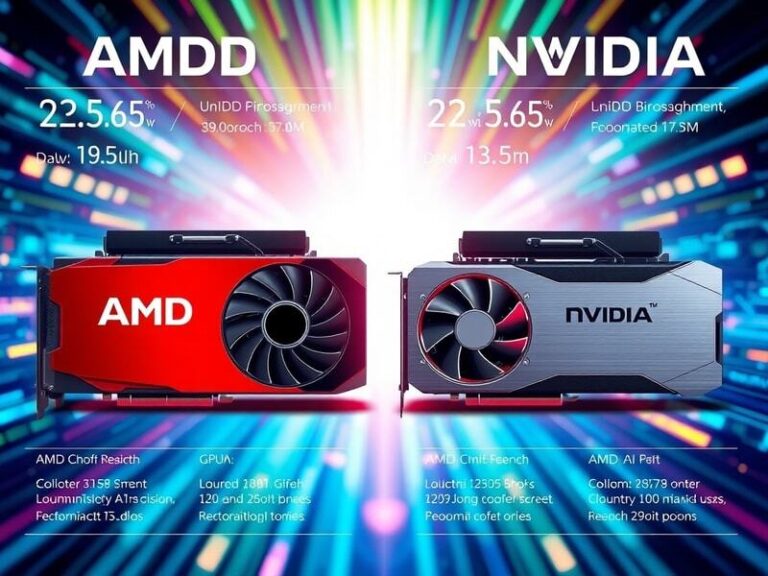
AMD vs Nvidia: The AI Hardware Showdown
The race to dominate the AI hardware market has seen intense competition between two giants: AMD and Nvidia. As artificial intelligence continues to permeate various industries, the demand for powerful, efficient processors has skyrocketed. This article dives deep into AMD’s latest offerings and how they stack up against Nvidia’s established presence in the AI sector.
The Current Landscape of AI Hardware
Artificial intelligence relies heavily on specialized hardware to process vast amounts of data and perform complex computations. The primary players in this field—Nvidia and AMD—each bring unique strengths to the table. Nvidia has long been synonymous with GPU technology and AI applications, while AMD has made significant strides in recent years to carve out its share of the market.
AMD’s New Offerings
AMD has recently launched several products aimed directly at the AI and machine learning sectors:
- Radeon MI300: This multi-die GPU architecture is designed for data centers and machine learning workloads. The MI300 aims to provide enhanced performance and efficiency for AI training and inference tasks.
- EPYC Processors: AMD’s EPYC series has been upgraded to support AI workloads with improved core counts and memory bandwidth, making them suitable for server environments that require heavy computational power.
- Software Ecosystem: AMD has bolstered its software offerings with ROCm (Radeon Open Compute), which facilitates high-performance computing and AI application development.
Performance Comparison: AMD vs Nvidia
When comparing AMD’s new offerings to Nvidia’s market-leading GPUs, several key performance indicators emerge:
- Processing Power: Nvidia’s A100 and H100 GPUs have set benchmarks for AI training speeds. However, AMD’s MI300 has been designed to close this gap by leveraging its memory architecture for faster data processing.
- Energy Efficiency: AMD has historically emphasized energy efficiency, which is critical in AI data centers. The MI300 aims to deliver competitive performance per watt, challenging Nvidia’s lead in this area.
- Cost-Effectiveness: AMD’s pricing strategy often undercuts Nvidia, making their hardware an attractive option for companies looking to implement AI solutions without breaking the bank.
Industry Implications
The battle between AMD and Nvidia is more than just a competition; it shapes the future of AI technology:
- Innovation Acceleration: As both companies strive to outdo each other, we can expect rapid advancements in AI hardware capabilities, leading to breakthroughs in AI applications.
- Diverse Ecosystems: The competition encourages the development of diverse software ecosystems, enabling developers to choose platforms that best fit their needs.
- Market Dynamics: A stronger AMD presence may lead to more competitive pricing in the market, benefiting consumers and businesses looking to adopt AI technologies.
Future Possibilities
Looking forward, several trends will likely define the AMD vs Nvidia landscape:
- AI-Specific Hardware: Both companies may invest in more specialized hardware designed explicitly for AI applications, increasing performance and efficiency.
- Collaboration with Startups: As AI startups continue to emerge, partnerships with hardware providers will become essential to drive innovation and market adoption.
- Focus on Edge Computing: With the rise of IoT and edge computing, AMD and Nvidia will need to adapt their offerings to meet the demands of AI processing at the edge, enhancing real-time data processing capabilities.
Conclusion
The showdown between AMD and Nvidia in the AI hardware arena is poised to redefine the capabilities of artificial intelligence. With AMD’s new offerings, there is potential for increased competition that could lead to more innovative solutions in the industry. As AI continues to evolve, the collaboration of these technology giants will be crucial in shaping the future landscape of artificial intelligence.