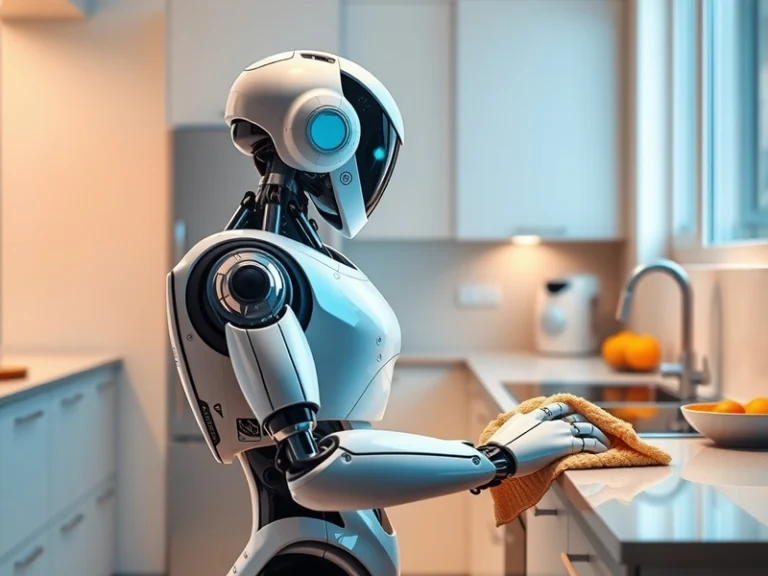
A significant advancement in robot learning is enabling humanoid robots to perform household chores in homes they have never encountered before, marking a crucial step toward truly autonomous domestic assistance.
Historically, robots designed for household tasks, such as robotic vacuum cleaners, operate within highly structured or pre-mapped environments. Their intelligence is often confined to specific tasks and locations, requiring extensive setup or relearning for new spaces. The recent breakthrough shifts this paradigm, allowing general-purpose humanoid robots to perceive, understand, and act effectively in novel, unstructured home environments through advanced AI models that facilitate generalization.
The Leap to Unseen Environments
The core of this development lies in equipping robots with the ability to generalize learned behaviors and visual understanding across diverse settings. Unlike previous generations that might rely on precise CAD models or extensive pre-mapping of a specific home, these new systems leverage large-scale robot learning techniques. This involves training AI models on vast datasets of real-world and simulated interactions, encompassing a wide variety of objects, room layouts, and task variations.
Key to this generalization is the integration of visual-language models (VLMs) with robotic control. These models, akin to the large language models (LLMs) that power conversational AI, are trained to understand both visual information and natural language commands. When applied to robotics, they allow a robot to interpret high-level instructions like “clean the kitchen” or “put away the dishes” and translate them into a sequence of physical actions, even if it has never seen that specific kitchen or those particular dishes before.
The learning process often combines several advanced AI methodologies:
- Imitation Learning: Robots learn by observing human demonstrations, either in virtual reality or through teleoperation, capturing the nuances of human manipulation and task execution.
- Reinforcement Learning: Through trial and error, often accelerated in simulation, robots refine their motor skills and decision-making processes to achieve desired outcomes efficiently.
- Sim-to-Real Transfer: Behaviors learned in highly realistic simulations are robustly transferred to physical robots, dramatically reducing the time and cost associated with real-world training.
- Foundation Models for Robotics: Similar to foundation models in natural language processing, these large, pre-trained models capture broad knowledge about the physical world and task execution, which can then be fine-tuned for specific robotic applications. This allows for rapid adaptation to new tasks and environments with minimal additional training data.
Overcoming Real-World Complexity
The domestic environment presents unique challenges for autonomous robots. Homes are inherently unstructured, filled with a diverse array of objects of varying shapes, sizes, textures, and fragility. Furthermore, tasks like cleaning involve intricate manipulation, understanding semantic concepts (e.g., what constitutes “clean” or “tidy”), and navigating around unexpected obstacles, including pets or people.
This new generation of humanoid robots addresses these complexities through enhanced capabilities:
- Robust Perception: Advanced computer vision systems, often incorporating depth sensors and high-resolution cameras, enable robots to accurately identify and localize objects, even partially obscured ones, and understand the 3D geometry of a room.
- Semantic Understanding: Leveraging VLMs, robots can associate visual cues with semantic labels, understanding that a “mug” is an object that can be “washed” or “put in a cupboard,” regardless of its specific design.
- Dexterous Manipulation: Sophisticated robotic hands and arms, coupled with precise control algorithms, allow for delicate grasping and manipulation of a wide range of household items, from soft laundry to fragile glassware.
- Adaptive Planning: The AI systems dynamically generate and adjust task plans in real-time based on sensory input, allowing the robot to adapt to changes in the environment or unexpected events without requiring human intervention.
Implications for Home Automation and Beyond
The ability of humanoid robots to autonomously perform chores in unfamiliar homes has profound implications. It moves beyond niche robotic appliances to a future where general-purpose robots can genuinely assist with a broad spectrum of domestic tasks, from tidying and cleaning to potentially cooking and personal assistance. This could significantly alleviate household burdens, particularly for the elderly, individuals with disabilities, or busy professionals.
While still in the research and development phase, these breakthroughs lay the groundwork for a future where humanoid robots are not just industrial tools but integral parts of our daily lives, capable of understanding and interacting with the world in a more human-centric way. The ongoing advancements in AI, particularly in large-scale model training and embodiment, continue to shrink the gap between specialized automation and truly intelligent, adaptable robotic assistance.