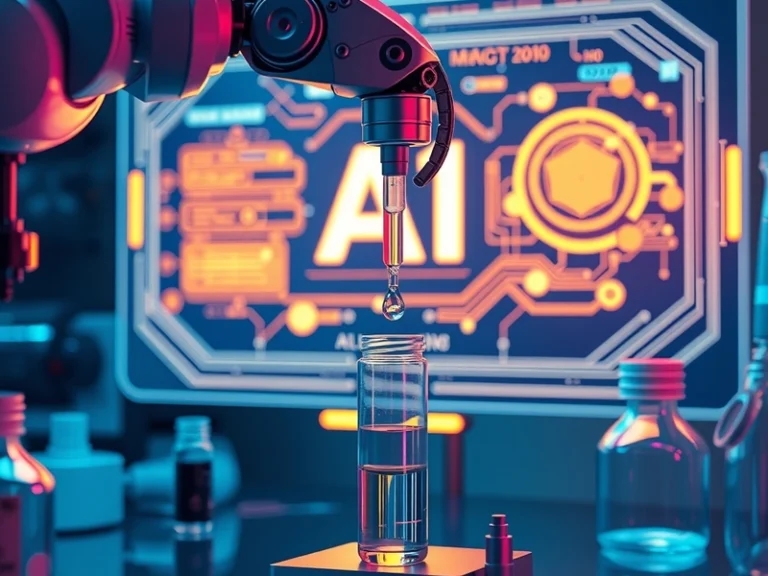
The long-anticipated vision of an autonomous scientific laboratory, where artificial intelligence systems design and execute their own experiments without human intervention, has now been realized in the realm of materials science. This groundbreaking development marks a significant shift from AI as merely an analytical tool to an active, self-driving agent in the scientific discovery process, capable of generating hypotheses, conducting physical experiments, and interpreting results to further its own understanding of material properties.
Historically, materials discovery has been a labor-intensive, often serendipitous process. Researchers spend countless hours in the lab, meticulously synthesizing compounds, characterizing their properties, and iterating based on intuition and prior knowledge. While computational tools and machine learning have increasingly assisted in predicting material behaviors and screening candidates, the physical execution and iterative refinement of experiments have largely remained within human purview. The advent of AI-driven autonomous labs fundamentally changes this paradigm, allowing for a continuous, self-optimizing cycle of scientific inquiry.
The Autonomous Scientific Method
At the core of these new autonomous systems is a closed-loop framework that integrates several advanced technologies:
- AI-Driven Hypothesis Generation: Leveraging sophisticated machine learning models, the AI analyzes vast datasets of existing materials science literature, experimental results, and theoretical predictions. From this knowledge base, it forms hypotheses about novel material compositions, processing parameters, or structural modifications that could lead to desired properties.
- Robotic Experimentation: Once a hypothesis is formulated, the AI translates it into a precise set of experimental instructions. These instructions are then executed by robotic arms and automated laboratory equipment. This includes tasks such as precise chemical synthesis, thin-film deposition, annealing, and sample preparation, all performed with high fidelity and repeatability.
- Automated Data Collection and Analysis: As experiments proceed, integrated sensors and analytical instruments (e.g., X-ray diffractometers, spectroscopes, electron microscopes) collect high-throughput data on the synthesized materials. The AI then processes and interprets this raw data, extracting key insights into the material’s structure, composition, and physical properties.
- Iterative Learning and Refinement: The results from each experiment feed back into the AI’s learning models. It compares the observed outcomes against its initial hypotheses, updates its internal knowledge representation, and refines its understanding of the underlying structure-property relationships. This iterative process allows the AI to continuously improve its predictive capabilities and design more targeted, efficient experiments in subsequent cycles.
This cycle enables the AI to explore vast experimental spaces far more systematically and rapidly than human researchers could. It can identify subtle correlations and optimal pathways that might be overlooked by conventional approaches, accelerating the discovery of materials with tailored functionalities.
Implications for Materials Discovery
The implications of AI-driven autonomous laboratories are profound, particularly for fields critical to technological advancement:
- Accelerated Discovery: By operating 24/7 without human intervention, these systems can compress years of traditional research into months or even weeks. This speed is crucial for developing new battery materials, catalysts, semiconductors, and drug compounds.
- Exploration of Novel Chemical Spaces: AI can intelligently navigate and explore vast, previously uncharted chemical and materials spaces, identifying unexpected compositions or processing routes that might lead to breakthrough properties. It is less constrained by human biases or conventional wisdom.
- Optimized Synthesis and Processing: Beyond discovery, autonomous labs can systematically optimize synthesis parameters, leading to more efficient, scalable, and cost-effective production methods for new and existing materials.
- Reduced Human Exposure and Error: Automating hazardous or highly repetitive experimental procedures reduces risks to human researchers and minimizes the potential for human error, leading to more reliable and reproducible results.
Challenges and Future Directions
While exceptionally promising, the development and widespread adoption of fully autonomous AI labs face several challenges. The initial capital investment in sophisticated robotics, integrated analytical equipment, and robust AI software infrastructure can be substantial. Furthermore, designing AI systems that are truly robust, capable of handling unexpected experimental outcomes, and adaptable to a wide array of scientific problems requires continuous research and development in areas like reinforcement learning, causal inference, and explainable AI.
Despite these hurdles, the trajectory is clear. As AI models become more sophisticated and robotic systems more dexterous and affordable, autonomous laboratories are poised to revolutionize not only materials science but also chemistry, pharmaceuticals, and biotechnology. The ability of an AI to “build its own lab” and conduct independent scientific inquiry represents a pivotal step towards a future where scientific discovery itself is fundamentally enhanced and accelerated by intelligent autonomous systems.