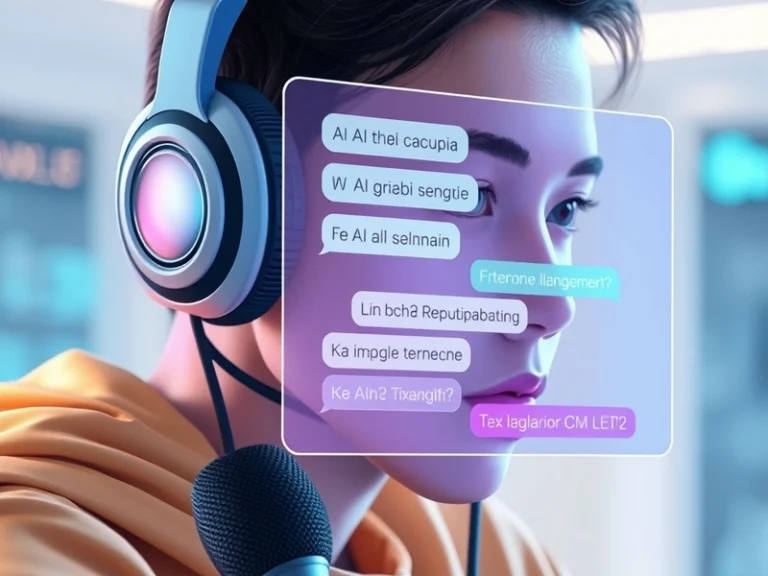
A new open-source application named OpenLingo has emerged, aiming to redefine language learning by offering a free, personalized, and conversational AI tutor.
OpenLingo positions itself as a significant entry in the burgeoning field of AI-driven educational tools, focusing specifically on breaking down barriers to language acquisition. By leveraging advanced artificial intelligence, the platform promises to adapt to individual learner needs, providing tailored conversational practice that traditional methods often struggle to deliver at scale or without significant cost.
The Promise of Personalized Conversational Learning
The core appeal of OpenLingo lies in its dual emphasis on personalization and conversational interaction. Unlike static learning apps that follow rigid curricula, an AI tutor can dynamically adjust its approach based on a user’s progress, errors, and expressed interests. This means that instead of rote memorization or predefined exercises, learners can engage in free-form dialogues, simulating real-world conversations.
For language learners, the opportunity to practice speaking and listening in a non-judgmental environment is invaluable. Many struggle with confidence when speaking a new language, especially with native speakers. An AI tutor can provide:
- Unlimited Practice: Available 24/7, allowing learners to practice whenever and wherever they choose.
- Adaptive Feedback: Real-time corrections on grammar, pronunciation, and vocabulary, tailored to the specific context of the conversation.
- Customizable Scenarios: The ability to request conversations around specific topics, from ordering coffee to discussing complex current events, making the learning highly relevant.
- Error Tolerance: A patient environment where mistakes are seen as learning opportunities, reducing anxiety often associated with language practice.
This approach moves beyond basic vocabulary and grammar drills, pushing learners into more complex sentence structures and natural conversational flow, which is critical for fluency.
How AI Powers Language Tutoring
The capabilities of OpenLingo likely stem from recent advancements in large language models (LLMs) and natural language processing (NLP). These technologies enable the AI to:
- Understand User Input: Through natural language understanding (NLU), the AI can comprehend spoken or typed questions, statements, and even nuanced expressions in various languages.
- Generate Relevant Responses: Using natural language generation (NLG), it can craft coherent, contextually appropriate, and grammatically correct replies, simulating a human conversation partner.
- Adapt and Learn: Integrating machine learning algorithms allows the system to analyze user performance over time, identifying areas of weakness and strength. This data then informs the subsequent interactions, ensuring the learning path remains challenging yet achievable.
- Speech Recognition and Synthesis: For a truly conversational experience, robust speech-to-text and text-to-speech technologies are essential. These enable users to speak naturally and hear the AI’s responses, aiding pronunciation and listening comprehension.
By combining these elements, OpenLingo can create an immersive learning environment that feels more like interacting with a human tutor than a traditional software application.
The Open-Source Advantage
The decision to release OpenLingo as an open-source project carries significant implications for its development, adoption, and long-term impact. The “free” aspect immediately lowers the barrier to entry, making high-quality language education accessible to a broader global audience who might not afford premium tutoring services or subscription-based apps.
Beyond cost, the open-source model fosters a collaborative environment:
- Community-Driven Development: Developers worldwide can contribute to OpenLingo’s codebase, suggesting improvements, fixing bugs, and adding new features or language modules. This can lead to faster innovation and a more robust, diverse platform.
- Transparency and Trust: The open nature of the code allows anyone to inspect its workings, potentially building greater trust in its pedagogical methods and data handling practices.
- Customization and Extension: Users with technical skills can modify OpenLingo to suit highly specific needs, or integrate it with other tools and platforms. Researchers can experiment with its underlying AI models.
- Sustainability and Longevity: An active community can ensure the project’s continued maintenance and evolution, even if initial funding or core development teams change over time.
This collaborative approach could allow OpenLingo to grow into a versatile and comprehensive tool, potentially supporting a wider array of languages and learning styles than a proprietary solution developed by a single entity.
Contrasting with Established Approaches
OpenLingo enters a crowded market of language learning solutions, each with its strengths. Traditional apps like Duolingo or Babbel excel at gamified, structured lessons, building foundational knowledge through repetitive exercises. Human tutors offer unparalleled nuance, cultural context, and emotional intelligence, but come with high costs and scheduling constraints.
OpenLingo carves out a niche by offering the personalization and conversational depth previously associated primarily with human tutors, but at the accessibility and scalability of a digital platform. It seeks to bridge the gap between structured lessons and real-world interaction, providing a crucial practice ground that many learners find missing.
Challenges and the Road Ahead
While promising, AI language tutors, including OpenLingo, face inherent challenges. AI models, despite their sophistication, can sometimes lack the subtle cultural understanding or emotional intelligence of a human teacher. They may struggle with highly abstract concepts, sarcasm, or complex idioms without explicit programming or extensive fine-tuning. Ensuring the AI’s responses remain consistently natural and engaging, rather than repetitive or generic, is an ongoing task for developers.
For OpenLingo, the open-source community will play a vital role in addressing these challenges. Continued contributions in areas like advanced conversational design, broader linguistic support, and integration of diverse pedagogical approaches will be key to its evolution. The project’s success will likely hinge on its ability to leverage its community to refine its AI, expand its language offerings, and continuously enhance the learning experience.
As AI technology continues to advance, tools like OpenLingo are poised to make significant impacts on how individuals worldwide acquire new languages, democratizing access to personalized and effective learning experiences.