Internet users’ assessment of artificial intelligence’s progress has evolved from distant awe at specific task mastery to direct, hands-on evaluation of increasingly general-purpose capabilities.
For decades, major AI milestones were often experienced by the broader internet-connected public as spectator events, reported through traditional media and then discussed online. The initial breakthroughs tended to be in narrow domains, demonstrating superhuman performance in specific, well-defined tasks.
Early Milestones and Spectator AI
One of the earliest widely publicized events was IBM’s Deep Blue chess computer defeating world champion Garry Kasparov in 1997. Online discussions at the time reflected a mix of wonder and skepticism. While impressive, many internet users understood Deep Blue as a powerful, purpose-built calculator, not a general intelligence. The sentiment often revolved around the idea that chess was a finite game, amenable to brute-force computation, rather than a true measure of human-like intellect.
Years later, in 2011, IBM’s Watson competed on the quiz show Jeopardy! against champions Ken Jennings and Brad Rutter. Watson’s victory, showcasing advanced natural language processing (NLP) and information retrieval, resonated more deeply with internet users. The ability to understand complex questions, parse nuances, and access vast amounts of unstructured data felt closer to human cognition. Online forums buzzed with discussions about its potential applications in healthcare, customer service, and education, though its limitations in truly understanding context or engaging in conversation were also widely noted.
The mid-2010s brought the deep learning revolution into the public eye, largely through the game of Go. In 2016, Google DeepMind’s AlphaGo defeated world champion Lee Sedol. This event sparked intense online discourse. Go, with its vast state space and reliance on intuition, was considered a much harder challenge for AI than chess. AlphaGo’s “creative” moves, particularly move 37 in the second game, generated significant excitement and even philosophical debate online about whether machines could truly innovate. This marked a shift: AI was no longer just a powerful calculator, but something that could discover novel strategies.
The Generative AI Era: Direct Interaction and Rapid Feedback
The landscape of internet users’ assessment fundamentally changed with the advent of large-scale generative AI models. While models like OpenAI’s GPT-3, released in 2020, demonstrated astonishing text generation capabilities to developers and early testers, it was the public release of user-friendly interfaces that truly democratized AI interaction and, consequently, its evaluation.
Key moments that shifted assessment from observation to direct engagement include:
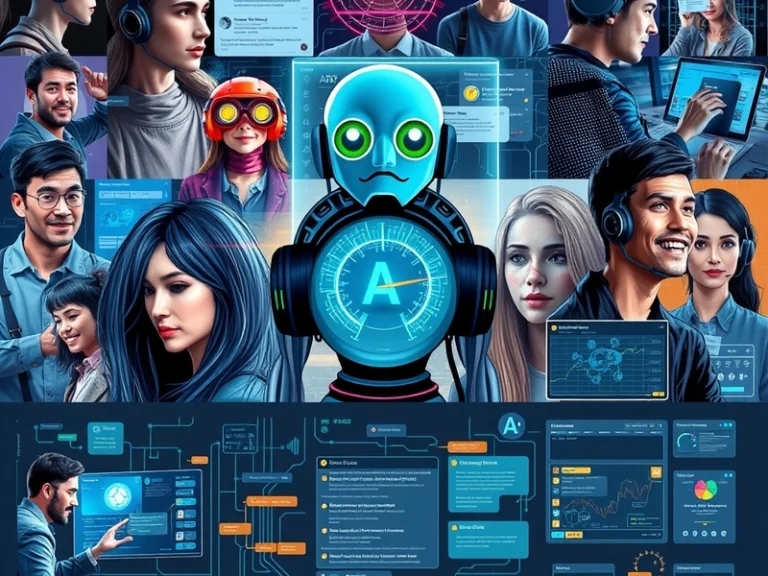
- ChatGPT (November 2022): OpenAI’s conversational AI quickly became a global phenomenon. Millions of internet users directly interacted with it, generating everything from poetry and code to essays and marketing copy. The immediate, personal experience of its capabilities and limitations led to an explosion of online content: tutorials, demonstrations of its strengths, and viral examples of its “hallucinations” or logical errors. Reddit, X (formerly Twitter), and YouTube became real-time laboratories for collective assessment, with users constantly pushing its boundaries.
- Text-to-Image Models (2022 onwards): Tools like DALL-E 2, Midjourney, and Stable Diffusion allowed anyone to generate complex images from simple text prompts. This sparked immediate online discussions among artists, designers, and hobbyists about creativity, copyright, the nature of art, and the potential for job displacement. Users shared breathtaking creations alongside humorous failures, collectively refining prompt engineering techniques and critiquing the models’ biases.
This direct interaction fostered a more nuanced and often critical assessment. Internet users quickly moved beyond simple awe to explore practical applications, identify shortcomings, and push for improvements. The speed at which feedback cycles operate online means that new AI features or models are almost immediately subjected to a global, distributed stress test.
Evolving Public Perception and Challenges
Today, the internet’s assessment of AI is characterized by several key aspects:
- Utility Focus: Users primarily evaluate AI based on its practical utility – how well it solves real-world problems, enhances productivity, or offers creative new tools. Abstract notions of “general intelligence” are often secondary to tangible benefits.
- Skepticism and Criticality: While excitement remains high, a healthy skepticism has emerged. Users are increasingly aware of issues like data privacy, algorithmic bias, the potential for misinformation, and the environmental impact of large model training. Discussions often delve into the ethical implications and the need for responsible AI development.
- Community-Driven Benchmarking: Informal benchmarking and comparative analyses are constantly happening across online communities. Users compare the outputs of different LLMs, image generators, or coding assistants, sharing findings and contributing to a collective understanding of each model’s strengths and weaknesses.
- Hype vs. Reality: The internet often amplifies both the hype and the subsequent disillusionment surrounding new AI technologies. Initial viral successes are often followed by detailed explorations of limitations, leading to a more balanced, albeit sometimes polarized, view.
The internet has transformed from a medium for reporting on AI achievements to a dynamic, interactive platform where millions actively engage with, evaluate, and collectively shape the understanding of AI’s progress. This continuous, real-time feedback loop is crucial for both developers and the broader public in navigating the rapid evolution of artificial intelligence.