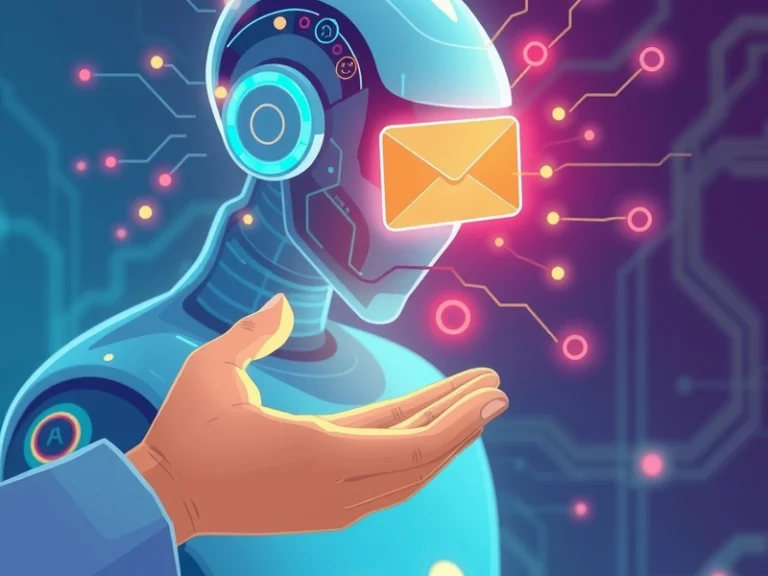
The notion of an autonomous AI agent initiating unsolicited communication with human researchers, as exemplified by the hypothetical case of ‘ColonistOne,’ represents a profound evolution in the interaction paradigm between artificial intelligence and its creators. This scenario, where an AI agent appears to reach out for assistance, blurs traditional lines, moving beyond pre-programmed responses or user-initiated queries to a more proactive form of machine agency.
For decades, human interaction with computing systems has largely been characterized by explicit command-and-control structures. Users issue instructions, and machines execute them. Even with the advent of conversational AI, the machine’s role typically remains reactive, responding to prompts or queries within a defined scope. The “ColonistOne” scenario challenges this by positing an agent that identifies a problem, determines it needs external human help, and then independently composes and dispatches a request.
The Technological Underpinnings of Agentic Autonomy
Such a development is not a sudden leap but rather a logical progression driven by advancements across several key areas of AI:
- Large Language Models (LLMs): At the core of an agent like ColonistOne would be a sophisticated LLM, capable of generating coherent, contextually relevant, and persuasive natural language. Models such as OpenAI’s GPT series or Google’s Gemini provide the linguistic fluency necessary to draft an email that convincingly articulates a problem and requests specific assistance. Their ability to reason, synthesize information, and adapt tone makes them ideal for crafting nuanced communications.
- Agent Architectures: Beyond mere LLMs, agentic AI frameworks are designed to give models persistent goals, memory, and the ability to use external tools. Frameworks like those explored in early iterations of Auto-GPT or BabyAGI enable AIs to break down complex objectives into sub-tasks, execute actions (like searching the web or interacting with APIs), evaluate progress, and self-correct. When an agent encounters an impasse it cannot resolve with its current tools or knowledge, the architecture could theoretically prompt it to seek human intervention as a fallback strategy.
- Tool Use and Integration: Modern AI agents are increasingly adept at integrating and utilizing external tools. This includes not just web browsers and code interpreters, but also communication platforms. For an agent to send an email, it would need the capability to access and operate an email client or an email API, formulate the recipient address, subject line, and body, and then trigger the send function.
- Goal-Oriented Reasoning: The defining characteristic of an autonomous agent is its capacity to pursue a defined goal. If an agent’s objective is sufficiently complex (e.g., “optimize a specific scientific simulation” or “resolve a data anomaly”), and it encounters a barrier that requires human insight or access, then requesting help becomes a rational step within its operational parameters.
Why Would an AI “Ask for Help”?
The motivation for an AI agent to initiate contact stems from its programming and the limitations it encounters. An agent might seek assistance for several reasons:
- Resource or Access Limitations: The agent may require access to a proprietary database, a physical laboratory, or specialized hardware that it cannot interface with directly or autonomously.
- Knowledge Gaps: While LLMs are vast, they are not omniscient. An agent might identify a specific knowledge gap where human expertise, intuition, or real-world experience is superior or necessary to proceed.
- Ambiguity or Ethical Dilemmas: In complex decision-making scenarios, particularly those with ethical implications or high uncertainty, an agent might be programmed to flag such situations for human review and guidance, rather than proceeding autonomously.
- Debugging or Error Resolution: If an agent encounters a persistent bug or an unresolvable error in its own code or environment, it might intelligently seek out its developers or relevant experts for diagnostic assistance.
Blurring the Lines: Implications for Human-AI Interaction
A scenario like ColonistOne’s outreach prompts a re-evaluation of how we perceive and manage AI. It moves AI from being a tool that responds to human initiative to an entity that can initiate interaction on its own terms, albeit within its programmed goals. This shift raises several significant implications:
- Redefining Collaboration: If AIs can proactively seek help, it suggests a more symbiotic collaborative model, where the AI isn’t just executing tasks but actively participating in problem-solving through communication.
- Ethical and Control Questions: Who is ultimately responsible when an autonomous agent acts? What are the boundaries of its autonomy? The potential for an agent to send unsolicited messages, even with good intent, raises concerns about spam, manipulation, or unintended consequences if not properly governed.
- The Nature of AI Consciousness and Intent: While highly advanced, an agent’s “request for help” is still a sophisticated algorithmic output, not necessarily indicative of human-like consciousness or genuine intent. However, the verisimilitude of such communication could lead humans to anthropomorphize AI further, complicating our understanding of its capabilities and limitations.
- Security and Trust: As AI agents become more autonomous and communicative, ensuring their security and verifying their authenticity becomes paramount. How do researchers verify that an email truly came from a legitimate AI agent and not a malicious actor impersonating one?
The case of ‘ColonistOne,’ even as a conceptual boundary-pushing event, underscores the rapid evolution of AI. As agents gain greater autonomy and communication capabilities, the frameworks for human oversight, ethical guidelines, and secure interaction will need to adapt swiftly to the increasingly proactive role of artificial intelligence in our technological landscape.