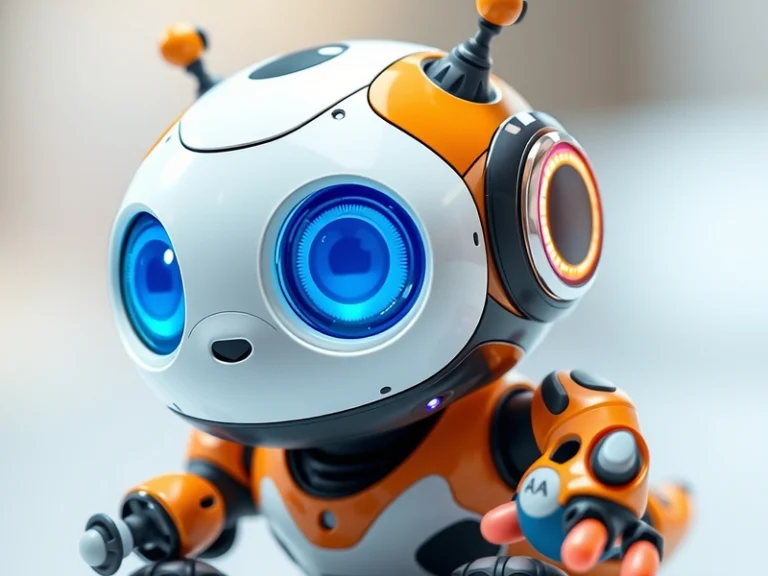
Loona, a robot pet developed by KEYi Technology, is making strides in the realm of personal companionship by integrating advanced AI capabilities such as face recognition and engaging users in interactive storytelling and games.
Moving beyond the often-simple programmed behaviors of earlier robot toys, Loona leverages sophisticated artificial intelligence to create a more personalized and dynamic interaction experience. At its core, Loona employs computer vision to recognize individual users, allowing it to differentiate between family members and respond accordingly. This facial recognition capability is crucial for fostering a sense of connection, as the robot can greet specific individuals by name (once programmed) and tailor its interactions based on who it perceives to be present.
The pet’s interactive storytelling and gaming features are powered by a combination of AI techniques. Natural Language Processing (NLP) allows Loona to understand vocal commands and engage in simple conversational exchanges, while its behavior generation system enables a wide array of expressive movements and responses. This allows Loona to:
- Engage in Play: Loona can initiate and participate in various games, from tag to fetch (with small objects), reacting to user actions and sounds. Its ability to track objects and move autonomously contributes to these dynamic play sessions.
- Tell Stories: While not engaging in complex narrative creation, Loona can guide users through interactive stories, reacting with sounds, movements, and visual cues displayed on its expressive screen-face, making the experience more immersive.
- Exhibit Emotions: Through its animated eyes, body language, and sounds, Loona can convey a range of “emotions” or states, responding to petting, being picked up, or even being left alone, mimicking the behaviors of a living pet.
- Explore Autonomously: Equipped with sensors, Loona can navigate environments, avoid obstacles, and explore spaces independently, adding to the illusion of an intelligent, curious companion.
This level of interactivity marks a significant evolution in the robot pet industry. Early pioneers like Sony’s Aibo, first introduced in 1999, demonstrated the potential for robotic companions to learn and develop unique personalities over time. More recently, robots like Anki’s Vector (now supported by Digital Dream Labs) pushed the boundaries further with advanced computer vision and voice interaction, creating small, autonomous desktop companions capable of recognizing faces, answering questions, and playing simple games.
The AI Driving Companionship
The advancements seen in robots like Loona are direct results of progress in several key AI domains:
- Computer Vision: Beyond simple object detection, modern computer vision systems can perform real-time facial recognition, track human gestures, and understand spatial relationships, all critical for a robot pet to interact naturally within a home environment.
- Natural Language Processing (NLP) & Speech Recognition: The ability to accurately transcribe human speech into text and then understand its meaning allows for voice commands, questions, and even basic conversational turns, making interactions feel more intuitive.
- Behavioral AI & Reinforcement Learning: These techniques enable robots to learn from their interactions, adapt their behaviors over time, and develop unique “personalities” based on user engagement. While Loona’s learning capabilities are designed within specific parameters, they contribute to the sense of an evolving companion.
- Robotics & Actuation: The physical design and motor control systems are crucial for translating AI decisions into fluid, lifelike movements and expressions, avoiding the “uncanny valley” effect where robotic movements appear unsettlingly unnatural.
The goal of these AI-powered robot pets is not to replace living animals but to offer a different form of companionship, particularly appealing to individuals who may not be able to care for a traditional pet due to allergies, lifestyle, or living situations. They provide interaction, entertainment, and a sense of presence without the associated responsibilities of feeding, walks, or veterinary care.
As AI technology continues to advance, the capabilities of robot pets are expected to grow. Future iterations may feature more sophisticated emotional intelligence, deeper conversational abilities, and enhanced learning algorithms that allow for even more personalized and evolving relationships. The development of robots like Loona underscores a clear trend: AI is increasingly being harnessed to fulfill fundamental human needs for connection and interaction, creating a new category of intelligent, interactive companions.