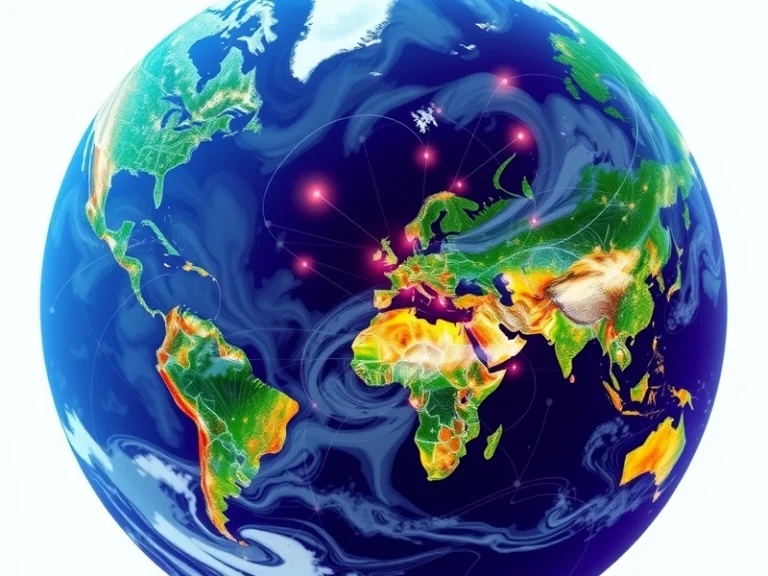
Artificial intelligence is driving a significant transformation in long-range weather forecasting, pushing the boundaries of reliable predictions for extended periods and effectively doubling the lead time for certain forecast parameters with maintained accuracy.
For decades, numerical weather prediction (NWP) models have been the bedrock of meteorological science. These models rely on complex physical equations to simulate atmospheric processes, requiring immense computational power to process vast datasets from satellites, radar, and ground sensors. While highly effective for short-to-medium range forecasts (up to 7-10 days), their accuracy diminishes rapidly for longer horizons due to the inherent chaotic nature of the atmosphere and accumulating model errors. The computational cost of running high-resolution NWP models for extended periods, often requiring supercomputers, has also been a limiting factor.
AI, particularly deep learning, offers a fundamentally different approach. Instead of explicitly programming physical equations, AI models learn directly from historical weather data. They identify intricate, non-linear relationships and patterns in atmospheric variables that might be too complex or subtle for human-designed equations to capture efficiently. This data-driven paradigm allows AI models to process massive datasets, including high-resolution imagery and sensor readings, to infer future atmospheric states.
Key AI Models Leading the Charge
Several prominent AI models have demonstrated groundbreaking capabilities in weather prediction:
- GraphCast by Google DeepMind: Unveiled in 2023, GraphCast is a graph neural network that directly predicts future weather states. Trained on decades of reanalysis data from the European Centre for Medium-Range Weather Forecasts (ECMWF), it has shown to outperform traditional NWP systems like the ECMWF’s Integrated Forecasting System (IFS) in terms of accuracy for medium-range forecasts (up to 10 days) on 90% of 1,380 tested variables, while being significantly faster to run.
- Pangu-Weather by Huawei: Also introduced in 2023, Pangu-Weather is a 3D Earth-specific transformer neural network. It has demonstrated superior accuracy compared to traditional NWP models for forecasts up to 7 days, particularly in predicting extreme weather events like tropical cyclones. Its speed allows it to generate a 10-day global forecast in mere seconds on a single GPU, a task that would take minutes or hours on supercomputers for traditional models.
- FourCastNet by NVIDIA: This deep learning model, developed in collaboration with Caltech and Lawrence Berkeley National Laboratory, leverages Fourier Neural Operators to learn complex spatio-temporal dynamics of the atmosphere. FourCastNet has shown to accurately predict global weather patterns and extreme events, such as atmospheric rivers and tropical cyclones, with speeds orders of magnitude faster than conventional NWP models.
How AI Boosts Accuracy and Range
The improvements observed with these AI models stem from several core advantages:
- Advanced Pattern Recognition and Data Assimilation: AI models excel at identifying subtle, long-range correlations and teleconnections within vast climate datasets. They can assimilate diverse forms of data, including satellite imagery and sparse ground observations, more effectively than traditional methods, leading to a more comprehensive initial state for prediction.
- Computational Efficiency: Once trained, AI models can generate forecasts incredibly quickly. This speed allows meteorologists to run more ensemble forecasts – multiple predictions with slightly varied initial conditions – which are crucial for quantifying forecast uncertainty and improving reliability for longer lead times. Traditional NWP models, while highly accurate, are computationally intensive, limiting the number of ensemble runs possible within operational timelines.
- Hybrid Approaches: AI is not solely replacing NWP but also augmenting it. AI models can be used to refine the outputs of traditional NWP models, correct their biases, or downscale global forecasts to provide more localized predictions. This hybrid approach combines the physical robustness of NWP with the pattern-learning prowess of AI.
- Learning from Errors: Unlike fixed physical equations, AI models can continuously learn and improve as they are fed new data and as their predictions are validated against actual observations. This iterative learning process allows them to adapt and become more accurate over time.
Real-World Impact and Applications
The ability to predict weather with greater accuracy at extended ranges has profound implications across numerous sectors:
- Agriculture: Farmers can make more informed decisions about planting, irrigation, and harvesting, optimizing yields and minimizing losses due to adverse weather. Longer lead times for drought or heavy rainfall forecasts are invaluable.
- Disaster Preparedness: Improved long-range forecasts for hurricanes, floods, heatwaves, and cold snaps allow communities more time to prepare, evacuate, and allocate resources, potentially saving lives and reducing economic damage.
- Energy Sector: For renewable energy sources like wind and solar, accurate long-range forecasts are critical for predicting generation capacity and managing grid stability. Conventional power plants can also better anticipate demand spikes or drops related to temperature extremes.
- Logistics and Transportation: Shipping, aviation, and ground transport can plan routes and schedules more efficiently, avoiding disruptions caused by severe weather.
Remaining Hurdles and the Road Ahead
Despite these significant advancements, challenges remain. AI models are data-hungry, requiring vast amounts of high-quality historical data for training, which can be limited in certain regions or for specific extreme events. The “black box” nature of some deep learning models can also make it difficult for meteorologists to understand why a particular forecast was made, impacting trust and interpretability. Furthermore, ensuring these models generalize well to unprecedented climate events or regions with sparse data is an ongoing area of research.
The integration of AI into operational weather forecasting is still evolving, with meteorological agencies worldwide exploring how best to leverage these powerful new tools alongside their established NWP systems. The trajectory suggests a future where AI and traditional physics-based models work in concert, leading to unprecedented accuracy and lead times in weather prediction, ultimately enhancing resilience and efficiency across global industries.