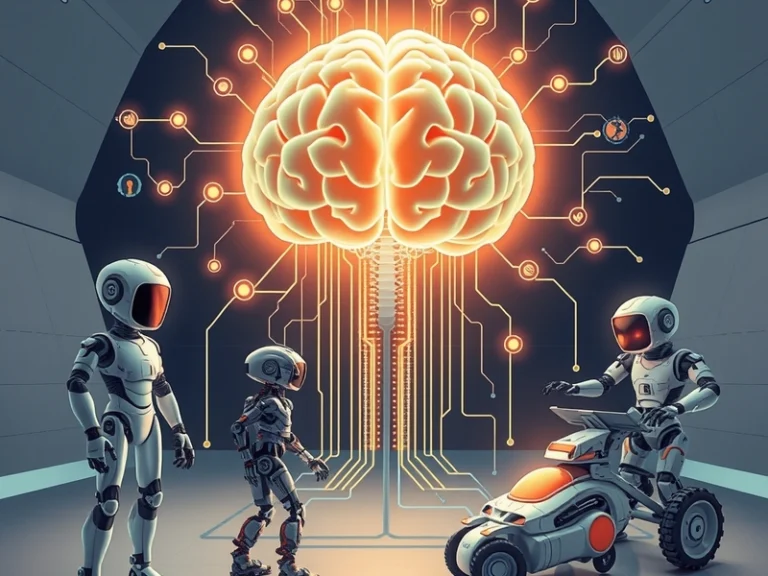
The field of robotics is witnessing a significant paradigm shift with the emergence of single AI models capable of controlling multiple types of robotic hardware without extensive prior training specific to each embodiment.
Traditionally, developing robotic systems has been a highly specialized endeavor. Each robot, with its unique kinematics, sensor suite, and actuator configuration, typically required bespoke control policies and extensive data collection for specific tasks. This approach led to fragmented development, high costs, and limited versatility, making it challenging to deploy robots in dynamic, unstructured environments or to quickly adapt them to new tasks or hardware platforms.
The recent advancements aim to overcome these limitations by introducing a “generalist robot agent” — a single, large AI model trained on a vast and diverse dataset of robotic interactions. This model learns to abstract away the specifics of individual robot bodies, focusing instead on task objectives, environmental understanding, and generalized motor primitives. The goal is for a single policy to command a wide array of robotic arms, wheeled robots, or even humanoid platforms, enabling them to perform novel tasks in a zero-shot or few-shot manner.
Key Enabling Technologies and Approaches
This leap forward is underpinned by several converging technological developments:
- Transformer Architectures: Borrowing heavily from the success of large language models (LLMs) and vision transformers, these architectures are adept at processing sequential data and learning long-range dependencies. In robotics, they can ingest diverse sensory inputs (images, joint states, force readings) and output sequences of actions (motor commands, gripper movements) in a highly flexible manner.
- Large-Scale, Diverse Datasets: The availability and aggregation of massive datasets are crucial. Initiatives like Google DeepMind’s Open X-Embodiment Dataset have been instrumental, compiling data from hundreds of thousands of real-world robot trajectories across dozens of distinct robot embodiments and tasks. This diversity allows models to learn embodiment-agnostic representations and generalize across different physical forms.
- Vision-Language Models (VLMs) Integration: By incorporating pre-trained VLMs, robot models can leverage the vast world knowledge embedded in human language and images. This enables robots to understand high-level natural language instructions and visually grounded goals, translating abstract commands like “pick up the red apple” into specific motor actions without explicit task-specific training.
- Embodiment-Agnostic Representations: The core innovation lies in training models to learn representations that decouple the task from the specific robot. Instead of learning to control a specific joint angle on a particular robot arm, the model might learn a more abstract concept of “reaching for an object” or “applying force,” which can then be mapped to the appropriate physical actions for various robot types.
Pioneering Research: The RT-X Family
A prime example of this trend is Google DeepMind’s Robotics Transformer (RT) family. Building on earlier work like RT-1, which demonstrated robust control across different environments, the introduction of RT-2 (Robotics Transformer 2) marked a significant milestone. RT-2 directly integrates VLM capabilities, enabling it to interpret novel commands and generalize to unseen objects and environments. Trained on a combination of robot data and web-scale vision-language data, RT-2 can translate visual and linguistic prompts into robot actions, often performing tasks it was never explicitly trained for.
The subsequent Robotics Transformer X (RT-X) initiative further amplifies this by creating a family of models trained on the Open X-Embodiment Dataset. This collaborative effort leverages data from 22 different robot embodiments, 21 research institutions, and over 500 skills, resulting in models that exhibit unprecedented generalization capabilities across diverse robotic hardware.
Implications for Robotics Development
The ability of a single AI model to control multiple robot types without prior training holds profound implications:
- Accelerated Deployment: Manufacturers and researchers can develop and deploy new robotic systems much faster, as the need for extensive, robot-specific training data and control policy development is significantly reduced.
- Enhanced Versatility: A single fleet of robots, even if physically diverse, could be dynamically repurposed for a wide range of tasks simply by updating the central AI policy, from factory automation to logistics, service robotics, and even household assistance.
- Reduced Costs: The economies of scale in developing and maintaining a single, generalist AI model rather than many specialized ones could substantially lower the overall cost of robotic solutions.
- Democratization of Robotics: By abstracting away much of the low-level control complexity, this approach could make advanced robotics more accessible to a broader range of developers and users, fostering innovation.
Challenges Ahead
Despite the remarkable progress, significant challenges remain. The sheer scale of data required for training these foundation models is immense, posing logistical and computational hurdles. Ensuring the safety and reliability of generalist agents in unpredictable real-world scenarios is paramount, as errors can have physical consequences. Furthermore, the interpretability of decisions made by these complex models is still an active area of research, crucial for debugging and building trust in autonomous systems.
As research continues to push the boundaries of large-scale robotic models and diverse data aggregation, the vision of truly versatile, general-purpose robots controlled by a single, intelligent “brain” is moving closer to reality, promising a future where robotic capabilities are no longer constrained by their physical form.