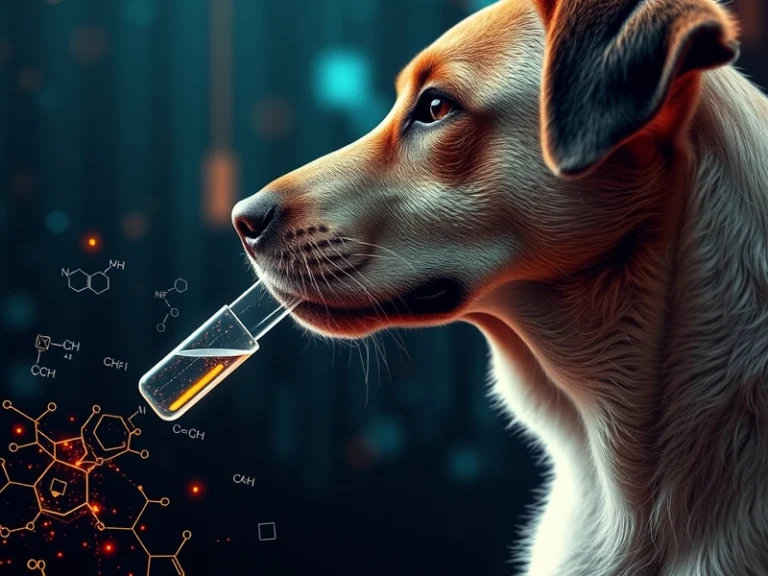
Researchers are increasingly exploring how artificial intelligence can augment the remarkable ability of trained canines to detect cancer through scent, particularly in breath samples, forging a new frontier in non-invasive early diagnosis.
The concept of using dogs to detect disease is not new; anecdotal evidence dates back centuries, but scientific investigation gained traction in recent decades. Dogs possess an olfactory system far superior to humans, with an estimated 300 million olfactory receptors compared to our 6 million. This allows them to discern minute concentrations of volatile organic compounds (VOCs) in biological samples, which can be indicative of various diseases, including several types of cancer.
Studies have shown dogs can be trained to identify specific cancer-associated VOCs in breath, urine, and blood samples from patients with lung, breast, prostate, ovarian, and colorectal cancers. Their sensitivity and specificity in controlled environments have often been impressive, leading to calls for further research into their practical application. However, relying solely on canine detection presents significant challenges, primarily related to scalability, standardization, and the inherent variability of animal performance.
The Canine Advantage: A Biological Sensor
The primary advantage of using trained dogs lies in their unparalleled biological sensing capabilities. Their olfactory epithelium, vastly larger than a human’s, allows for the detection of an extremely broad spectrum of chemical compounds at concentrations as low as parts per trillion. This makes them ideal for screening complex biological mixtures like breath, which contains thousands of VOCs.
- Unmatched Sensitivity: Dogs can detect biomarkers at concentrations far below the current detection limits of many conventional diagnostic tools.
- Non-Invasive Sampling: Breath samples are easy to collect, painless, and pose minimal risk to patients, making widespread screening more feasible.
- Broad Spectrum Detection: Unlike targeted chemical assays, dogs can potentially identify novel or complex patterns of VOCs that might be missed by instruments looking for specific markers.
The AI Imperative: Precision, Scalability, and Standardization
While dogs offer incredible biological sensitivity, AI brings the critical elements of precision, scalability, and standardization necessary for clinical application. AI algorithms excel at pattern recognition in vast datasets, a perfect complement to the complex chemical signatures involved in cancer detection. The synergy between canine and artificial intelligence approaches manifests in several key areas:
1. Decoding Olfactory Signatures with Machine Learning
One of the most promising avenues involves using AI to analyze the chemical profiles of samples that dogs have successfully identified as cancerous. When a trained dog correctly flags a breath sample, that sample can then be subjected to advanced analytical techniques such as gas chromatography-mass spectrometry (GC-MS) or ion mobility spectrometry (IMS). These instruments break down the sample into its constituent VOCs, generating complex chemical “fingerprints.”
Machine learning algorithms, particularly deep learning networks, can then be trained on these high-dimensional datasets. By correlating the chemical profiles with canine indications and confirmed biopsy results, AI can identify specific VOC patterns or ratios that are indicative of cancer. This process helps to:
- Identify Biomarkers: Pinpoint the exact chemical compounds or combinations that dogs are reacting to, which might be too subtle or complex for human analysis.
- Build Predictive Models: Develop robust algorithms that can predict the presence of cancer based on chemical signatures alone, without canine involvement in every test.
- Improve Specificity: Differentiate between cancer-related VOCs and those associated with other conditions, reducing false positives.
2. Developing AI-Powered “Electronic Noses”
The ultimate goal for many researchers is to create AI-driven “electronic noses” (e-noses) that can mimic or even surpass canine olfactory capabilities. These devices typically consist of arrays of chemical sensors designed to react to VOCs, producing electrical signals that vary based on the chemical composition of the air sample. AI plays a crucial role in interpreting these signals.
Machine learning models are trained on data from these sensor arrays, learning to recognize the complex patterns associated with different diseases. By leveraging insights gained from canine studies—understanding which VOCs are most relevant—AI can help optimize sensor design and interpretative algorithms for e-noses. This approach offers significant advantages:
- Scalability: E-noses can process many more samples than individual dogs, making them suitable for large-scale screening programs.
- Standardization: Instrumental analysis eliminates the variability inherent in biological systems, ensuring consistent results.
- Cost-Effectiveness: While initial development is expensive, mass-produced e-noses could be more economical than maintaining and training canine teams.
3. Enhancing Canine Research and Training Protocols
Beyond direct sample analysis, AI can also contribute to the study and optimization of canine cancer detection itself. AI tools can analyze vast amounts of data generated during canine training and testing, identifying patterns in dog performance, learning curves, and potential biases. This can lead to:
- Optimized Training: AI can help design more effective training protocols by identifying which reward systems, sample presentations, or environmental factors lead to the best canine performance.
- Performance Monitoring: Machine learning can track individual dog performance over time, detecting subtle changes in accuracy or fatigue that might impact reliability.
- Data Validation: AI can cross-reference canine indications with other diagnostic data to validate the dogs’ accuracy and identify areas for improvement in their training or handler protocols.
Hurdles and Horizons
Despite the promise, significant hurdles remain. The complexity of the human metabolome means that VOC profiles can be influenced by diet, medication, lifestyle, and other co-morbidities, making it challenging to isolate cancer-specific markers. Standardizing sample collection and storage across different studies and clinical settings is also critical for reliable data. Reproducibility of results, both from canine and electronic systems, is paramount before these methods can be integrated into routine clinical practice.
However, the ongoing collaboration between canine bio-detectors and advanced AI analytics represents a compelling future for early cancer detection. By leveraging the unparalleled biological sensitivity of dogs as a discovery platform and combining it with the analytical power and scalability of AI, researchers are moving closer to developing highly accurate, non-invasive, and accessible screening tools that could revolutionize how cancer is detected.