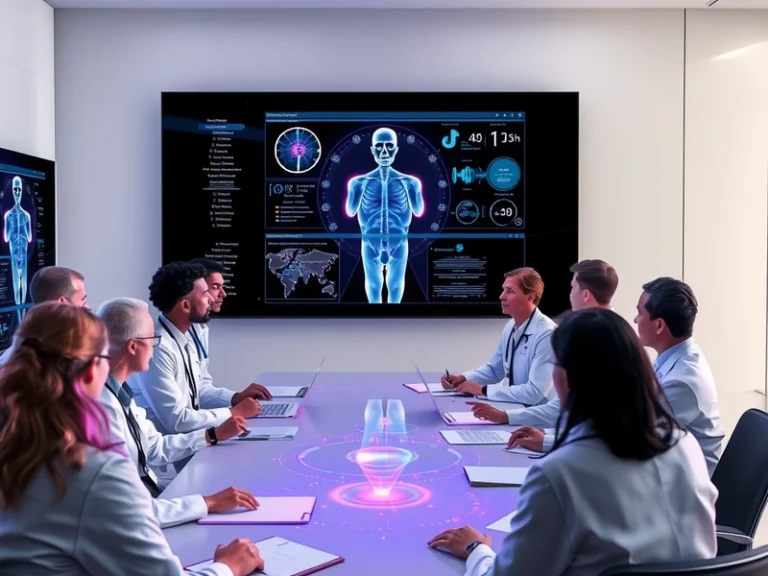
The integration of artificial intelligence into multidisciplinary medical panels is beginning to redefine the diagnostic process for complex cases, offering new avenues for precision and efficiency in healthcare.
Traditionally, medical panels, often composed of specialists from various disciplines like oncology, radiology, pathology, and genetics, convene to discuss intricate patient cases. These collaborative sessions are crucial for synthesizing diverse expert opinions, particularly when faced with rare diseases, ambiguous symptoms, or treatment resistance. However, these panels are resource-intensive, limited by the availability of top specialists, and can be challenged by the sheer volume of medical literature and patient data relevant to a single case. AI is now stepping in to augment these panels, not replace them, by providing enhanced data synthesis, diagnostic support, and personalized insights.
AI’s Transformative Role in Diagnostic Panels
AI’s contribution to medical panels primarily revolves around its capacity to process, analyze, and interpret vast amounts of structured and unstructured data at speeds and scales impossible for human clinicians alone. Several key AI technologies are at play:
- Natural Language Processing (NLP) and Knowledge Graphs: AI systems leverage NLP to ingest and comprehend medical literature, clinical guidelines, research papers, and patient records, including physician notes, lab results, and genomic data. These systems can then construct intricate knowledge graphs that map relationships between symptoms, diagnoses, treatments, genetic markers, and drug interactions. This allows the AI to quickly identify relevant information, flagging potential diagnoses or treatment considerations that might otherwise be overlooked by human review due to information overload.
- Computer Vision for Image Analysis: In cases involving imaging (MRI, CT, X-ray, histopathology slides), AI-powered computer vision models can analyze scans with remarkable precision, identifying subtle anomalies, quantifying disease progression, and assisting pathologists in detecting microscopic indicators of disease. These insights are then presented to the panel, providing an objective and comprehensive layer of analysis.
- Predictive Analytics and Differential Diagnosis: Based on the synthesized patient data and external medical knowledge, AI algorithms can generate a prioritized list of differential diagnoses, complete with supporting evidence and probabilities. These systems can also predict potential treatment responses or adverse events based on similar patient profiles and outcomes found in aggregated datasets. This capability acts as a sophisticated second opinion, guiding the panel’s discussion and helping to narrow down possibilities.
- Genomic Data Interpretation: For cases involving genetic components, AI can rapidly analyze complex genomic sequences, identify pathogenic variants, and correlate them with known diseases or drug sensitivities. This is particularly vital in precision medicine, where tailored treatments often depend on a deep understanding of a patient’s unique genetic makeup.
Key Benefits of AI-Enhanced Panels
The integration of AI into medical panels offers several compelling advantages that promise to improve patient outcomes and optimize healthcare resources:
- Enhanced Diagnostic Accuracy: By sifting through comprehensive data and cross-referencing against global medical knowledge, AI can help reduce diagnostic errors and improve the precision of complex diagnoses, especially for rare or atypical conditions.
- Accelerated Case Resolution: The time-consuming process of gathering and synthesizing information is significantly shortened, allowing panels to reach conclusions more quickly. This can be critical in time-sensitive conditions where early intervention improves prognosis.
- Democratization of Expertise: AI systems can encapsulate and make accessible a vast repository of medical knowledge, effectively extending the reach of specialized expertise even to regions with limited access to certain specialists.
- Support for Clinicians: By automating data review and presenting synthesized insights, AI reduces the cognitive load on human clinicians, allowing them to focus their expertise on critical decision-making, patient interaction, and ethical considerations.
Challenges and Considerations
While the potential is immense, the deployment of AI in medical panels is not without its challenges. Data privacy and security remain paramount, necessitating robust anonymization techniques and adherence to regulations like HIPAA and GDPR. The quality and representativeness of training data are also crucial; biased datasets can lead to biased diagnostic recommendations, exacerbating existing health disparities. Furthermore, regulatory bodies like the U.S. Food and Drug Administration (FDA) are still evolving their frameworks for approving AI-powered diagnostic tools, requiring rigorous validation and transparency.
Perhaps the most critical consideration is maintaining the “human in the loop.” AI is designed to augment, not replace, the clinical judgment of human specialists. The nuanced understanding of a patient’s individual context, ethical considerations, and the ability to communicate empathetically remain squarely in the domain of human physicians. The AI’s role is to provide a comprehensive, evidence-based foundation upon which the human panel can build its final, informed decisions.
The Future of Collaborative Diagnosis
As AI technologies continue to mature and become more integrated into clinical workflows, AI-powered medical panels are poised to become a standard component of advanced diagnostic processes. Continued research into explainable AI (XAI) will further enhance trust and transparency, allowing clinicians to understand the reasoning behind AI-generated recommendations. The collaborative paradigm, where human expertise is amplified by artificial intelligence, represents a significant step forward in tackling the complexities of modern medicine, ultimately aiming for more accurate diagnoses and improved patient care globally.