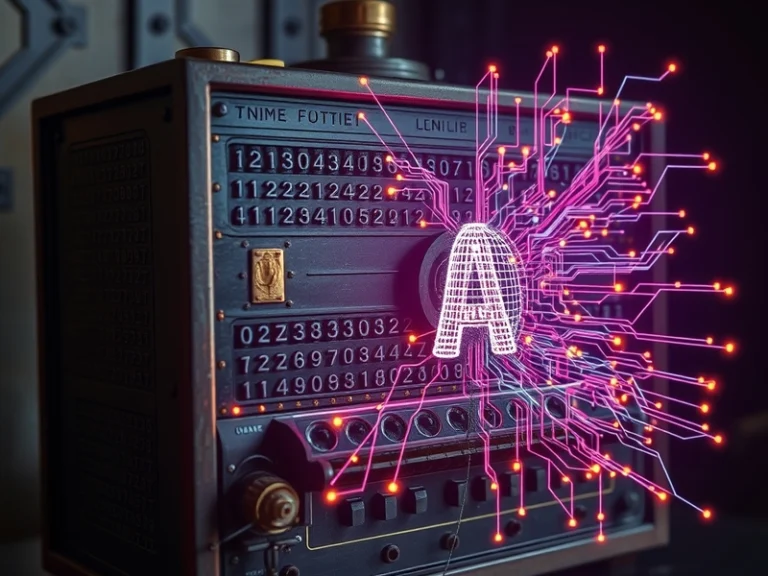
Artificial intelligence is increasingly being deployed to tackle one of history’s most enduring cryptographic challenges: the vast trove of undeciphered and partially understood military communications from World War II.
The Second World War saw an unprecedented explosion in cryptographic complexity, with nations like Germany, Japan, and the Allied powers developing sophisticated methods to secure their communications. While legendary efforts at sites like Bletchley Park in the UK, home to the Enigma and Lorenz codebreakers, and the US Navy’s Station C (OP-20-G) for Japanese codes, famously cracked crucial enemy ciphers, countless messages remained, and continue to remain, unread. These include intercepted signals that were too complex, too damaged, or simply too numerous for human analysts to process in real-time or in the decades that followed. Modern AI techniques are now offering a new frontier in unlocking these historical secrets, promising fresh insights into military strategies, intelligence operations, and the human experiences of the conflict.
The Enduring Challenge of Wartime Cryptography
Wartime cryptography presented a multifaceted challenge. Ciphers ranged from simple substitution and transposition systems to highly complex electromechanical rotor machines like the German Enigma and the teleprinter-based Lorenz cipher. Japanese codes, particularly those used by their naval forces, also posed significant hurdles, often relying on intricate codebooks and super-encipherment techniques. The sheer volume of intercepted traffic, coupled with deliberate obfuscation, operator errors, and the inherent difficulty of the cryptographic methods themselves, meant that even with the brilliant minds and early computing machines of the era, much was left untranslated.
The process of cryptanalysis during WWII was largely a human-driven endeavor, albeit one augmented by purpose-built machines like the British Bombe and Colossus. These machines performed rapid, repetitive tasks, but the initial breakthroughs, pattern recognition, and linguistic insights often came from human ingenuity. Today, AI offers a new paradigm, combining immense computational power with advanced pattern recognition and language processing capabilities that can complement, and in some cases, surpass traditional methods.
How AI Approaches Historical Code-Breaking
AI’s utility in historical cryptanalysis stems from its ability to process vast datasets, identify subtle statistical anomalies, and learn from patterns that might be imperceptible or too time-consuming for human analysts. Several key areas of AI are proving instrumental:
- Pattern Recognition and Statistical Analysis: Many historical ciphers, despite their complexity, exhibit underlying statistical regularities based on the natural language they encode. AI algorithms, particularly those rooted in machine learning, can analyze ciphertext for frequency distributions of characters, digrams, trigrams, and other patterns. These statistical fingerprints can hint at the underlying language, the type of cipher used, or even potential keys.
- Natural Language Processing (NLP): Once a potential plaintext language is identified or small fragments of plaintext are recovered, NLP models can become invaluable. They can predict missing words, identify common phrases and grammatical structures, and even correct for historical linguistic variations or common telegraphic abbreviations. This capability is crucial for reconstructing meaningful messages from partial decryptions.
- Machine Learning for Key Space Exploration: For ciphers with large but finite key spaces, AI-driven search algorithms can explore potential keys much more efficiently than brute-force methods. Supervised learning models can be trained on known plaintext-ciphertext pairs (if available from other decryptions) to learn the characteristics of encrypted messages and then apply this knowledge to new, undeciphered traffic. Unsupervised learning might identify clusters or relationships within ciphertext that suggest a common encryption method or key.
- Computational Linguistics and Historical Context: Beyond pure cryptanalysis, AI can assist in understanding the historical context of communications. By analyzing vast archives of historical documents, AI can help identify common military terminology, organizational structures, and individual names, providing crucial contextual clues that can aid in the interpretation of deciphered messages.
- Handling Imperfections and Noise: Wartime communications were often subject to transmission errors, signal degradation, or deliberate distortions. AI models can be more robust in dealing with noisy or incomplete data, inferring meaning even when parts of a message are missing or corrupted, a task that often stymied human decoders.
Beyond Pure Cryptography: Archival Analysis
The application of AI extends beyond merely cracking the ciphers themselves. Many historical documents related to WWII intelligence and operations are handwritten, faded, or exist in vast, unstructured archives. Computer vision and optical character recognition (OCR) technologies, powered by deep learning, are being used to:
- Digitize and Transcribe: Automatically transcribe handwritten notes, reports, and intercepted messages, making them searchable and analyzable.
- Information Extraction: Identify and extract key entities like dates, locations, unit designations, and personnel names from millions of pages of archival material, creating structured datasets that can reveal connections previously hidden.
- Cross-Referencing: Correlate information across disparate documents, potentially linking a partially deciphered message to a known operational detail or a specific unit’s movement.
Challenges and Ethical Considerations
While promising, applying AI to historical code-breaking is not without its challenges. The scarcity of ground truth data (known plaintext-ciphertext pairs) for many uncracked messages can make supervised learning difficult. Historical linguistic nuances, abbreviations, and the specific jargon of WWII military communication require sophisticated models. Furthermore, the ethical implications of uncovering sensitive historical information, particularly regarding individuals or covert operations, must be carefully navigated, ensuring responsible handling and dissemination of newly discovered insights.
The ongoing application of AI to WWII messages represents a fascinating intersection of history, linguistics, and advanced computing. By leveraging the power of modern machine learning and computational linguistics, researchers are not only bringing new tools to bear on old problems but are also illuminating previously dark corners of one of humanity’s most pivotal conflicts, offering a richer, more complete understanding of its hidden narratives.