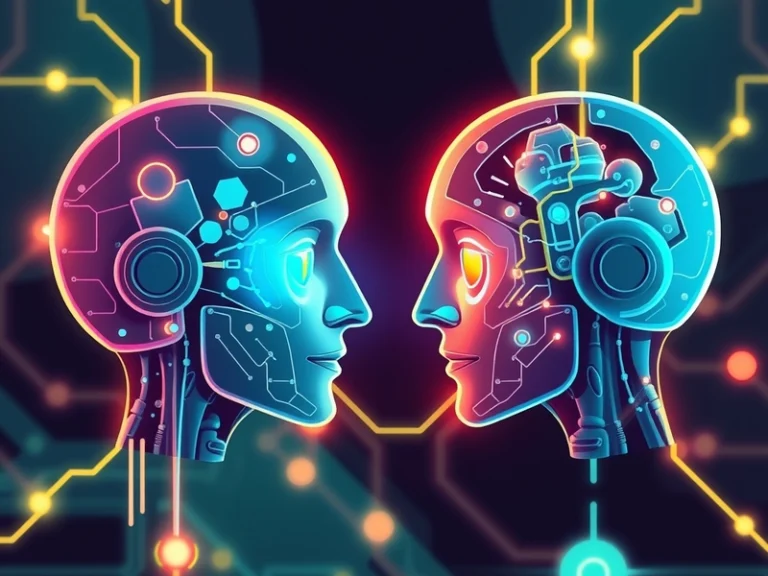
The field of artificial intelligence is witnessing a significant evolution where AI models are increasingly being designed not just to perform tasks, but to actively optimize, refine, and even diagnose issues within other AI systems, effectively leveraging one AI to enhance another’s ‘cognitive’ function. This inter-model assistance marks a crucial step towards more autonomous and self-improving AI ecosystems, moving beyond human-centric development cycles to a paradigm where AI itself acts as a meta-developer.
Automated Model Design and Optimization
One of the most prominent forms of AI assisting AI lies in the realm of automated machine learning (AutoML) and neural architecture search (NAS). Historically, designing effective neural network architectures and tuning their myriad hyperparameters has been a labor-intensive process, often relying on expert intuition and extensive trial and error. Today, AI models are taking on this very challenge.
- **Neural Architecture Search (NAS):** This technique involves an AI algorithm (often a reinforcement learning agent or an evolutionary algorithm) exploring a vast search space of possible neural network architectures to find one that performs optimally on a given task. Instead of a human hand-crafting layers and connections, an AI system systematically generates and evaluates candidate architectures, learning from its trials to propose increasingly effective designs. While computationally expensive, requiring significant resources typically from cloud providers like Google Cloud or AWS, NAS has demonstrated the ability to discover architectures that sometimes outperform human-designed ones.
- **Hyperparameter Optimization:** Beyond architecture, an AI can also fine-tune the various settings that govern a model’s training process, such as learning rates, batch sizes, and regularization strengths. Tools like Google Cloud AutoML and Microsoft Azure Automated ML provide platforms where developers can upload data, and AI-driven processes then automatically select algorithms, preprocess data, and optimize hyperparameters to build high-performing models with minimal human intervention. This significantly lowers the barrier to entry for machine learning and accelerates development cycles.
Knowledge Transfer and Model Refinement
Another critical area where one AI bolsters another’s capabilities is through knowledge transfer, particularly in the context of model efficiency and deployment.
- **Knowledge Distillation:** This technique involves a larger, more complex “teacher” model transferring its learned knowledge to a smaller, more efficient “student” model. The teacher model, often a high-performing but computationally intensive network, trains the student model not just on ground truth labels, but also on the teacher’s softened probability distributions (logits). This allows the student to mimic the teacher’s decision-making process, often achieving a significant portion of the teacher’s performance while being much smaller and faster. This approach is invaluable for deploying sophisticated models on edge devices or in latency-sensitive applications. For example, Hugging Face’s Transformers library often includes distilled versions of large language models, making advanced NLP capabilities more accessible and practical for real-world use.
- **Self-Supervised Learning:** While not strictly “one AI fixing another,” self-supervised learning represents a form of internal assistance where an AI model generates its own supervisory signals from unlabeled data. By solving pretext tasks (e.g., predicting missing parts of an image, or predicting the next word in a sentence), a model learns rich, general-purpose representations that can then be fine-tuned for specific downstream tasks with far less labeled data. This mechanism allows models to improve their foundational understanding of data autonomously, laying a stronger groundwork for subsequent specialized learning.
Enhancing Robustness and Debugging
The concept of AI fixing or improving another AI also extends to making models more resilient and helping to identify and correct errors.
- **Adversarial Training:** In the quest for robust AI systems, one AI can act as an adversary to another. An adversarial AI generates subtly perturbed inputs that are designed to fool a target model, causing it to make incorrect predictions. By training the target model on these adversarial examples, it learns to become more robust and less susceptible to such attacks. This “stress testing” by an AI helps fortify another AI’s defenses, making it more reliable in real-world, unpredictable environments.
- **AI-Assisted Debugging and Validation:** As AI systems grow in complexity, debugging their internal workings becomes increasingly challenging. Researchers are exploring how AI, particularly advanced large language models (LLMs), can assist in identifying logical flaws, inconsistencies, or performance bottlenecks in other AI models or their surrounding code. An LLM trained on vast codebases could, for instance, analyze a neural network’s implementation to suggest potential errors in layer definitions or data handling, or even review the output of an AI model against expected behaviors to flag anomalies. This represents a nascent but powerful application of AI to ensure the correctness and reliability of its peers.
Challenges and Future Directions
While the promise of inter-model assistance is immense, this field faces significant challenges. The computational expense of methods like NAS remains a barrier for many organizations. The complexity of designing meta-learning systems that can effectively optimize other AIs introduces new layers of abstraction and potential for emergent, hard-to-interpret behaviors. Ensuring the stability, fairness, and explainability of AI systems that are optimized by other AIs also presents ongoing research questions.
Despite these hurdles, the trend of AI models acting as architects, teachers, and diagnosticians for their counterparts is set to accelerate. This shift promises to unlock unprecedented levels of automation in AI development, leading to more sophisticated, efficient, and robust AI systems that can adapt and improve with greater autonomy, pushing the boundaries of what artificial intelligence can achieve.