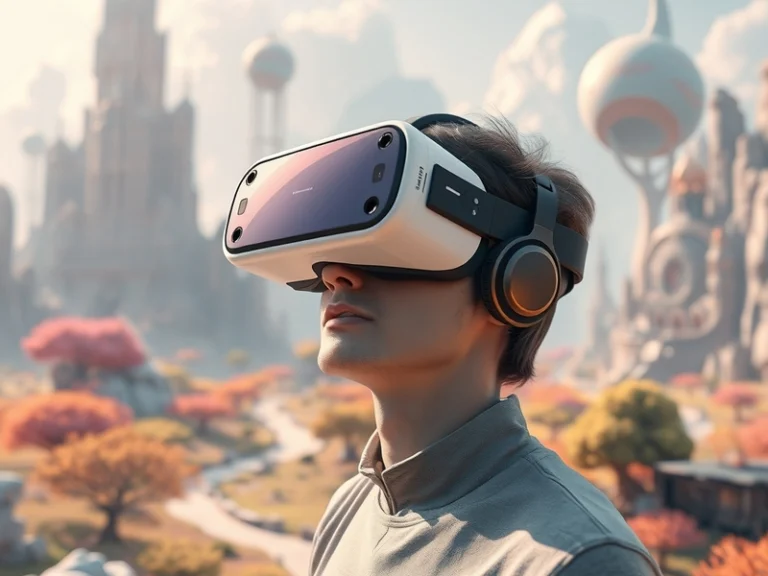
The concept of an AI system dynamically generating immersive environments in real-time, based on a user’s perspective as they explore, is gaining significant traction, exemplified by systems like the conceptual “Frameboy.” This paradigm shift promises to move beyond pre-rendered or statically procedurally generated worlds, offering truly adaptive and unique experiences. Instead of relying on a fixed set of assets or a pre-computed map, these advanced generative models aim to conjure detailed landscapes, structures, and objects on the fly, tailoring the visual experience to the viewer’s every movement and gaze.
At its core, such a system would leverage sophisticated artificial intelligence models, most likely a blend of diffusion models, generative adversarial networks (GANs), and potentially techniques inspired by neural radiance fields (NeRFs), to synthesize visual data. The primary input would be the user’s current camera position and orientation within a virtual space. This information, combined with high-level semantic cues (e.g., “forest,” “desert,” “ancient ruins”) or even implicit contextual understanding gleaned from previously generated areas, would feed into the generative pipeline.
How AI Draws Worlds on the Fly
The process of an AI dynamically generating a world as a user explores it would involve several interconnected components:
- Perspective-Dependent Synthesis: Unlike traditional procedural generation that might create an entire map before exploration, Frameboy-like systems would prioritize what is currently visible to the user. As the user moves, new geometry, textures, and lighting information would be synthesized for areas entering the field of view.
- Semantic Guidance: Users or designers could provide high-level prompts, steering the AI towards specific themes or biomes. For instance, instructing the system to generate a “lush jungle” would activate different generative pathways than requesting a “barren moonscape.” The AI would need to interpret these prompts and translate them into coherent visual elements.
- Coherence and Consistency: A major technical hurdle is maintaining world consistency. As the user navigates, the newly generated sections must seamlessly integrate with previously seen areas. This requires the AI to remember the “state” of the world it has already created, ensuring continuity in terrain, architecture, and even lighting conditions. Techniques for global consistency might involve latent space interpolation or hierarchical generation.
- Real-time Performance: For an immersive experience, generation must occur almost instantaneously. This demands highly optimized models and inference pipelines, potentially leveraging specialized hardware like NVIDIA’s Tensor Cores or cloud-based GPU clusters to offload computation.
Technical Challenges and Considerations
While the promise of such dynamic world generation is immense, several significant technical challenges stand in the way of its widespread adoption and perfection:
- Computational Intensity: Generating high-fidelity visual content in real-time is incredibly demanding. Current state-of-the-art generative models, while impressive, often require substantial inference times, which need to be drastically reduced for interactive applications. Optimizations in model architecture, quantization, and hardware acceleration are critical.
- Maintaining Global Coherence: Ensuring that a dynamically generated world doesn’t feel disjointed or “poppy” as new areas appear is a complex problem. The AI must understand and maintain a spatial and semantic memory of the environment, predicting plausible continuations beyond the current view. This goes beyond simply filling in details; it requires a deep understanding of world structure.
- Controllability and Predictability: For creators or even advanced users, having some level of predictable control over the generation process is important. Unconstrained AI generation can sometimes produce unexpected or nonsensical results. Balancing creative freedom with user guidance is key.
- Artifacts and Hallucinations: Generative models can sometimes produce visual artifacts or “hallucinate” details that don’t make sense within the context of the world. Robust training data and refined model architectures are essential to minimize these occurrences and ensure plausible outputs.
- Memory Footprint: Storing the generated world state, even implicitly, can become a significant memory challenge as the user explores vast environments. Efficient data structures and state representation techniques are necessary.
Potential Applications Across Industries
The ability of an AI to draw worlds as you explore has transformative potential across various sectors:
- Video Games: This is perhaps the most obvious application, enabling truly infinite, unique, and dynamic game worlds. Imagine role-playing games where every cave, forest, or city block is uniquely generated based on your approach, or survival games with constantly evolving landscapes. This could lead to unparalleled replayability and emergent narratives.
- Virtual and Augmented Reality: For VR/AR experiences, dynamic environment generation could create more immersive and less repetitive virtual spaces. Training simulations could benefit from endlessly varied scenarios without needing extensive manual asset creation. In AR, the AI could adapt real-world environments with synthetic overlays that blend seamlessly and react to user movement.
- Content Creation and Design: Artists and designers could use such tools to rapidly prototype environments, iterate on concepts, and generate variations with minimal manual effort. This could democratize environment design and accelerate production pipelines for film, animation, and architectural visualization.
- Scientific Visualization and Simulation: Researchers could use AI to generate complex, data-driven visualizations of scientific phenomena or simulate diverse environmental conditions for climate modeling, urban planning, or disaster preparedness.
While a fully realized “Frameboy” capable of flawlessly generating boundless, coherent, and high-fidelity worlds in real-time remains an ambitious goal, the rapid advancements in generative AI, particularly with models like Stable Diffusion and Midjourney, and the increasing sophistication of real-time rendering techniques, suggest that such a future is increasingly within reach. The shift from static content to dynamic, AI-driven creation represents a profound evolution in how we will interact with and experience digital environments.