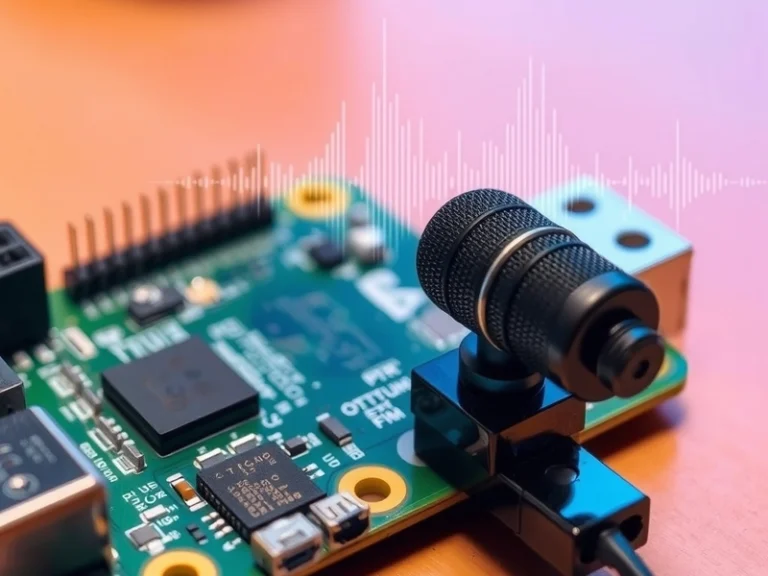
A programmer recently leveraged readily available AI technology to solve a common household mystery: an intermittent, unidentifiable beep, transforming a frustrating auditory puzzle into a practical demonstration of machine learning’s capabilities.
The challenge of a phantom sound is familiar to many. A subtle, often high-pitched beep that appears sporadically, defying attempts to pinpoint its origin through traditional methods like listening intently or systematically unplugging devices. Such sounds can originate from a myriad of sources, from dying smoke detector batteries to failing appliance components or smart home devices signaling a low charge.
For a technically inclined individual, this problem presented an opportunity for an automated, data-driven solution. The core idea was to deploy an array of microphones throughout the home, continuously record audio, and then use an AI model to detect the specific “beep” sound and log its location and time. This approach moves beyond human auditory fatigue and subjective interpretation, relying instead on persistent, objective data analysis.
Building the Auditory Surveillance System
The initial phase involved setting up a network of audio capture devices. Modern single-board computers, such as various models of the Raspberry Pi, coupled with inexpensive USB microphones, offer a robust and affordable foundation for such a project. These micro-computers can be distributed across different rooms or zones of a house, each configured to record ambient audio.
- Hardware Deployment: Multiple Raspberry Pi units, each connected to a standard USB microphone, were strategically placed. These devices were configured to record short audio clips continuously, often in 5-10 second intervals, and store them locally or upload them to a centralized network storage.
- Audio Preprocessing: Raw audio data is often noisy and requires preparation for machine learning. This typically involves converting the audio waveforms into a visual representation known as a spectrogram. Spectrograms display frequency content over time, making distinct sound patterns, like a specific beep, visually identifiable to a convolutional neural network (CNN).
- Data Labeling: To train an AI model to recognize the elusive beep, examples of the sound itself are critical. This often involves capturing instances of the beep when it occurs and manually labeling these segments. Equally important is collecting “negative” examples – audio of normal household ambient noise without the beep – to teach the model what *not* to detect.
The AI Model: A Custom Sound Classifier
With data collection and preprocessing in place, the next step was to develop a machine learning model capable of accurately identifying the target sound. Sound event detection and classification are well-established fields within machine learning, often relying on deep learning architectures.
A common approach for this type of task involves using a Convolutional Neural Network (CNN). CNNs are particularly adept at recognizing patterns in grid-like data, making them highly effective for analyzing spectrograms. The model would be trained to classify each spectrogram segment as either containing the “beep” or not. Frameworks like TensorFlow or PyTorch, accessible via Python libraries, provide the necessary tools for building and training such models even on consumer-grade hardware or cloud instances.
The training process involved feeding the labeled spectrograms to the CNN. The model learns to identify the unique frequency and temporal characteristics that define the specific beep, distinguishing it from general background noise like conversation, appliance hums, or outdoor sounds. Iterative refinement, including adjusting model parameters and expanding the training dataset, is often necessary to achieve high accuracy and minimize false positives.
Pinpointing the Source
Once trained, the AI model was deployed back onto the Raspberry Pi units. Each unit continuously captured audio, processed it into spectrograms, and fed these to its local model for real-time classification. When a beep was detected, the system logged the time, the specific Raspberry Pi unit that detected it, and potentially even the confidence score of the detection.
By correlating detections across multiple devices and observing which sensor consistently reported the beep with the highest confidence, the programmer was able to narrow down the sound’s origin. Instead of aimlessly searching, the system provided precise data points, effectively localizing the source to a specific room or even a particular corner of a room.
In this particular instance, the persistent beeping was ultimately traced to a compact smart home sensor, tucked away on a shelf, signaling a critically low battery. While seemingly trivial, the resolution of such a persistent, annoying sound through a sophisticated yet accessible AI system underscored the practical utility of machine learning in everyday problem-solving.
This project exemplifies how accessible AI tools, combined with off-the-shelf hardware, can be applied to solve real-world, albeit mundane, problems. It highlights the power of sound classification models beyond more common applications like voice assistants or industrial anomaly detection, demonstrating that even elusive household noises can be demystified through persistent, intelligent monitoring.