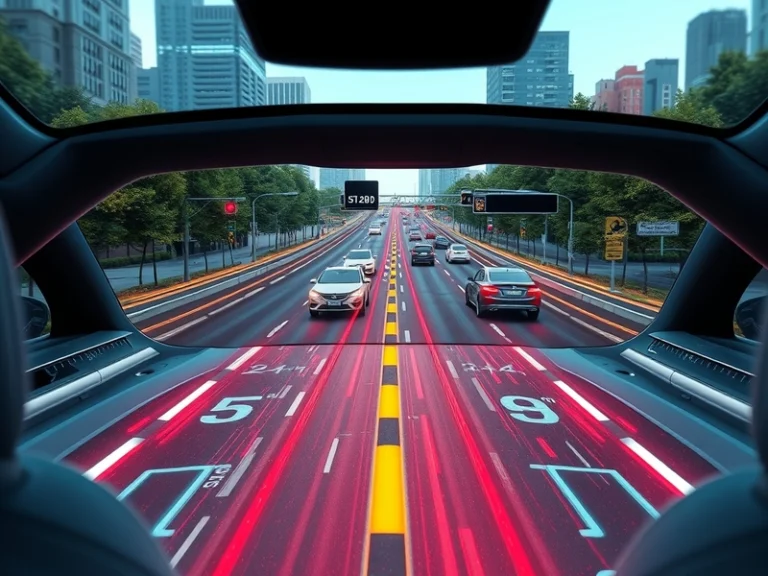
Tesla’s Full Self-Driving (FSD) Beta system continues to evolve, with recent updates placing a strong emphasis on enhanced transparency through a detailed visualization of what the AI perceives on the road. This capability allows drivers to observe, in real-time, the complex 3D world model the vehicle’s neural networks construct from raw sensor data.
The core innovation lies in the system’s ability to “rebuild reality” – not merely displaying sensor feeds, but synthesizing a comprehensive digital representation of the driving environment. This includes other vehicles, pedestrians, cyclists, traffic lights, lane markings, road signs, and even the predicted trajectories of dynamic objects. For a technically literate audience, this isn’t just a fancy graphic; it’s a direct window into the AI’s operational understanding of the world, highlighting the output of its perception stack.
Why Transparency Matters in Autonomous Systems
The push for such detailed visualization serves multiple critical purposes, extending beyond mere user interface aesthetics:
- Building Driver Trust: For autonomous driving systems to gain widespread acceptance, human drivers need to understand and trust their vehicle’s decisions. Seeing what the AI “sees” and how it interprets the environment can demystify its actions, making its maneuvers less opaque and more predictable to the occupant.
- Debugging and Validation: For Tesla’s internal development teams and the expansive FSD Beta testing community, this visualization is an invaluable debugging tool. Discrepancies between the AI’s perceived world and actual reality become immediately apparent, allowing engineers and testers to identify edge cases, perception failures, or planning misinterpretations.
- Educational Tool: It educates users on the capabilities and limitations of the system. Drivers can learn to anticipate the vehicle’s responses by understanding its perception of the road ahead, fostering a more informed interaction with the technology.
- Regulatory Compliance and Accountability: As autonomous driving regulations mature, the ability to demonstrate an AI’s real-time understanding of its environment could become crucial for validation and accountability.
The Technical Underpinnings: From Pixels to 3D Vectors
Tesla’s approach to autonomous driving heavily relies on a vision-first paradigm, primarily utilizing a suite of external cameras. The journey from raw camera pixels to the rich 3D visualization seen on the in-car display involves several sophisticated machine learning techniques:
- Multi-Camera Neural Networks: The system ingests streams from multiple cameras simultaneously. These raw video feeds are fed into deep neural networks designed to process and fuse information from different viewpoints.
- Occupancy Networks and Vector Space: Instead of traditional object detection bounding boxes, Tesla’s FSD Beta has increasingly leveraged what it describes as “occupancy networks” or a “vector space” representation. This allows the AI to predict not just the presence of specific object categories, but also the general occupancy of 3D space, road surfaces, and dynamic elements with high fidelity. This creates a much richer, continuous representation of the environment.
- Real-time 3D Reconstruction: The neural networks are tasked with constructing a dynamic, bird’s-eye view 3D model of the vehicle’s surroundings. This model includes precise localization of lane lines, road edges, traffic light states, and the positions and velocities of other agents. The visualization on the screen is a rendering of this internal 3D model.
- Predictive Capabilities: Beyond current perception, the system also visualizes predicted trajectories for other vehicles and pedestrians. This demonstrates the AI’s ability to not only understand the present but also anticipate future movements, a critical component for safe and smooth autonomous navigation.
The evolution of this visualization has been marked by increasing detail and fidelity. Earlier iterations might have shown simpler representations of vehicles and lane lines. More recent updates showcase complex geometries for diverse objects, nuanced road surface textures, and a more comprehensive understanding of the vehicle’s immediate and distant environment, including complex intersections and construction zones.
Implications for the Future of AI-Driven Mobility
This level of transparency sets a precedent for how autonomous systems can communicate their internal state to human operators. As AI takes on more complex and safety-critical roles, the ability to peer into its decision-making process becomes paramount. While the visualization is a simplified representation of the underlying neural network activations and computations, it provides a crucial abstraction layer that allows humans to grasp the AI’s perception of reality.
The continued refinement of these visualization tools will likely play a significant role in the ongoing development and public acceptance of autonomous vehicles. It underscores a fundamental challenge in AI: bridging the gap between sophisticated, opaque neural network operations and human understanding, fostering confidence and enabling more effective human-AI collaboration on the road.