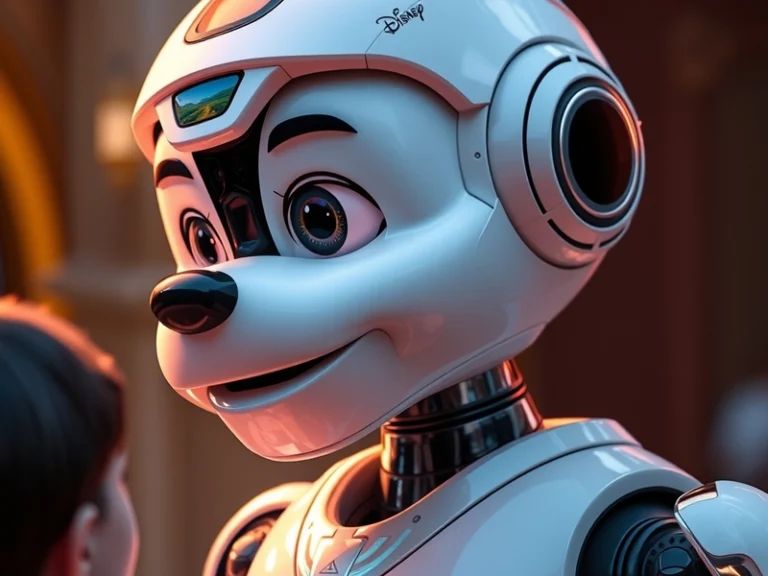
Disney is significantly advancing its animatronics, leveraging artificial intelligence to create autonomous robots capable of dynamic interaction and conversational engagement, marking a profound evolution from its long-standing tradition of pre-programmed figures.
For decades, Disney Imagineering has been synonymous with animatronics, bringing beloved characters to life through intricate mechanical and hydraulic systems. These figures, while impressive, historically operated on precise, pre-programmed sequences, repeating movements and dialogue regardless of audience interaction. The new wave of AI-powered animatronics, largely driven by innovations from Disney Research, aims to break these constraints, introducing a level of autonomy and responsiveness previously confined to science fiction.
The Quest for Autonomous Characters
At the heart of Disney’s robotic advancements is the pursuit of truly autonomous characters that can navigate complex environments, perform intricate actions, and interact naturally with guests. This vision requires sophisticated AI systems that can perceive their surroundings, process information in real-time, and make intelligent decisions on the fly.
Stuntronics: A Leap in Physical Autonomy
One of the most publicly recognized examples of Disney’s AI-driven robotics is the “Stuntronics” initiative. These autonomous acrobatic robots are designed to perform complex aerial maneuvers, mimicking the dramatic stunts of superheroes. The most prominent example is the Spider-Man animatronic at Disney California Adventure’s Avengers Campus, which launches high into the air, performs flips, and lands safely before resetting for the next performance.
The AI driving Stuntronics is crucial for several reasons:
- Real-time Trajectory Planning: The robots use sensors and algorithms to calculate and adjust their flight path in real-time, ensuring precise landings.
- Balance and Stability: AI-powered control systems maintain balance and orientation throughout the stunt, even when encountering unexpected variables.
- Fall Recovery: Should an unforeseen issue arise, the robots are designed with AI-driven fall recovery mechanisms to minimize damage and ensure safety.
This level of physical autonomy demonstrates AI’s capacity to manage complex, high-stakes actions, moving far beyond simple repetitive motion to adaptive, dynamic performance.
Towards Social and Conversational AI
Beyond physical prowess, Disney Research is actively exploring how AI can enable animatronics to engage in more sophisticated social and conversational interactions. This involves equipping robots with the ability to perceive human cues, understand natural language, and generate contextually appropriate responses, both verbally and non-verbally.
Research prototypes have showcased animatronics with highly expressive faces, capable of subtle emotional displays that enhance realism and relatability. These robots can track human gaze, interpret gestures, and respond with their own synchronized movements and vocalizations. The underlying AI systems for these capabilities often involve:
- Computer Vision: To recognize faces, track eye movements, and interpret body language, allowing the robot to understand a guest’s focus and emotional state.
- Natural Language Processing (NLP): While not yet fully deployed for unscripted, free-form conversation in public park settings, research focuses on robust speech recognition and natural language understanding to interpret spoken queries and generate coherent, character-appropriate dialogue.
- Generative AI for Expression: Algorithms can synthesize realistic facial expressions, head movements, and gestures that complement spoken words, making interactions feel more natural and engaging.
- Reinforcement Learning: Used to train robots on various interaction scenarios, allowing them to learn optimal responses and behaviors over time, improving the quality of engagement.
The goal is to move beyond pre-recorded dialogue trees to dynamic conversations where the animatronic can adapt its responses based on the specific interaction, the guest’s reactions, and the unfolding narrative. While currently more prevalent in research labs and controlled prototypes, the integration of these AI components represents a significant step toward truly interactive characters.
Challenges and the Path Forward
Developing and deploying AI-driven animatronics on a large scale presents numerous challenges:
- Safety and Reliability: Ensuring the absolute safety of guests interacting with autonomous robots is paramount. Systems must be rigorously tested and fault-tolerant.
- Computational Demands: Real-time AI processing for perception, decision-making, and expressive output requires significant on-board computing power, often in compact, power-constrained forms.
- The Uncanny Valley: As robots become more human-like, there’s a risk of falling into the “uncanny valley,” where near-human realism can evoke feelings of eeriness or revulsion. AI must be finely tuned to navigate this psychological threshold.
- Scalability and Maintenance: Deploying and maintaining a fleet of highly complex, AI-powered robots across multiple theme parks requires robust infrastructure and specialized expertise.
Despite these hurdles, Disney’s commitment to leveraging AI in its animatronics signals a clear direction: to create more immersive, personalized, and truly magical experiences. By blending advanced robotics with sophisticated artificial intelligence, Disney is not just building robots; it’s crafting the next generation of interactive storytelling, where characters can genuinely engage with their audience in unprecedented ways.