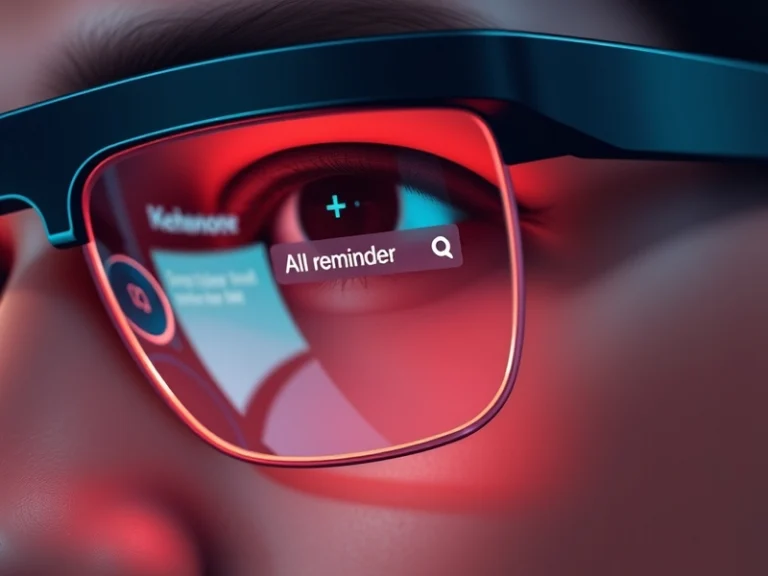
The concept of wearable technology designed to actively assist users in remembering commitments through real-time voice recognition is gaining traction, building on advancements in smart glasses and conversational AI. This emerging application promises to transform personal productivity by offloading the mental burden of tracking spoken promises and deadlines.
Far from being a science fiction trope, the foundational technologies for such “memory glasses” are already in our pockets and on our faces. Modern smart glasses, exemplified by products like the Ray-Ban Meta Smart Glasses developed in collaboration with Meta Platforms and EssilorLuxottica, or augmented reality (AR) devices such as the XREAL Air, already provide a discreet hardware platform for audio capture, playback, and visual overlays. Coupled with sophisticated AI models capable of understanding and processing natural language, the leap to a commitment-tracking system is becoming increasingly feasible.
The Technical Underpinnings
Realizing glasses that can remember commitments involves a sophisticated interplay of several AI and hardware components:
- Advanced Speech Recognition (ASR): The system must accurately transcribe spoken conversations, often in noisy environments or with multiple speakers. Modern ASR models, like those powering OpenAI’s voice capabilities in ChatGPT Voice or Google Assistant, have reached remarkable levels of accuracy, even differentiating between speakers.
- Natural Language Understanding (NLU): Transcribed speech needs to be parsed for intent, entities, and deadlines. For instance, if a user says, “I’ll send John the Q3 report by Friday afternoon,” the NLU model must identify “send,” “John,” “Q3 report,” and “Friday afternoon” as key elements of a commitment. This requires context awareness and robust semantic analysis.
- Commitment Extraction and Storage: Once identified, commitments need to be structured and stored in a retrievable format, potentially linked to a personal knowledge graph or task management system. This storage must be secure and easily searchable by the user.
- Proactive Reminders and Display: The glasses would need a mechanism to deliver timely, non-intrusive reminders. This could be through subtle audio cues, a gentle haptic vibration, or a discreet visual overlay on the lens, similar to how notifications appear on the Apple Vision Pro or existing AR headsets.
- On-Device Processing and Cloud Integration: To ensure privacy and low latency, some initial processing (like wake-word detection or basic transcription) might occur on the device itself, while more complex NLU and knowledge graph interactions could leverage cloud-based AI services.
Challenges and Considerations
While the potential is significant, several technical and ethical hurdles need to be addressed before such glasses become a mainstream reality:
- Privacy and Consent: The most prominent concern is the continuous recording and processing of conversations. Clear ethical guidelines and user controls are paramount. Users must have full transparency over what is recorded, how it’s processed, and who, if anyone, has access to the data. This extends to the privacy of others in conversations.
- Battery Life and Form Factor: Always-on voice recognition and processing are power-intensive. Integrating the necessary computational power into a sleek, comfortable, and long-lasting glasses form factor remains a significant engineering challenge.
- Contextual Understanding: Differentiating between a casual statement and a firm commitment requires sophisticated AI. The system must avoid generating too many false positives (reminding users of non-commitments) or false negatives (missing actual promises).
- Data Management: Over time, the volume of commitments could become overwhelming. Effective summarization, prioritization, and archival tools would be necessary to prevent information overload.
Looking Ahead
The development of commitment-tracking smart glasses represents a fascinating intersection of wearable technology, advanced AI, and human-computer interaction. Companies like Meta and Google continue to invest heavily in smart glasses, pushing the boundaries of what these devices can do. As AI models become more adept at understanding nuanced human communication and hardware becomes more efficient, the vision of a discreet, intelligent assistant embedded in our daily wear, helping us stay on top of our word, moves closer to reality. The success of such products will ultimately hinge on their ability to offer genuine utility while meticulously safeguarding user privacy and trust.