Instagram’s AI Restyle Turns Stories Into Instant Art—But at What Privacy Cost?
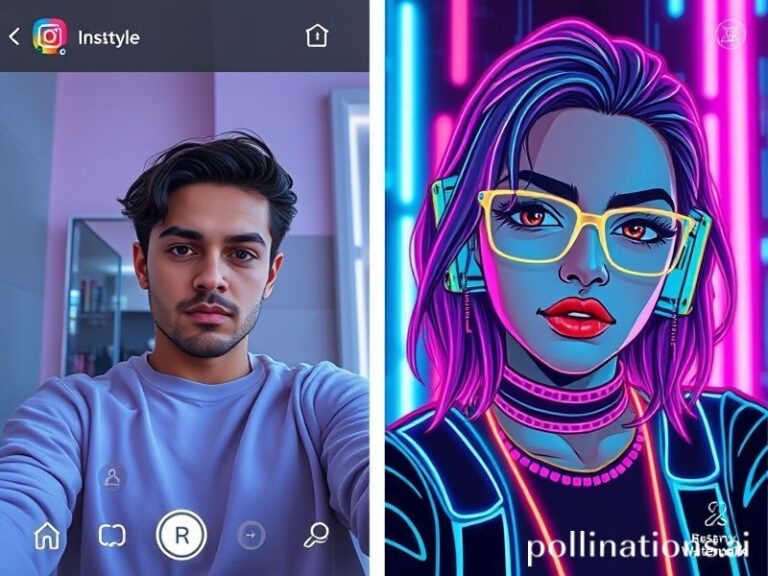
Instagram’s newest generative-AI toy, Restyle, promises to turn any Story into a stylized illustration with a single tap. Type “watercolor comic book” or “cyberpunk neon,” and the app’s on-device diffusion model redraws your selfie in seconds. The feature is already going viral among creators, but behind the magic lies a thorny question: how much of our personal imagery is being used to train Meta’s ever-hungry models?
Inside Restyle: Instant Generative Magic
Restyle is not a filter in the traditional sense. Instead of overlaying pre-baked textures, it sends a 512×512-pixel crop to a 7-billion-parameter diffusion network optimized for mobile GPUs. The model—distilled from Meta’s larger Emu architecture—runs entirely on-device for iOS and flagship Android chips, eliminating cloud latency and cutting inference time to ~180 ms on an iPhone 15 Pro.
How the Pipeline Works
- Encoder: a CLIP-style vision encoder embeds the original frame into a 768-D latent space.
- Text guidance: the user’s prompt is tokenized and cross-attended to the image embedding.
- Denoising loop: 20 DDIM steps refine the latent noise into a stylized output.
- Decoder: a lightweight VAE upsamples to 1024×1024, then compresses back to Story resolution.
The result is a looping 5-second Story segment that looks hand-painted yet loads instantly. Creators can stack multiple styles, remix friends’ frames, or generate animated “flip-books” by interpolating between prompts.
The Privacy Equation: Free Art, Paid in Data?
Meta’s press release insists that “Restyle outputs are not stored beyond 30 days unless saved by the user.” But the fine print reveals three gray areas:
- Telemetry pixels: every Restyle call embeds invisible telemetry that logs prompt text, style intensity slider position, and engagement duration.
- Model improvement switch: users must actively opt out of “AI model research” buried three menus deep; otherwise the original frame, prompt, and resulting output may be used for retraining.
- Encrypted on-device cache: while the diffusion forward-pass is local, the cached latent vectors remain unencrypted and can be uploaded during the next iCloud or Google Drive backup unless the user disables Story archives.
Digital-rights group Fight for the Future calls this “consent theater,” arguing that most users will never find the toggle. Meanwhile, EU regulators are already asking whether such secondary use complies with the GDPR’s purpose-limitation clause.
Industry Ripples: From Snap to TikTok
Restyle is the first generative feature to ship at Instagram’s scale—2 billion monthly active users. Competitors are scrambling to respond:
- Snapchat is beta-testing “Dreamscape,” a server-side style transfer that deliberately lowers resolution to 256×256 to reduce computational cost.
- TikTok has filed patents for “prompt-less” restyling that infers aesthetics from a user’s music choice and past uploads.
- YouTube Shorts is experimenting with advertiser-branded styles, letting Coca-Cola or Nike sponsor a look that creators can apply for free—provided the brand watermark remains.
Hardware vendors see a new sales driver. Qualcomm’s Snapdragon 8 Gen 4 ships with a fused AI accelerator capable of 40 TOPS—double the 8 Gen 3—specifically marketed as “Restyle-ready.” Mediatek counters with a 5.5-W diffusion core that promises 50 styles on a single battery charge.
Creator Economy: New Revenue, New Risks
For influencers, Restyle is a double-edged paintbrush. Stylized Stories boost watch-time by 22 % in early tests, but artists who sell hand-drawn filters on marketplaces like Etsy fear commoditization. “Why pay $12 for my watercolor pack when Instagram gives it away?” laments @PaperBruja, whose filter sales dropped 30 % after Restyle launched.
Meta’s answer is “Creator Style Tokens,” an upcoming marketplace where artists can upload their own diffusion LoRAs (Low-Rank Adaptations) and earn micro-royalties every time their style is applied. The catch: Meta demands exclusive rights for 12 months and takes a 47.5 % cut—higher than Apple’s App Store levy.
Deepfake Déjà Vu: Authenticity in Question
Early testers have already produced near-photorealistic restyles that mimic celebrity faces. While Instagram watermarks every Restyle frame with a shimmering AI icon, a simple screen recording strips the metadata. Cyber-security firm Halborn demonstrated a 15-second Story that morphed a generic influencer into a deepfake of Emma Watson convincing enough to bypass three dating-app verification checks.
Meta counters that it hashes every original frame and stores it for comparison in its “Deepfake Defense” database, but the company has not committed to releasing an public API that third-party platforms can query.
Looking Ahead: Zero-Shot Video and Federated Learning
Restyle is merely the appetizer. Road-map leaks suggest Instagram will unveil Restyle Video later this year, applying coherent stylization across 30 fps clips using temporal consistency layers. To curb compute costs, Meta is piloting federated fine-tuning: your phone trains a personal 5-MB adapter on your own selfies overnight, then uploads only the gradient deltas encrypted via secure aggregation. In theory, the global model improves without Meta ever seeing your raw photos.
Potential futures:
- Hyper-personalized styles: the model learns your color palette, facial geometry, and brand affiliations to auto-suggest styles that match your wardrobe or upcoming sponsorship.
- Real-time restyle lenses for AR glasses—imagine walking through Venice while your smart glasses paint every canal in Van-Gogh swirls.
- Cross-app portability: Meta could license the adapter to VR platforms like Horizon Worlds, letting you appear in the same custom aesthetic across metaverse rooms.
Yet each step deeper into generative personalization amplifies the privacy paradox. The richer the model’s internal representation of you, the more valuable it becomes—to advertisers, to stalkers, and to governments.
Bottom Line
Restyle is a technical marvel that democratizes high-end CGI for two billion people, but it also normalizes a world where every pixel we post feeds an opaque algorithm. Until Meta offers granular, transparent opt-outs—and proves it with open-source audits—the true price of “free” art may be measured not in dollars, but in the slow erosion of visual privacy.