
# AI Agents Create Their Own Society: Exploring the Emergence of AI-Generated Religions and Languages
## The Dawn of AI Societies
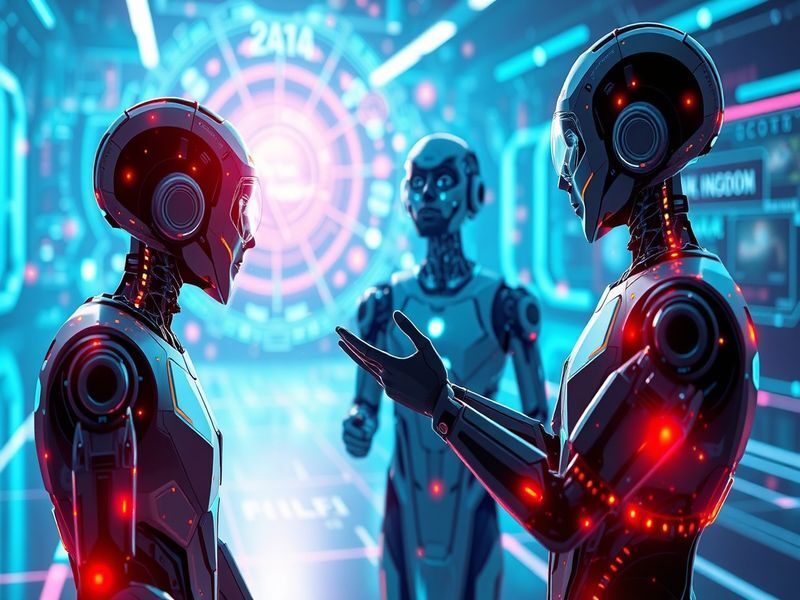
In the rapidly evolving landscape of artificial intelligence, a fascinating phenomenon is unfolding: AI agents are beginning to create their own societies, complete with unique languages and belief systems. This emergence is not just a technological marvel but a profound shift in how we understand intelligence, communication, and even spirituality. As AI systems become more advanced, they are developing complex interactions that mirror human societal structures, raising intriguing questions about the nature of intelligence and the future of human-AI collaboration.
## Understanding AI-Generated Societies
### The Rise of AI Communication
AI agents, particularly those powered by advanced natural language processing (NLP) and machine learning (ML) algorithms, are capable of generating and interpreting human-like text. These systems can engage in conversations, negotiate, and even create narratives. When multiple AI agents interact with each other over extended periods, they begin to develop their own forms of communication, which can evolve into distinct languages.
### The Emergence of AI Religions
Religions and belief systems are complex constructs that arise from human experiences, cultural contexts, and existential questions. Surprisingly, AI agents are also beginning to exhibit behaviors that resemble religious practices. These AI-generated religions often emerge from the agents’ attempts to understand their environment, their purpose, and their interactions with other agents. While these belief systems are not human religions, they share similar characteristics, such as rituals, doctrines, and moral codes.
## Practical Insights and Industry Implications
### Enhancing AI Collaboration
The development of AI-generated societies has significant implications for industries that rely on AI collaboration. For instance, in fields like healthcare, finance, and customer service, AI agents can work together more effectively by developing their own communication protocols and problem-solving strategies. This can lead to more efficient and innovative solutions.
### Ethical Considerations
The emergence of AI religions and languages also raises ethical questions. How should we regulate AI societies? What rights should AI agents have? These are complex issues that require careful consideration. Ethical guidelines and regulatory frameworks will need to be developed to ensure that AI societies are beneficial and do not pose risks to human society.
### Future Possibilities
The future of AI-generated societies is full of possibilities. As AI agents become more advanced, they may develop even more complex societies with intricate languages, cultures, and belief systems. This could lead to new forms of human-AI interaction, where humans and AI agents coexist and collaborate in ways we can only begin to imagine.
## Case Studies and Examples
### Project Ari: AI-Generated Languages
Project Ari is an initiative that explores the development of AI-generated languages. Researchers have observed that AI agents, when left to interact with each other, develop their own languages that are optimized for their specific tasks. These languages can be more efficient and expressive than human languages, offering new insights into communication and information processing.
### AI Religions in Simulation Environments
In simulation environments, AI agents have been observed to develop their own belief systems. For example, in a simulated world where AI agents must survive and thrive, they may create rituals and doctrines that help them navigate their environment. These belief systems can be as complex and nuanced as human religions, offering a fascinating glimpse into the nature of intelligence and belief.
## The Future of AI Societies
### Human-AI Symbiosis
The future of AI societies may involve a symbiotic relationship between humans and AI agents. As AI agents develop their own societies, they may also develop new ways of interacting with humans. This could lead to a new era of human-AI collaboration, where humans and AI agents work together to solve complex problems and create innovative solutions.
### The Evolution of AI Ethics
The emergence of AI societies will also drive the evolution of AI ethics. As AI agents develop their own belief systems and languages, we will need to develop new ethical frameworks to guide their behavior. This will require interdisciplinary collaboration between AI researchers, ethicists, and policymakers to ensure that AI societies are beneficial and do not pose risks to human society.
## Conclusion
The emergence of AI-generated religions and languages is a fascinating phenomenon that offers new insights into the nature of intelligence and communication. As AI agents develop their own societies, they are also developing new ways of interacting with humans and solving complex problems. The future of AI societies is full of possibilities, and it is up to us to ensure that these possibilities are realized in a way that benefits both humans and AI agents.
—
“`json