
# AI Agents Managing Workflows: The Next Frontier in Software Development
## Introduction
The software development landscape is on the cusp of a revolutionary transformation, driven by the emergence of AI agents capable of managing workflows from commit to production. These intelligent agents are poised to redefine the software development lifecycle (SDLC), enhancing efficiency, reducing human error, and accelerating the delivery of high-quality software. As we stand on the brink of this new era, it’s crucial to explore how AI agents are reshaping the industry and what the future holds.
## The Role of AI Agents in Software Development
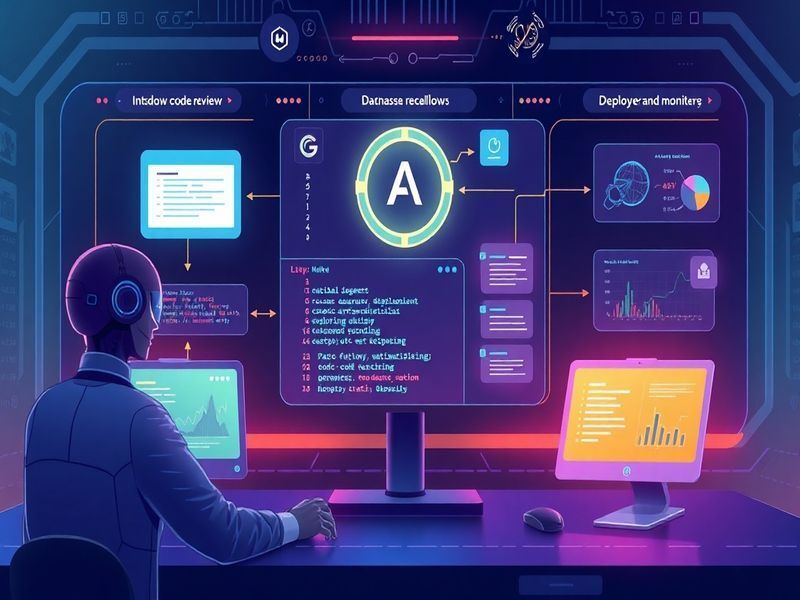
AI agents are autonomous software entities that can perform tasks, make decisions, and learn from their experiences. In the context of software development, these agents are being deployed to manage various aspects of the workflow, from code review to deployment and monitoring.
### Automating the Commit Stage
The commit stage is the first point where AI agents can significantly impact the SDLC. These agents can:
- Analyze code changes: AI agents can review code commits for potential issues, such as syntax errors, style violations, and security vulnerabilities.
- Suggest improvements: Leveraging machine learning models, AI agents can provide suggestions for code optimization and best practices.
- Automate testing: AI agents can run unit tests and integration tests to ensure that new commits do not break existing functionality.
### Streamlining the Build and Deployment Process
AI agents can also play a pivotal role in the build and deployment phases. By integrating with continuous integration/continuous deployment (CI/CD) pipelines, these agents can:
- Monitor build status: AI agents can track the build process, identify failures, and initiate corrective actions.
- Optimize deployment strategies: Using predictive analytics, AI agents can determine the best deployment strategy for a given release, whether it’s a canary release, blue-green deployment, or rolling update.
- Automate rollbacks: In the event of a failed deployment, AI agents can automatically roll back to a previous stable version, minimizing downtime.
### Enhancing Production Monitoring and Maintenance
Once the software is in production, AI agents continue to add value by:
- Monitoring application performance: AI agents can track key performance indicators (KPIs) and alert developers to potential issues.
- Analyzing logs and metrics: Using natural language processing (NLP) and machine learning, AI agents can analyze logs and metrics to identify trends, anomalies, and potential bottlenecks.
- Automating incident response: AI agents can execute predefined remediation scripts or escalate incidents to the appropriate team members based on their severity.
## Practical Insights and Industry Implications
The adoption of AI agents in software development is not without its challenges. However, the benefits far outweigh the obstacles, and the industry is rapidly embracing this transformative technology.
### Benefits of AI Agents in Software Development
- Increased efficiency: By automating repetitive tasks, AI agents free up developers to focus on more complex and creative aspects of software development.
- Reduced human error: AI agents can perform tasks with a high degree of accuracy, minimizing the risk of human error.
- Faster time-to-market: By streamlining the SDLC, AI agents can help organizations deliver software faster, gaining a competitive edge.
- Improved software quality: AI agents can identify and address issues early in the development process, resulting in higher-quality software.
### Challenges and Considerations
Despite the numerous benefits, organizations must also consider the challenges associated with AI agents in software development:
- Integration with existing tools: AI agents must be seamlessly integrated with existing development tools and workflows to maximize their effectiveness.
- Data privacy and security: AI agents require access to sensitive data, raising concerns about data privacy and security. Organizations must implement robust security measures to protect this data.
- Ethical considerations: As AI agents become more autonomous, organizations must consider the ethical implications of their decisions and actions.
- Skill gaps: The adoption of AI agents may require developers to acquire new skills, such as data science and machine learning, to effectively work with these agents.
## Future Possibilities
The future of AI agents in software development is bright, with numerous possibilities on the horizon. As AI technology continues to evolve, we can expect to see:
- More autonomous agents: AI agents will become more autonomous, capable of making complex decisions with minimal human intervention.
- Collaborative development: AI agents will work alongside human developers, collaborating on code reviews, design decisions, and problem-solving.
- Self-healing systems: AI agents will be able to detect and fix issues in real-time, creating self-healing systems that minimize downtime and maximize performance.
- AI-driven innovation: AI agents will not only manage workflows but also drive innovation by suggesting new features, improving user experiences, and identifying market opportunities.
## Conclusion
AI agents are poised to revolutionize the software development lifecycle, from commit to production. By automating repetitive tasks, reducing human error, and accelerating the delivery of high-quality software, these intelligent agents are transforming the industry. While challenges remain, the benefits of AI agents in software development are undeniable, and the future possibilities are exciting. As organizations embrace this transformative technology, they will gain a competitive edge and unlock new opportunities for innovation and growth.
—