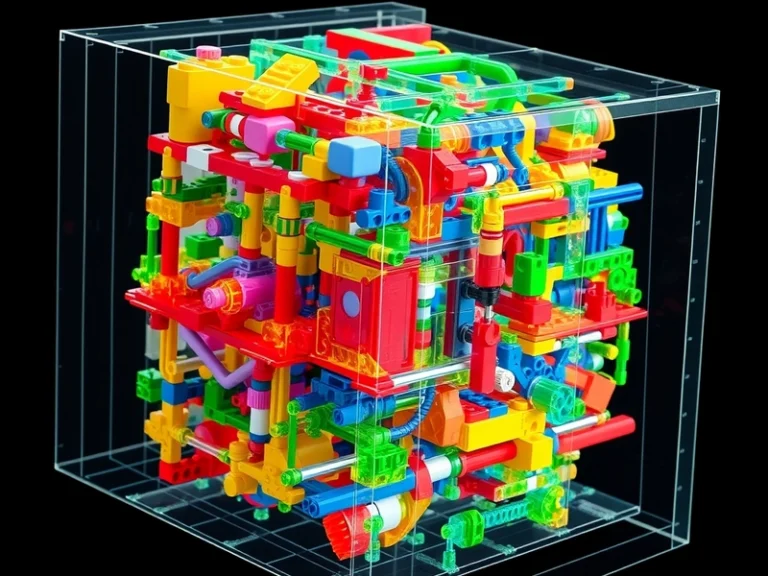
Artificial intelligence systems are now demonstrating the capability to design functional LEGO-style models that are guaranteed to be physically buildable with real parts, marking a significant step forward in AI-assisted design and engineering.
For years, digital design tools have allowed creators to assemble intricate virtual structures using interlocking bricks, much like the popular LEGO system. However, a persistent challenge has been the gap between a visually appealing digital model and a physically stable, buildable structure. A design that looks perfect on screen might be impossible to construct in reality due to issues like unsupported connections, unbalanced weight distribution, insufficient structural integrity, or reliance on rare or non-existent parts. This new breakthrough directly addresses these real-world physical constraints.
The Intricacies of Physical Buildability
The complexity of ensuring physical buildability goes far beyond simply snapping digital bricks together. It involves a sophisticated understanding of several factors:
- Structural Integrity: A model must withstand gravity and potential external forces without collapsing. This requires proper load bearing, bracing, and connection strength.
- Part Connectivity Rules: Each type of brick has specific connection points and limitations. A digital model might inadvertently create “floating” bricks or invalid connections that don’t exist in the physical world.
- Balance and Stability: Tall or asymmetrical structures can become top-heavy or unstable, requiring careful design considerations for their base and internal supports.
- Part Availability and Inventory: Real-world builders operate with a finite set of parts. Designing with a specific inventory in mind, or ensuring that required parts are commonly available, is crucial for practical construction.
- Assembly Sequence: Some complex structures might be physically impossible to assemble if the design doesn’t account for the order in which parts must be connected.
Traditionally, overcoming these challenges required extensive human expertise, trial-and-error, and often, multiple physical prototypes. This iterative process is time-consuming and costly.
AI’s Role in Bridging the Digital-Physical Divide
The recent advancements leverage sophisticated AI techniques to directly incorporate these physical constraints into the generative design process. Instead of merely optimizing for aesthetic appeal or a target shape, these AI models are trained on vast datasets of existing physically sound designs, engineering principles, and even failure modes. This allows them to predict and prevent structural issues before a single physical brick is laid.
Key AI methodologies contributing to this capability include:
- Generative Design Algorithms: These algorithms explore a vast design space, creating numerous potential model configurations. Unlike traditional methods, they are guided by a fitness function that prioritizes physical stability and buildability alongside aesthetic or functional goals.
- Constraint Satisfaction Programming: The AI system can encode the rules of brick connectivity, structural load distribution, and part availability as hard constraints. This ensures that every generated design adheres to fundamental physical laws and component limitations.
- Reinforcement Learning: In some approaches, AI agents can “learn” optimal building strategies by simulating construction and stability tests in a virtual environment, receiving rewards for stable designs and penalties for unstable ones. This iterative learning refines their ability to produce robust structures.
- Knowledge Graphs and Part Libraries: By integrating detailed knowledge graphs of LEGO or similar brick systems (including part dimensions, connection types, and availability), the AI can design with an awareness of real-world component inventories.
- Physics-Based Simulation: Integrating lightweight physics engines allows the AI to perform real-time structural analysis and stability checks during the design process, identifying potential weak points or areas of collapse.
Implications for Design, Education, and Beyond
This breakthrough has wide-ranging implications, promising to democratize complex design and accelerate prototyping in various fields:
- For Hobbyists and Enthusiasts: It empowers amateur builders to realize their creative visions without being limited by their engineering knowledge. Users can input desired shapes or functions, and the AI can generate buildable instructions, drastically reducing frustration from unstable or unbuildable models.
- In Education: AI-assisted design tools can serve as powerful educational aids, allowing students to experiment with engineering principles in a hands-on, interactive way. They can design complex structures and immediately see the physical implications of their choices.
- For Professional Design and Prototyping: Architects, product designers, and engineers can leverage these tools for rapid prototyping of modular systems. From designing custom fixtures to pre-visualizing complex assemblies, the AI ensures that digital designs translate directly into functional physical objects, saving significant time and resources in the development cycle.
- In Robotics and Modular Systems: The principles extend to designing modular robots or configurable systems where physical stability and correct part assembly are paramount. AI can optimize for both function and buildability simultaneously.
While interlocking brick systems like LEGO provide an accessible and tangible demonstration, the underlying AI principles are applicable to a much broader spectrum of physical design challenges. From custom furniture assembly to modular housing components, the ability of AI to generate designs that are not just aesthetically pleasing but also inherently practical and constructible marks a significant advancement in the convergence of AI and physical engineering.