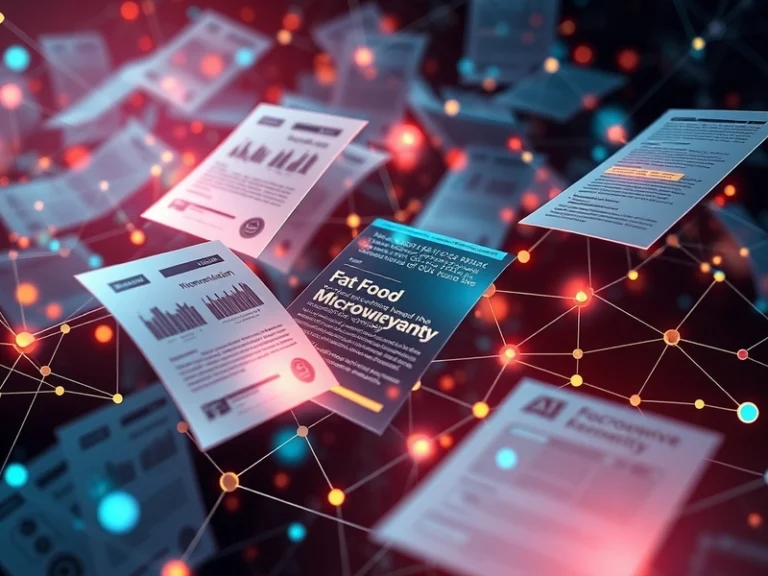
AI is now actively streamlining data collection from extensive food science literature, enabling researchers to uncover significant patterns in food microwave interactions with unprecedented efficiency. This application of artificial intelligence is transforming how the food industry approaches research and development, moving beyond manual data collation to automated insight generation.
For decades, understanding the complex interplay between microwave energy and various food matrices has been a labor-intensive process. Researchers studying microwave effects on food safety, nutritional value, and sensory properties typically rely on published scientific papers. Extracting specific data points—such as microwave power levels, heating durations, food composition, temperature profiles, microbial inactivation rates, or nutrient retention levels—from hundreds or thousands of articles is a monumental task. This manual approach is not only time-consuming but also prone to inconsistencies and human error, severely limiting the scope and speed at which overarching trends can be identified across disparate studies.
The AI-Powered Data Extraction Solution
The core of this transformation lies in the application of Natural Language Processing (NLP) and machine learning techniques. AI models are being developed and fine-tuned to automatically read, understand, and extract structured data from unstructured text in scientific publications. This involves several sophisticated steps:
- Text Preprocessing: Scientific papers are often in PDF format, requiring optical character recognition (OCR) to convert them into machine-readable text. Further steps involve tokenization, sentence segmentation, and part-of-speech tagging to prepare the text for analysis.
- Named Entity Recognition (NER): AI models are trained to identify specific entities relevant to food microwave research. These entities include food types (e.g., “chicken breast,” “potato puree”), microwave parameters (e.g., “900 W,” “60 seconds,” “2.45 GHz”), processing conditions (e.g., “initial temperature,” “final temperature”), and measured outcomes (e.g., “Listeria monocytogenes reduction,” “vitamin C content,” “texture hardness”).
- Relation Extraction: Beyond identifying entities, AI also works to understand the relationships between them. For instance, connecting a specific “microwave power” and “duration” to a resulting “microbial inactivation rate” or “nutrient degradation percentage” within a given “food matrix.”
- Quantitative Data Extraction: Numerical values are extracted alongside their units (e.g., “5 log CFU/g reduction,” “75% retention,” “120 seconds”). This often involves advanced pattern matching and contextual understanding to correctly interpret numerical data presented in tables, figures, or within prose.
- Contextual Understanding with LLMs: The advent of large language models (LLMs) has significantly enhanced these capabilities. LLMs, when fine-tuned on domain-specific corpora, can demonstrate a deeper contextual understanding, improving the accuracy of extraction even from complex or ambiguously worded scientific prose. They can infer implied relationships and handle variations in scientific terminology more robustly than earlier rule-based or simpler machine learning models.
Uncovering Significant Patterns
Once vast quantities of structured data have been extracted and aggregated from thousands of research papers, the next phase involves leveraging machine learning algorithms to identify meaningful patterns and correlations that would be virtually impossible for humans to discern manually. This aggregated dataset becomes a powerful resource for predictive modeling and hypothesis generation.
Examples of patterns AI can uncover include:
- Optimal Processing Parameters: Identifying the most effective microwave power and duration combinations for achieving specific food safety goals (e.g., pathogen inactivation) in particular food matrices, while minimizing negative impacts on nutritional value or sensory attributes.
- Impact of Food Composition: Understanding how variations in moisture content, fat content, or sugar levels influence microwave heating uniformity and efficiency across different food types.
- Nutrient Retention vs. Processing: Correlating specific microwave processing conditions with the retention or degradation rates of various vitamins, antioxidants, or other bioactive compounds in different foods.
- Predictive Models for Shelf Life: Developing models that predict the shelf life or quality degradation of microwave-processed foods based on processing parameters and initial food characteristics.
- Thermal vs. Non-Thermal Effects: Distinguishing between patterns attributable to purely thermal effects of microwaves and those potentially related to non-thermal or specific microwave effects on biological systems.
This systematic aggregation and analysis of data allow food scientists to move beyond individual experimental results to a macro-level understanding of microwave-food interactions. It can reveal subtle yet significant trends that might be obscured by the sheer volume and diversity of published research.
Implications for Food Science and Industry
The implications of this AI-driven approach are far-reaching. For academic researchers, it accelerates literature reviews, facilitates meta-analyses, and allows for the rapid testing of hypotheses against a comprehensive global dataset. For the food industry, it promises to:
- Accelerate Product Development: Speed up the R&D cycle for new microwave-ready meals, snacks, or ingredients by providing quick access to aggregated knowledge.
- Improve Food Safety: Enhance the design of microwave pasteurization and sterilization processes by identifying parameters that consistently achieve desired microbial reduction targets across various food products.
- Optimize Nutritional Value: Develop microwave processing protocols that maximize nutrient retention, addressing consumer demands for healthier food options.
- Reduce Waste: Optimize processing to improve shelf life and reduce spoilage, contributing to sustainability efforts.
- Inform Regulatory Guidelines: Provide data-driven insights that can support the development of more precise and effective food processing regulations.
While the technology is still evolving, the integration of AI for data extraction and pattern discovery in food science literature marks a significant leap forward. It transforms scientific papers from static repositories of information into dynamic datasets, unlocking their collective intelligence to drive innovation and address critical challenges in food production and consumption.