

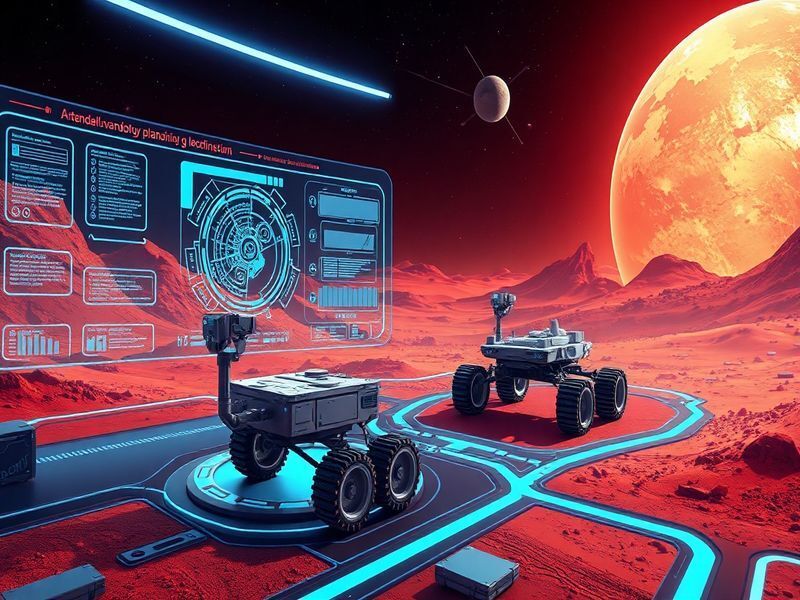
# AI in Space Exploration: Claude’s Autonomous Mission Planning on Mars
## The New Frontier of Space Exploration
Space exploration has always been a testament to human ingenuity and technological prowess. However, as we venture further into the cosmos, the challenges become increasingly complex. Enter **Claude**, an advanced AI system designed to revolutionize space missions through autonomous planning capabilities. Claude’s deployment in Mars missions marks a significant milestone in the integration of artificial intelligence in space exploration.
## The Role of AI in Space Missions
### Autonomous Decision Making
Traditional space missions rely heavily on ground-based control centers, where human operators make critical decisions. This approach has limitations, particularly for missions to distant planets like Mars, where communication delays can span several minutes. Claude’s AI-driven autonomous decision-making capabilities address this challenge head-on.
Claude can analyze real-time data from various sensors and instruments, make informed decisions, and execute commands without human intervention. This autonomy is crucial for missions where split-second decisions can mean the difference between success and failure.
### Adaptive Planning
Space missions are fraught with uncertainties. Unpredictable weather conditions, equipment malfunctions, and unexpected discoveries can derail even the most meticulously planned missions. Claude’s adaptive planning capabilities enable it to adjust mission parameters on the fly, ensuring that objectives are met despite unforeseen challenges.
For example, if a rover encounters an obstacle that wasn’t anticipated in the original mission plan, Claude can quickly recalculate the best path forward, avoiding potential hazards and optimizing the rover’s trajectory.
## Practical Insights and Industry Implications
### Enhanced Efficiency
The integration of AI like Claude in space missions significantly enhances operational efficiency. By automating routine tasks and decision-making processes, mission control teams can focus on more strategic aspects of the mission. This not only reduces the workload on human operators but also minimizes the risk of human error.
Moreover, AI-driven systems can process vast amounts of data much faster than human operators, enabling quicker responses to critical situations. This speed and efficiency are invaluable in the high-stakes environment of space exploration.
### Cost Reduction
Space missions are notoriously expensive. The cost of launching and maintaining spacecraft, along with the salaries of highly skilled personnel, can add up quickly. AI systems like Claude can help reduce these costs by automating various aspects of mission planning and execution.
For instance, AI can optimize fuel consumption, reduce the need for human intervention, and minimize the risk of mission failure, all of which contribute to significant cost savings. These savings can be reinvested in other areas of space exploration, accelerating the pace of discovery and innovation.
### Data Analysis and Insights
One of the most exciting aspects of AI in space exploration is its ability to analyze vast amounts of data and extract meaningful insights. Claude can process data from multiple sources, including images, sensor readings, and telemetry, to identify patterns and anomalies that might go unnoticed by human operators.
This capability is particularly valuable for scientific research. For example, AI can help identify potential sites for further exploration, detect signs of past or present life, and analyze the composition of Martian soil and atmosphere. These insights can revolutionize our understanding of Mars and pave the way for future human missions.
## Future Possibilities
### Human-Machine Collaboration
While AI systems like Claude are incredibly powerful, they are not meant to replace human operators entirely. Instead, they are designed to augment human capabilities, enabling a new era of human-machine collaboration. This synergy can lead to more efficient, effective, and innovative space missions.
In the future, we can expect to see AI systems working alongside human operators, providing real-time insights, recommendations, and support. This collaboration can enhance mission success rates and open up new possibilities for exploration and discovery.
### Expanding the Horizons
The success of AI-driven missions like Claude’s deployment on Mars is just the beginning. As AI technology continues to evolve, we can expect to see its applications expand to other areas of space exploration. For example, AI could be used to plan and execute missions to the outer planets, explore distant exoplanets, and even support human settlements on Mars and beyond.
The possibilities are truly limitless. AI has the potential to revolutionize every aspect of space exploration, from mission planning and execution to data analysis and scientific discovery. As we continue to push the boundaries of what is possible, AI will undoubtedly play a central role in shaping the future of space exploration.
## Conclusion
Claude’s autonomous mission planning capabilities represent a significant leap forward in space exploration. By enabling autonomous decision-making, adaptive planning, and enhanced data analysis, AI is revolutionizing the way we explore the cosmos. The practical insights and industry implications of AI in space missions are profound, offering enhanced efficiency, cost reduction, and new scientific discoveries.
As we look to the future, the potential for AI in space exploration is vast. From human-machine collaboration to expanding the horizons of exploration, AI will continue to play a pivotal role in our quest to understand the universe. The journey has just begun, and the possibilities are endless.
—
“`json