

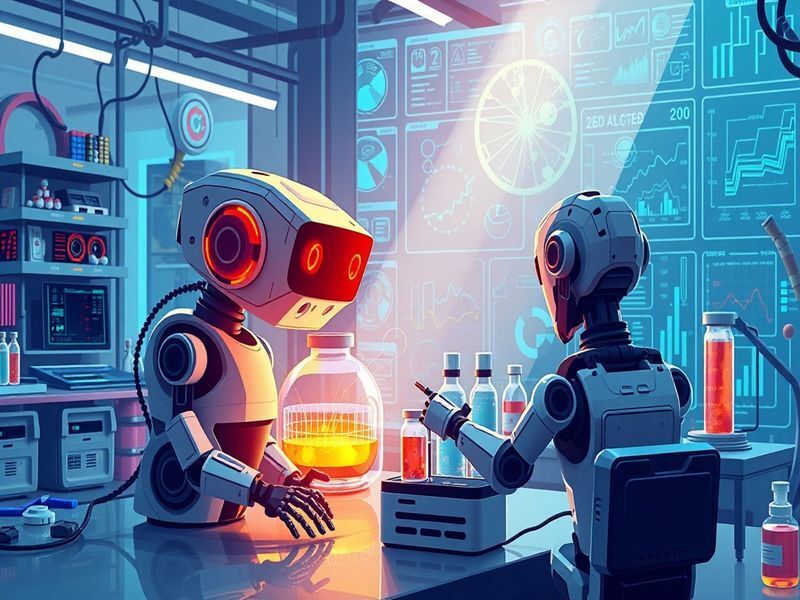
AI-Powered Autonomous Labs: A Leap in Scientific Research
The realm of scientific research is undergoing a transformative change with the advent of AI-powered autonomous labs. These innovative environments utilize advanced technologies like GPT-5 to enhance efficiency and streamline processes, making experimental science more accessible and cost-effective. This article delves into how these autonomous labs function, their implications for various industries, and the future possibilities they hold.
The Functionality of AI-Powered Autonomous Labs
At the core of AI-driven laboratories is the integration of artificial intelligence algorithms that can manage experiments, analyze data, and even draw conclusions without human intervention. GPT-5, with its sophisticated natural language processing capabilities, plays a significant role in this evolution.
- Experiment Design: AI can autonomously design experiments based on existing data and hypotheses. By analyzing previous research, GPT-5 can suggest novel approaches to experimentation.
- Data Analysis: The ability to process vast amounts of data quickly allows AI to identify patterns and insights that might elude human researchers.
- Adaptive Learning: As experiments progress, AI systems can adapt methodologies based on real-time data, making adjustments to improve outcomes.
- Automated Reporting: AI can generate comprehensive reports, summarizing findings and providing actionable insights, thus saving time for researchers.
Enhancing Efficiency and Reducing Costs
The integration of AI in scientific research does not merely enhance the quality of experiments; it also drastically reduces costs and improves efficiency. Here’s how:
- Reduced Labor Costs: By automating routine tasks, laboratories can operate with fewer personnel, freeing up scientists to focus on innovative research.
- Faster Turnaround Times: With AI handling data analysis and experiment design, researchers can achieve results in significantly less time, accelerating the pace of discovery.
- Decreased Material Waste: AI optimizes resource use, ensuring that experiments are conducted using only the necessary materials, which minimizes waste and lowers costs.
- Scalability: Autonomous labs can easily scale their operations based on demand, allowing for greater flexibility in research projects without the need for substantial additional investment.
Industry Implications
As AI-powered labs gain traction, various industries are poised to benefit significantly.
- Pharmaceuticals: The drug discovery process can be expedited through AI, leading to faster development of life-saving medications.
- Environmental Science: AI can facilitate the monitoring of ecological systems, aiding in the development of sustainable practices and solutions to combat climate change.
- Manufacturing: In materials science, AI can help develop new materials with desired properties, reducing the time spent in trial-and-error experimentation.
- Education: Autonomous labs can serve as teaching tools, allowing students to engage in hands-on experiments without the constraints of traditional lab settings.
Future Possibilities
The future of AI-powered autonomous labs is both exciting and full of potential. As technology continues to evolve, we can expect to see:
- Greater Collaboration: AI can facilitate collaboration across global laboratories, enabling researchers from different countries to work together seamlessly.
- Enhanced Personalization: AI systems could tailor experiments to individual researchers’ styles and preferences, optimizing the research process further.
- Integration with Robotics: The combination of AI and robotics could lead to fully automated laboratories, where machines conduct experiments and analyze data without human oversight.
- Ethical Considerations: As AI takes a more central role in research, discussions around ethical implications, data privacy, and the role of human oversight will become increasingly important.
In conclusion, the advent of AI-powered autonomous labs signifies a major leap in scientific research, driven by technologies like GPT-5. By enhancing efficiency and reducing costs, these labs are not only changing the way experiments are conducted but also paving the way for groundbreaking discoveries across various fields. As we move forward, the potential for innovation is limitless, promising a future where science is conducted at unprecedented speeds and with unparalleled accuracy.