

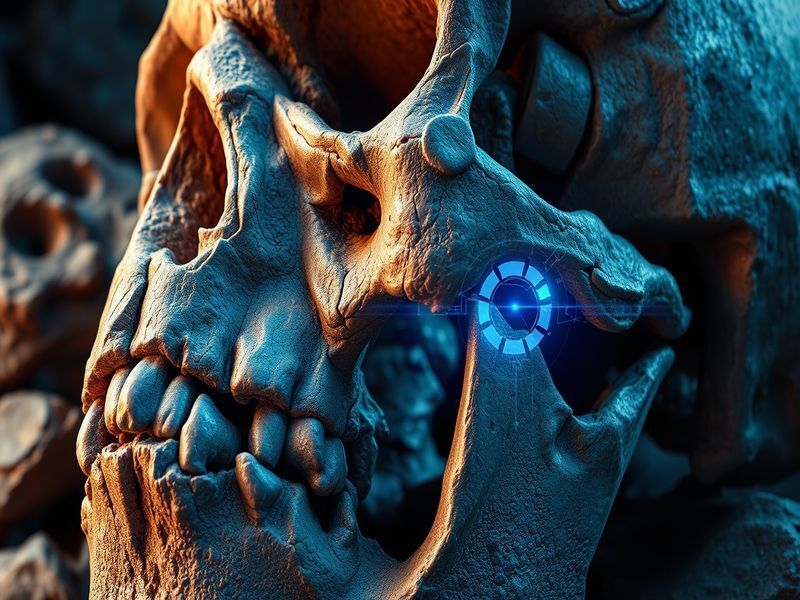
AI Solves an Ancient Murder Mystery: Uncovering Gruesome Truths about Human Ancestors
In a remarkable intersection of artificial intelligence and archaeology, researchers have recently leveraged advanced AI techniques to analyze bite marks found in ancient remains. This innovative approach not only sheds light on the violent past of our ancestors but also showcases the potential of AI to solve mysteries that have eluded scientists for centuries. This article explores the details of this groundbreaking research, the implications for various industries, and the future possibilities that AI holds in the realm of historical analysis.
The Context of the Discovery
The research focuses on a series of prehistoric human remains discovered in a cave in Europe, dating back approximately 1.5 million years. These remains bore distinctive bite marks, which researchers initially believed could provide insights into the social behaviors and lifestyles of early humans.
However, traditional methods of analysis proved insufficient in accurately determining the cause of death and the manner in which these individuals lived. This is where AI stepped in, offering a fresh perspective and powerful analytical capabilities.
How AI Analyzed Bite Marks
The researchers employed a combination of machine learning algorithms and computer vision techniques to analyze the bite marks on the remains. Here’s how the process unfolded:
- Data Collection: Researchers collected high-resolution images of the bite marks and compiled a dataset of known bite patterns from various species.
- Training the Model: A neural network was trained using this dataset to recognize and differentiate between the bite marks of different animals, including those of early humans and their predators.
- Pattern Recognition: The AI model identified similarities and differences in the bite marks, allowing researchers to ascertain which species were likely responsible for the injuries.
- Reconstruction: The insights gained from AI analysis helped reconstruct possible scenarios surrounding the individuals’ deaths, including social structure and survival strategies.
This advanced analysis led to shocking revelations about the violent interactions between early humans and their predators, suggesting that they were not just passive victims but active participants in their survival.
Practical Insights and Industry Implications
The implications of this research extend beyond mere historical curiosity. The use of AI in analyzing ancient remains can transform several fields:
- Archaeology: AI can expedite the analysis of artifacts, enabling archaeologists to unearth insights more rapidly than traditional methods allow.
- Forensic Science: Techniques developed for ancient analysis can be applied to modern forensic cases, improving accuracy in determining causes of death and identifying patterns in violent crimes.
- Biology and Anthropology: Understanding the interactions between species can lead to better insights into evolutionary processes and human development.
- AI Training and Development: The methodologies used in this research can inform new approaches to AI training, particularly in the areas of image recognition and pattern analysis.
Future Possibilities
The successful application of AI to analyze ancient bite marks opens the door to numerous possibilities:
- Broader Applications: Similar techniques could be applied to other archaeological findings, such as tools, pottery, and even ancient texts, to gain insights into the lives of our ancestors.
- Collaborative Projects: Cross-disciplinary collaborations between AI experts, archaeologists, and historians could lead to more comprehensive explorations of human history.
- Enhanced Data Analysis: As AI technology continues to evolve, its capabilities in analyzing large datasets will improve, allowing for more complex historical inquiries.
- Diverse Research Areas: AI’s potential in other fields like climate science, sociology, and even economics could revolutionize our understanding of past events and societal changes.
As we continue to integrate AI into various fields, the potential for innovative discoveries grows exponentially. By utilizing these advanced technologies, we can unlock the mysteries of our past and gain valuable insights that inform our present and future.
Conclusion
The intersection of AI and archaeology not only highlights the power of technology in solving ancient mysteries but also paves the way for future interdisciplinary collaborations. As researchers harness the capabilities of AI to analyze and interpret historical data, we stand on the brink of a new era in our understanding of human history.