
From Script to Speech: Dia’s 1.6B-Parameter Model Redefines Synthetic Voice Acting
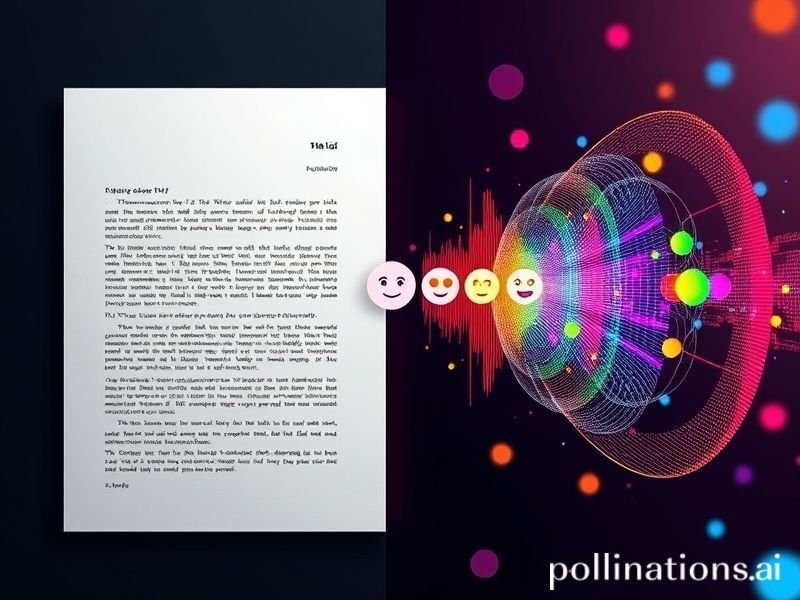
In a breakthrough that could reshape the entire audio production landscape, researchers have unveiled Dia—a 1.6-billion parameter speech synthesis model that doesn’t just read scripts, it performs them. By analyzing a simple text transcript alongside a brief emotion reference clip, Dia generates stunningly realistic dialogue complete with natural imperfections: coughs, laughs, sighs, and all the human vocal tics that make conversation feel authentic.
This isn’t your grandmother’s text-to-speech. While traditional TTS systems produce robotic, monotone outputs, Dia represents a quantum leap in emotional intelligence and vocal realism. The implications stretch far beyond mere convenience—they point to a future where AI-generated content becomes indistinguishable from human-created media.
The Technical Marvel Behind the Magic
Dia’s architecture builds upon recent advances in diffusion models and transformer architectures, but with crucial innovations that set it apart. The model processes two key inputs simultaneously: a text transcript and a short audio clip capturing the desired emotional tone. Through sophisticated pattern recognition, Dia extracts subtle vocal characteristics—pitch variations, speaking rhythm, emotional intensity—and applies them to generate entirely new speech.
Breaking Down the 1.6 Billion Parameters
The model’s massive parameter count enables unprecedented nuance in speech generation. Each parameter contributes to understanding and reproducing:
- Prosodic patterns and stress placement
- Micro-expressions in voice (subtle tremors, breathiness)
- Contextual emotional shifts within conversations
- Natural disfluencies (ums, uhs, false starts)
- Age, gender, and personality markers in voice
What makes Dia particularly remarkable is its ability to generate these “imperfections” organically. Unlike systems that randomly insert coughs or laughs, Dia understands when such vocalizations naturally occur in human speech, creating dialogue that feels genuinely conversational rather than artificially enhanced.
Industry Disruption: Who Wins and Who Worries
The entertainment and media industries are already grappling with Dia’s implications. Voice actors, audiobook narrators, and dubbing artists face legitimate concerns about job displacement. However, the technology also opens new creative possibilities:
Immediate Applications
- Video Game Development: Generate thousands of unique character voices without hiring extensive voice casts
- Podcast Production: Create host transitions or sponsor reads in the original host’s voice
- Film ADR: Seamlessly re-record dialogue while maintaining emotional authenticity
- Accessibility Tools: Provide more natural-sounding assistive communication devices
The Democratization Debate
Independent creators suddenly gain access to production-quality voice acting without Hollywood budgets. A solo developer can now populate their game with diverse, emotionally rich character voices. Small podcast networks can maintain consistent hosting during illness or vacation. This democratization, however, comes with thorny questions about consent and voice ownership.
Practical Implementation: Getting Started with Dia
For developers and creators eager to experiment with Dia, the model offers several integration pathways. Early adopters report that the key to achieving optimal results lies in carefully curating emotion reference clips. A 10-15 second sample capturing the desired emotional state—whether excitement, melancholy, or casual conversation—provides sufficient context for Dia to generate minutes of consistent, emotionally-aligned dialogue.
Best practices emerging from the beta community include:
- Using high-quality reference audio without background noise
- Matching the reference emotion intensity to your script’s requirements
- Experimenting with multiple reference clips for complex emotional arcs
- Post-processing generated audio with subtle EQ to match production standards
The Ethical Tightrope
As with any technology that can convincingly replicate human characteristics, Dia presents significant ethical challenges. The ability to generate someone’s voice from a brief sample raises immediate concerns about deepfakes and audio forgery. Industry leaders are already calling for robust authentication systems and watermarking technologies to verify authentic human speech.
The voice acting community’s response has been mixed. While some see existential threats, others view Dia as a tool for scaling their work—imagine licensing your voice for use in multiple projects simultaneously. Labor unions are pushing for frameworks that ensure performers maintain control over their vocal likenesses and receive appropriate compensation for AI-generated content using their voices.
Future Horizons: Where Dia Leads Us
Looking ahead, Dia’s underlying technology points toward even more sophisticated applications. Researchers are already experimenting with:
Multilingual Emotional Transfer
Early prototypes suggest Dia could maintain emotional authenticity across language translations, potentially revolutionizing international content distribution. An actor’s performance could be emotionally preserved even as the language changes.
Real-Time Processing
Current implementations require significant processing time, but optimization efforts point toward real-time applications. Imagine video calls where language barriers disappear while emotional nuance remains intact, or live events with AI-powered translation that preserves the speaker’s passion and emphasis.
Personalized Voice Assistants
As the technology miniaturizes, personalized voice assistants that truly understand and replicate your communication style become feasible. Your digital assistant could speak with your cadence, humor, and emotional intelligence.
The Road Ahead
Dia represents more than just another AI milestone—it’s a glimpse into a future where the boundaries between human and synthetic media blur beyond recognition. For content creators, it offers powerful new tools for expression. For society, it demands new frameworks for authenticity, consent, and creative rights.
As we stand at this crossroads, one thing remains clear: the age of robotic, emotionless AI speech is ending. In its place emerges a new era where artificial voices don’t just speak—they perform, emote, and connect with human-like authenticity. The question isn’t whether this technology will transform media production, but how quickly we’ll adapt to a world where every script can spring to life with coughs, laughs, and all the beautiful imperfections that make speech human.