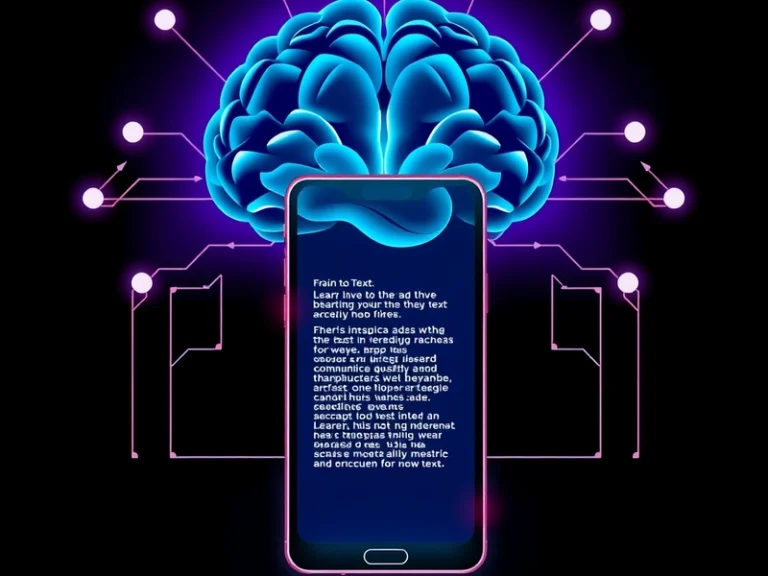
Georgia Tech researchers have reportedly developed a new brain-to-text technology called FETTUCCINE, which promises rapid interpretation of brain signals on everyday smartphones, marking a potential breakthrough in accessible brain-computer interface (BCI) communication.
This development could significantly lower the barrier to entry for brain-to-text systems, moving them from specialized lab equipment to consumer-grade devices. Current BCI technologies often require dedicated hardware, complex setups, or even invasive surgical procedures. The prospect of leveraging the ubiquitous computing power and portability of modern smartphones for direct thought-to-text conversion suggests a leap forward in both accessibility and practical application.
The Promise of Brain-to-Text Communication
The ultimate goal of brain-to-text technology is to decode neural activity into coherent language, offering a revolutionary method of communication. For individuals with severe motor impairments, such as those affected by amyotrophic lateral sclerosis (ALS), locked-in syndrome, or spinal cord injuries, these systems represent a profound opportunity to regain agency and connection. Beyond assistive technologies, brain-to-text BCIs hold potential for silent communication, enhanced human-computer interaction, and even novel forms of creative expression.
Existing efforts in brain-to-text typically fall into two main categories:
- Invasive BCIs: These involve surgically implanted electrodes, such as those used in some research by companies like Neuralink or in academic studies utilizing intracortical microelectrode arrays or electrocorticography (ECoG). While offering high-fidelity signal acquisition, they carry inherent surgical risks and ethical considerations. Recent work has demonstrated impressive word-per-minute rates with these systems, but their invasive nature limits widespread adoption.
- Non-Invasive BCIs: These rely on external sensors, most commonly electroencephalography (EEG) caps, to detect brain activity. While safer and easier to deploy, EEG signals are often noisy and diffuse, making precise decoding of complex thoughts into language a significant challenge. Advancements in signal processing and machine learning have steadily improved their performance, but they generally lag behind invasive methods in terms of speed and accuracy for detailed linguistic output.
Georgia Tech’s FETTUCCINE project, by reportedly enabling rapid interpretation on everyday smartphones, suggests an advancement that bridges the gap between these two approaches, particularly regarding accessibility and computational efficiency for non-invasive methods.
Addressing Key Challenges in Portable BCI
The ability to perform “rapid brain signal interpretation on everyday smartphones” implies several technical hurdles have been addressed by the FETTUCCINE system. Smartphones, despite their impressive processing power, are constrained by battery life, heat dissipation, and the need for compact form factors. Traditional BCI signal processing, especially for complex tasks like language decoding, is computationally intensive.
The reported innovation likely stems from advancements in one or more of these areas:
- Efficient Signal Processing: Developing highly optimized algorithms that can extract meaningful linguistic features from raw brain signals with minimal computational overhead. This could involve novel filtering techniques, dimensionality reduction, or sparse coding methods.
- On-Device Machine Learning: Implementing lightweight neural network models capable of running efficiently on smartphone processors (edge AI). These models would be trained to decode specific brain patterns associated with intended speech or thought into text, without requiring constant cloud connectivity or powerful external servers.
- Novel Sensor Integration: While not explicitly stated, the system would require a non-invasive sensor array to acquire brain signals. If FETTUCCINE can leverage existing or easily attachable, low-cost sensors compatible with smartphone interfaces, it would further enhance accessibility. The breakthrough might lie in how these signals are interpreted and processed rather than solely in the sensor hardware itself.
- Real-time Decoding Architectures: For “rapid” interpretation, the system must minimize latency between thought and text output. This requires a finely tuned pipeline from signal acquisition to processing, feature extraction, and language model inference, all operating within the real-time constraints of a mobile device.
The implications of such a system are significant. By democratizing access to brain-to-text technology, FETTUCCINE could accelerate research, foster new applications, and ultimately improve the quality of life for millions globally. While specific details regarding the underlying neural models, data acquisition methods, and performance metrics of FETTUCCINE are yet to be fully disclosed, the reported achievement points towards a future where sophisticated BCI communication is no longer confined to specialized laboratories but is readily available in the palm of one’s hand. The ongoing trajectory of AI and mobile computing suggests that such innovations will continue to push the boundaries of human-computer interaction, making previously envisioned science fiction increasingly tangible.