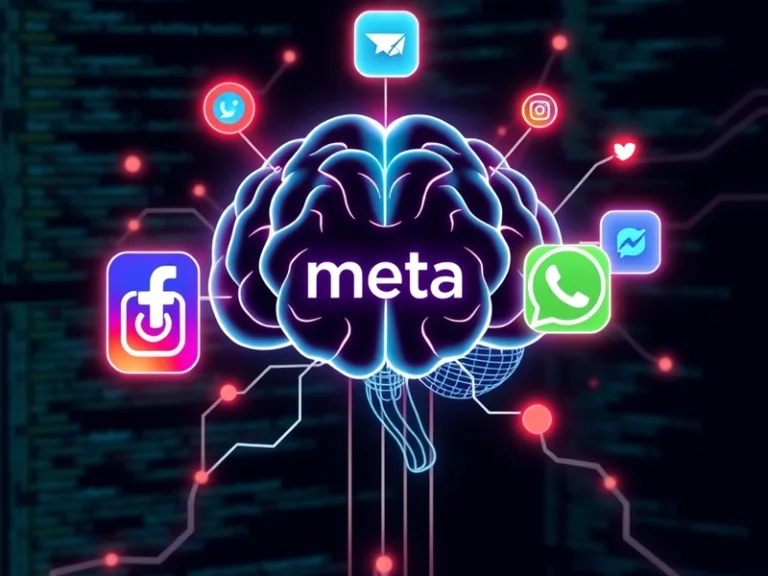
The competitive landscape of artificial intelligence is experiencing a significant shift, with Meta’s strategic advancements in AI agent development, spearheaded by its powerful Llama models and widespread integration of the Meta AI assistant, rapidly reshaping the market and presenting a formidable challenge to established platforms like OpenAI’s ChatGPT. Meta’s aggressive push into generative AI, characterized by its open-source philosophy and deep product integration, marks a pivotal moment in the race for AI supremacy.
Meta’s Foundational Models: The Llama Advantage
At the core of Meta’s AI strategy is its family of large language models, Llama. Unlike many competitors that keep their most advanced models proprietary, Meta has adopted a largely open-source approach with Llama 2 and Llama 3. This strategy has several profound implications:
- Democratization of AI: By making Llama models freely available for research and commercial use (under certain conditions), Meta has fostered a vibrant ecosystem of developers, startups, and researchers. This accelerates innovation, allows for rapid iteration, and expands the reach of Meta’s technology far beyond its own products.
- Community-Driven Improvement: The open-source community contributes to identifying bugs, suggesting improvements, and developing specialized applications, effectively creating a distributed R&D network for Meta’s foundational models.
- Competitive Pressure: The availability of high-performing open-source models like Llama 3, which consistently ranks among the top models on various benchmarks, puts pressure on developers to consider alternatives to closed-source APIs from companies like OpenAI and Google. This competition can drive down costs and foster more diverse applications.
Llama 3, released in April 2024, notably includes models with 8 billion and 70 billion parameters, with larger versions (over 400 billion parameters) still in training. These models have demonstrated strong performance across a range of tasks, often matching or exceeding the capabilities of similarly sized proprietary models, making them a compelling choice for developers building their own AI agents and applications.
The Rise of the Meta AI Assistant
Beyond foundational models, Meta has directly entered the AI agent arena with its “Meta AI” assistant. Powered by the latest Llama models, this assistant is not a standalone product but is deeply integrated across Meta’s vast ecosystem:
- Massive Reach: Meta AI is accessible directly within Facebook, Instagram, WhatsApp, and Messenger. This immediate availability to billions of users globally provides an unparalleled distribution channel, allowing Meta to rapidly onboard users to its AI agent experience without requiring them to download new apps or visit separate websites.
- Contextual Integration: The assistant can perform various tasks directly within conversations and feeds, from answering questions and generating images (powered by Meta’s Emu model) to assisting with content creation and providing recommendations. For instance, users can ask Meta AI for restaurant suggestions in a WhatsApp group chat or generate creative captions for Instagram posts.
- Real-time Information: Meta AI integrates with search engines like Google and Bing to provide real-time information, addressing a common limitation of many LLMs trained on historical data.
This strategy of embedding AI directly into existing, widely used social platforms differs significantly from OpenAI’s initial approach with ChatGPT, which started as a web-based chat interface. Meta’s approach leverages its core strength: its massive global user base and deeply integrated product suite.
Implications for the AI Landscape
Meta’s aggressive AI strategy has several key implications for the broader AI landscape:
Increased Competition and Innovation: The robust performance of Llama models and the pervasive integration of Meta AI intensify competition among major AI developers. This pressure encourages faster innovation, better model performance, and more diverse application development across the industry.
Shifting Business Models: Meta’s open-source Llama models challenge the prevailing closed-source API model. While OpenAI and Google offer powerful proprietary APIs, Meta provides a viable, high-quality alternative that developers can host and fine-tune themselves, potentially leading to lower operational costs and greater control for businesses.
Accessibility and Democratization: By making advanced AI widely available, Meta is accelerating the democratization of AI technology. This can lead to a broader range of applications, including those developed by smaller entities or in regions with fewer resources, fostering a more inclusive AI future.
Ethical and Safety Considerations: The open-source nature of Llama models also brings increased scrutiny and community involvement in addressing ethical concerns, bias, and safety. While Meta invests heavily in responsible AI development, the distributed nature of open-source deployment means that the community plays a crucial role in shaping the ethical use of these powerful tools.
Meta’s concerted efforts in developing powerful foundational models and integrating sophisticated AI agents across its platforms mark it as a formidable force in the AI ecosystem. Its strategic choices are not only enhancing its own product offerings but are also significantly influencing the direction and accessibility of AI development worldwide.