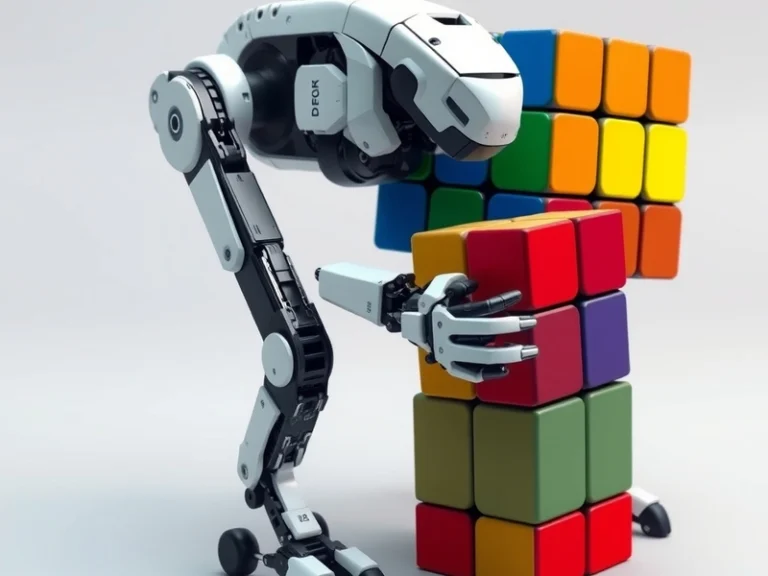
The prospect of robot dogs solving a Rubik’s Cube using their ingenious feet, a task traditionally reserved for human hands or specialized robotic grippers, underscores a significant evolution in robotic control and embodied artificial intelligence. This hypothetical yet technically plausible feat highlights a future where multi-functional robots adapt existing hardware for complex manipulation, pushing the boundaries of what autonomous systems can achieve in unstructured environments.
The Core Challenge: Manipulation Without Hands
Robot dogs, such as Boston Dynamics’ Spot or Unitree’s Go1 and B1 models, are engineered primarily for robust locomotion, navigation, and inspection. Their legs and “feet” (often simple pads or compliant end-effectors) are designed for stability, traction, and shock absorption across varied terrain. Leveraging these same appendages for the intricate, precise movements required to manipulate a Rubik’s Cube presents a formidable challenge, far exceeding tasks like opening a door or carrying a light load with an attached arm.
The difficulties stem from several factors:
- Lack of Dedicated Grippers: Traditional robotic manipulation relies on multi-fingered grippers or suction cups designed for grasping. A robot dog’s foot lacks these features, requiring creative approaches to hold, rotate, and reposition the cube.
- High Degrees of Freedom, Low Precision: While a robot dog’s legs offer numerous degrees of freedom for agile movement, translating this into fine-grained, controlled manipulation of a small object like a Rubik’s Cube demands extreme precision in joint control and force application.
- Maintaining Stability: Any manipulation task requires the robot to maintain its balance. For a quadruped, lifting one or more feet for manipulation inherently reduces its stability, demanding sophisticated balance control algorithms to prevent tipping.
- Perception and State Estimation: Accurately identifying the cube’s orientation and the color configuration of each face, then tracking these states throughout the manipulation, requires advanced computer vision and robust state estimation.
Ingenious Footwork: How it Could Be Done
Overcoming these challenges would likely involve a synergistic blend of advanced AI, sophisticated control algorithms, and clever exploitation of existing robot kinematics.
Perception and Planning
The initial steps would involve:
- Cube Recognition: Using onboard cameras (e.g., RGB-D sensors) and computer vision algorithms, the robot would first identify the Rubik’s Cube, determine its position and orientation in space, and precisely map the colors on all visible faces.
- State Representation: The visual data would be translated into a symbolic representation of the cube’s current state, a digital model understood by a solving algorithm.
- Solving Algorithm: Standard Rubik’s Cube solving algorithms, such as Kociemba’s algorithm, could then compute the optimal sequence of rotations to reach the solved state. The challenge is not in the puzzle’s logic, but in executing the physical moves.
Reinforcement Learning for Dexterous Control
The most promising approach for teaching a robot dog to manipulate a Rubik’s Cube with its feet would likely be Reinforcement Learning (RL). Traditional inverse kinematics might struggle with the highly non-linear and constrained dynamics of using a foot for manipulation. RL, however, allows a robot to learn complex motor policies through trial and error in simulated or real-world environments.
An RL agent would be trained to:
- Grasp and Hold: Learn how to use combinations of feet and body posture to secure the cube without applying too much force or dropping it. This might involve pinning the cube against the ground or the robot’s own body, or using multiple feet in a coordinated “pincer” movement.
- Rotate Faces: Develop policies for applying precise pushes, nudges, or frictional movements with a foot to rotate a specific face of the cube. This would require exceptional force control and understanding of contact dynamics.
- Reposition the Cube: Learn how to reorient the entire cube to access different faces, perhaps by carefully rolling it or lifting and placing it.
- Maintain Balance: Simultaneously integrate balance control into every action, ensuring the robot remains stable throughout the entire solving process.
Simulations, potentially coupled with techniques like domain randomization, would be critical for training these complex skills before deployment on physical hardware, accelerating the learning process and mitigating wear and tear on the robot.
Implications for Embodied AI
An achievement like a robot dog solving a Rubik’s Cube with its feet would be more than just a novelty; it would represent a significant milestone in several areas:
* Redefining Dexterity: It would demonstrate that highly dexterous manipulation is not solely dependent on human-like hands, but can emerge from novel combinations of existing robot morphology and advanced AI.
* Multi-functional Robotics: This would pave the way for robots that can perform a wider array of tasks without needing to carry specialized tools or bulky end-effectors, enhancing their utility in dynamic and unpredictable environments.
* Advances in Embodied Learning: The successful application of RL to such a complex, non-traditional manipulation task would further validate the power of data-driven approaches for acquiring general-purpose physical skills in robots.
* Resilience and Adaptability: A robot capable of such a feat would inherently possess a high degree of adaptability, able to repurpose its limbs for tasks beyond their original design, crucial for real-world deployment in disaster response, exploration, or logistics.
The path to such granular control over non-traditional manipulators is challenging, but the ongoing progress in reinforcement learning, robust robotics platforms, and sensor fusion suggests that tasks once considered the exclusive domain of human-like dexterity are increasingly within the reach of intelligent machines. The “ingenious feet” of robot dogs may well be just the beginning of a new era in robotic versatility.