

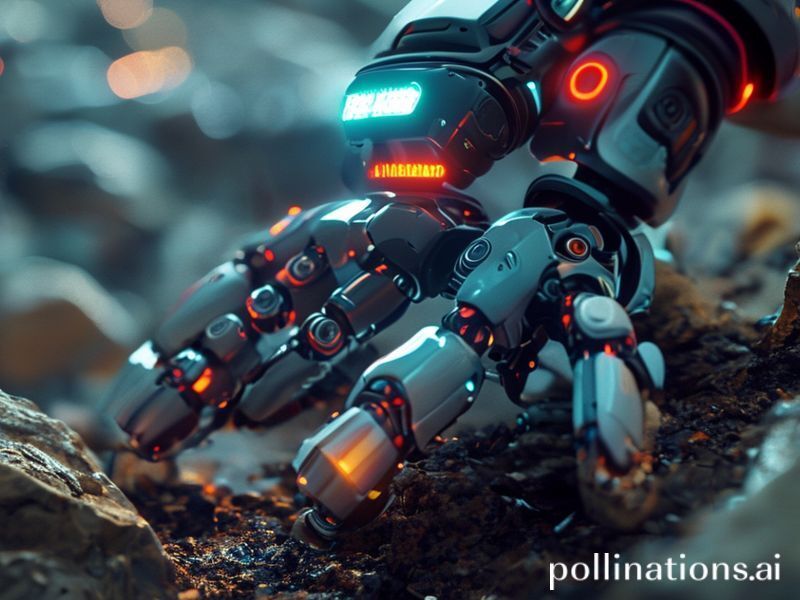
# Robot Hands That Crawl Without Arms: Innovations in Robotics with Detachable, Crawling Hands
In the rapidly evolving world of robotics, one of the most groundbreaking innovations is the development of detachable, crawling hands. These robotic hands, designed to operate independently of traditional robotic arms, are revolutionizing the way we think about automation, artificial intelligence, and machine learning. This article delves into the fascinating world of these innovative robotic hands, exploring their technology, practical applications, industry implications, and future possibilities.
## The Technology Behind Detachable, Crawling Hands
### AI and Machine Learning Integration
The development of detachable, crawling hands is heavily reliant on advancements in artificial intelligence and machine learning. These hands are equipped with sophisticated sensors and actuators that enable them to navigate complex environments and perform intricate tasks. Machine learning algorithms allow these hands to learn from their experiences, improving their performance over time.
### Modular Design and Detachable Features
One of the key features of these robotic hands is their modular design. Unlike traditional robotic arms, which are fixed to a base, these hands can detach and crawl independently. This modularity allows them to adapt to various environments and tasks, making them incredibly versatile.
### Crawling Mechanisms
The crawling mechanism of these hands is another area of innovation. They use a combination of grippers, wheels, and tracks to move across surfaces. Some models even mimic the movement of insects, using legs to crawl and navigate obstacles. This versatility makes them suitable for a wide range of applications, from industrial automation to search and rescue missions.
## Practical Applications
### Industrial Automation
In the industrial sector, detachable, crawling hands are being used to automate tasks that were previously too complex or dangerous for traditional robotic arms. For example, they can be used to inspect and maintain machinery in hazardous environments, reducing the risk to human workers.
### Search and Rescue Missions
The ability of these hands to navigate complex and dangerous environments makes them ideal for search and rescue missions. They can crawl through rubble, climb over obstacles, and even operate in confined spaces, providing valuable assistance in disaster scenarios.
### Medical Applications
In the medical field, detachable, crawling hands are being explored for their potential in minimally invasive surgeries. Their ability to navigate the human body with precision and dexterity could revolutionize surgical procedures, making them safer and more effective.
## Industry Implications
### Cost Efficiency
The use of detachable, crawling hands can lead to significant cost savings for industries. By automating tasks that were previously performed by human workers, companies can reduce labor costs and improve efficiency. Additionally, the modular design of these hands means that they can be easily repaired and maintained, further reducing costs.
### Enhanced Safety
The ability of these hands to operate in hazardous environments reduces the risk to human workers. This not only improves safety but also allows companies to comply with increasingly stringent safety regulations.
### Increased Productivity
The versatility and adaptability of detachable, crawling hands mean that they can perform a wide range of tasks quickly and efficiently. This increased productivity can lead to significant competitive advantages for companies that adopt this technology.
## Future Possibilities
### Space Exploration
One of the most exciting potential applications of detachable, crawling hands is in space exploration. Their ability to navigate complex and unpredictable environments makes them ideal for exploring distant planets and moons. They could be used to collect samples, conduct experiments, and even repair spacecraft.
### Underwater Exploration
Similarly, detachable, crawling hands could be used for underwater exploration. Their ability to navigate through water and operate in high-pressure environments makes them ideal for exploring the depths of the ocean, where human divers cannot go.
### Everyday Assistive Devices
In the future, detachable, crawling hands could become commonplace in our daily lives. They could be used as assistive devices for people with disabilities, helping them to perform tasks that would otherwise be difficult or impossible. They could also be used in smart homes, performing tasks such as cleaning, cooking, and maintenance.
## Conclusion
The development of detachable, crawling hands represents a significant leap forward in the field of robotics. Their versatility, adaptability, and intelligence make them suitable for a wide range of applications, from industrial automation to space exploration. As the technology continues to evolve, we can expect to see even more innovative uses for these remarkable devices.
—