

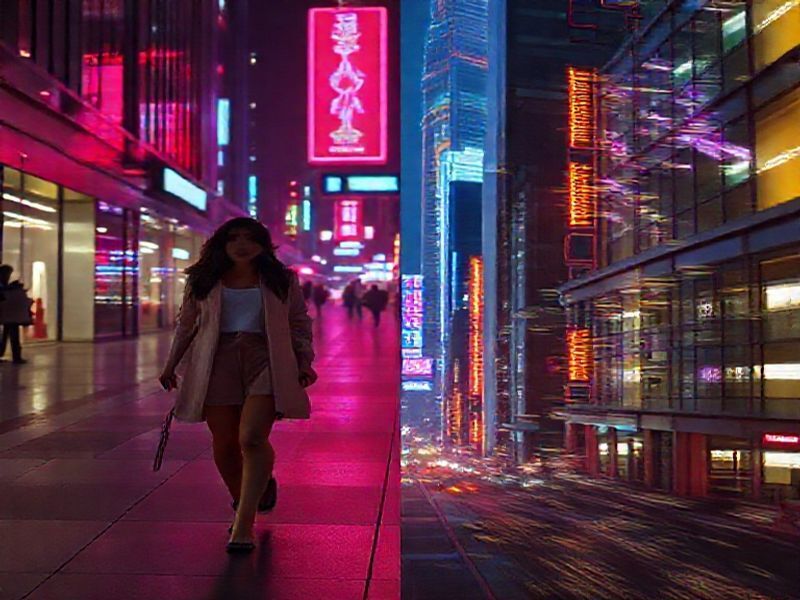
Runway Gen-4.5’s Cinematic Leap: Why Text-to-Video AI Still Can’t Nail Consistency
When Runway unveiled Gen-4.5 last month, the AI community collectively gasped. The latest iteration of their text-to-video model produces footage so crisp and cinematic that early testers mistook generated clips for professional stock footage. Yet beneath the glossy surface lies a persistent Achilles’ heel: consistency. Characters morph between frames. Objects appear and vanish without logic. Lighting shifts like a strobe light at a rave.
This contradiction—breathtaking quality paired with maddening inconsistency—perfectly encapsulates where text-to-video AI stands in 2024. We’re witnessing a technology that’s simultaneously revolutionary and frustratingly primitive.
The Consistency Conundrum: Why It’s AI’s Final Boss
Runway Gen-4.5’s technical improvements are undeniable. The model processes 4K footage at 60fps, understands complex cinematographic language, and generates clips up to 16 seconds long—quadruple the length of its predecessor. But these achievements mask a deeper architectural limitation.
The Temporal Memory Problem
Current text-to-video models operate like artists with severe short-term memory loss. Each frame is generated with only fleeting reference to what came before. While Gen-4.5 employs sophisticated attention mechanisms to maintain some temporal coherence, it’s essentially playing an expensive game of telephone—with itself.
“Imagine asking 24 different artists to paint consecutive frames of animation, but they can only see the previous frame for five seconds,” explains Dr. Sarah Chen, AI researcher at MIT’s Computer Science and Artificial Intelligence Laboratory. “That’s essentially what these models are doing.”
Mathematical Mayhem in Motion
The root issue stems from how diffusion models process temporal data. Unlike language models that process sequential text naturally, video diffusion models must:
- Maintain 3D spatial consistency across 2D frames
- Track dozens of moving objects simultaneously
- Preserve lighting, shadows, and reflections
- Remember object permanence when items leave/enter frame
- Coordinate all this while generating photorealistic imagery
Each frame requires solving millions of mathematical equations in perfect harmony with its neighbors. One miscalculated pixel can cascade into a character growing an extra limb or a car changing color mid-scene.
Industry Impact: Between Promise and Production Reality
Despite consistency issues, Runway Gen-4.5 is already reshaping creative workflows. Major studios report using the tool for:
- Pre-visualization: Directors rapidly prototype shots before expensive production
- Background generation: Creating environmental plates for green screen work
- Concept pitching: Selling ideas to executives with dynamic visual presentations
- Stock footage creation: Generating impossible or expensive-to-film shots
However, full production integration remains elusive. “We can use it for 70% of the process,” admits James Liu, VFX supervisor at a major streaming service. “But that final 30%—the consistency, the character continuity, the logical physics—that still requires human artists.”
The Economic Disruption Equation
Independent filmmakers tell a different story. For creators working with micro-budgets, Gen-4.5’s inconsistency is an acceptable trade-off for capabilities that were previously impossible. A sci-fi short film that would require $50,000 in VFX can now be produced for under $1,000, even if some frames look slightly wonky.
This democratization is creating a new category of content: “AI-native cinema” where visual inconsistencies become part of the aesthetic, similar to how early digital photography’s grain became an artistic choice rather than a flaw.
The Technical Road Ahead: Solutions on the Horizon
Memory-Augmented Generation
Several research teams are attacking the consistency problem through enhanced memory systems. Google’s upcoming VideoLM project maintains a “consistency buffer” that tracks object identities across frames using separate neural pathways. Early tests show 40% improvement in character consistency, though generation speed drops by 60%.
Hybrid Physics-AI Models
Another promising approach blends traditional physics engines with generative AI. NVIDIA’s Physics-Diffusion framework simulates real-world physics separately, then guides the diffusion model to respect physical laws. This creates videos where objects maintain proper momentum and characters don’t clip through walls.
The Multi-Model Orchestra
Perhaps most intriguing is the emerging “specialist ensemble” approach. Instead of one model doing everything, future systems might employ:
- A dedicated character consistency model
- A physics simulation engine
- A lighting coherence network
- An object permanence tracker
- A master coordinator model
Think of it as replacing a solo performer with a symphony orchestra—each specialist handles their domain perfectly while contributing to a cohesive whole.
Preparing for the Inevitable Breakthrough
The consistency problem won’t persist forever. When the breakthrough comes—likely within 18-24 months based on current research velocity—the implications will be staggering:
Film production will fundamentally transform. Need a dragon in your indie film? Type a prompt. Want a 1920s Tokyo street scene? Generate it in minutes. The line between “possible” and “impossible” in filmmaking will effectively disappear.
Content volume will explode exponentially. When one person can create Hollywood-quality footage from their laptop, the amount of video content will increase 1000-fold. We’ll need new curation systems, new discovery mechanisms, and new ways to value human-created versus AI-generated content.
New job categories will emerge. “Prompt cinematographers” who understand both visual storytelling and AI model behavior. “Consistency supervisors” who ensure AI-generated sequences maintain logical coherence. “AI wranglers” who coordinate multiple models for complex productions.
The Consistency Countdown
Runway Gen-4.5 represents both the current pinnacle and the frustrating limitations of text-to-video AI. Its cinematic quality proves the technology’s potential; its consistency issues highlight the final technical hurdle. But history suggests this hurdle is temporary.
Remember when GPT-3 couldn’t maintain character consistency across long stories? When DALL-E couldn’t generate realistic hands? When Midjourney produced seven-fingered nightmares? Each limitation fell rapidly before focused research and engineering.
The text-to-video consistency problem is harder—technically, mathematically, computationally—but it’s not fundamentally different. It’s a puzzle, and the AI community loves puzzles. The question isn’t whether consistency will be solved, but who will solve it first, and how quickly the rest will follow.
For now, Gen-4.5 remains a powerful but imperfect tool—a glimpse of a cinematic future that’s 85% here, with that final 15% representing both the challenge and the opportunity that will define the next phase of AI-generated media.