
The Rise of ‘Vibe Working’: How AI is Redefining Office Culture Beyond Coding
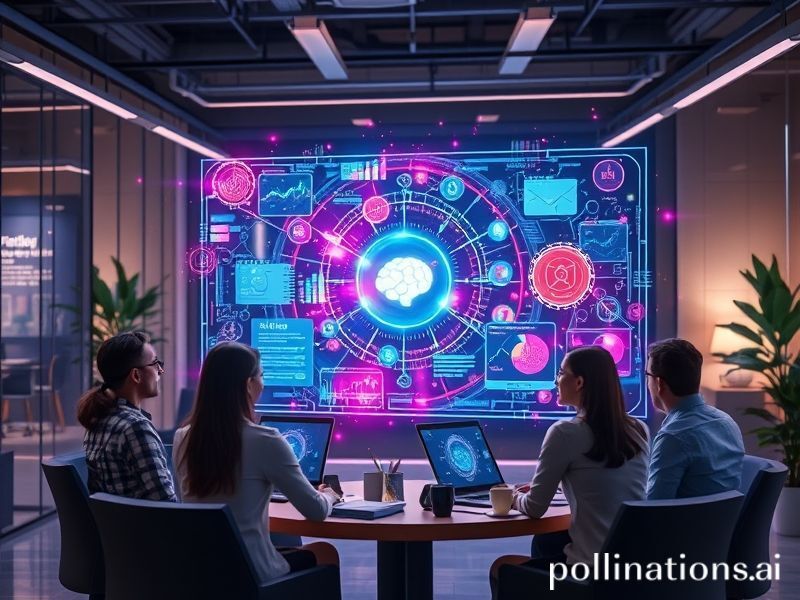
Something unprecedented is unfolding in workplaces worldwide. Teams are gathering around virtual whiteboards, speaking naturally about their ideas, and watching as AI transforms their casual conversations into actionable project plans, prototypes, and presentations—all in real-time. Welcome to the era of “vibe working,” where artificial intelligence is dissolving the traditional boundaries between brainstorming and execution, and fundamentally reshaping how we collaborate.
This isn’t just another productivity trend. It’s a paradigm shift that’s moving AI from the realm of specialized technical teams into the daily workflow of marketing departments, HR divisions, and executive boards. As AI tools become more intuitive and conversational, organizations are discovering that the technology’s greatest impact may not be in replacing human workers, but in amplifying human creativity and enabling a new form of freestyle collaboration.
What Exactly Is Vibe Working?
Vibe working represents a fundamental departure from traditional project management and collaboration methods. Instead of rigid frameworks and predetermined workflows, teams engage in fluid, conversational sessions where AI acts as both facilitator and executor. Participants share ideas, build on each other’s thoughts, and watch as AI transforms their collective vision into tangible outputs—all without switching between multiple applications or waiting for specialized technical resources.
The Core Components of Vibe Working
This new approach relies on several key elements that distinguish it from conventional collaboration:
- Natural language interfaces that allow anyone to interact with AI tools without technical expertise
- Real-time content generation spanning documents, presentations, code, designs, and data analysis
- Contextual understanding that maintains conversation history and project continuity across sessions
- Multi-modal capabilities enabling seamless transitions between text, voice, images, and interactive elements
- Adaptive workflow creation that adjusts to team dynamics and project needs on the fly
How AI Enables This Transformation
The technological foundations enabling vibe working have evolved rapidly over the past two years. Large language models now possess the contextual understanding necessary to follow complex, multi-part conversations while maintaining coherence across extended sessions. Meanwhile, advances in multimodal AI allow these systems to process and generate not just text, but images, code, data visualizations, and interactive prototypes.
Perhaps most significantly, AI systems have developed the ability to understand organizational context—recognizing company terminology, project histories, and team dynamics. This contextual awareness allows them to serve as knowledgeable participants rather than mere tools, contributing relevant insights and suggestions that feel natural and valuable to human collaborators.
From Coding Assistants to Creative Partners
Initially, AI tools like GitHub Copilot and ChatGPT found their strongest adoption among developers and technical teams. These early use cases focused on code generation, debugging, and technical documentation. However, as the technology matured and interfaces became more intuitive, non-technical professionals began experimenting with AI for their own workflows.
Marketing teams discovered they could brainstorm campaign concepts with AI, receiving instant mockups, copy variations, and audience analysis. Product managers found they could describe features in plain language and receive user stories, technical specifications, and even working prototypes. HR departments began using AI to design onboarding experiences, craft policy documents, and analyze employee feedback patterns.
Industry Implications and Early Adopters
Forward-thinking companies across industries are already reaping the benefits of vibe working. Design agencies report 40-60% reductions in project timelines as AI handles the transition from concept to initial deliverable. Consulting firms find that junior staff can now contribute meaningfully to complex client engagements, with AI providing real-time research and analysis support.
Sector-Specific Transformations
Different industries are experiencing unique applications of vibe working:
- Creative Industries: Advertising agencies use AI to generate campaign concepts, mood boards, and initial creative assets during client meetings, allowing for immediate feedback and iteration.
- Financial Services: Investment firms conduct vibe working sessions where analysts discuss market trends while AI generates real-time data visualizations, risk assessments, and investment scenarios.
- Healthcare: Medical teams collaborate with AI to review patient cases, generate treatment options, and create educational materials for patients and families.
- Education: Curriculum teams design courses by conversing with AI about learning objectives, receiving instant lesson plans, assessment rubrics, and interactive content suggestions.
Practical Insights for Implementation
Organizations looking to adopt vibe working should consider several practical factors. The transition requires more than simply purchasing AI tools—it demands a cultural shift toward more open, experimental collaboration styles. Teams need psychological safety to share half-formed ideas, knowing that AI will help refine and develop them rather than judge their initial quality.
Successful implementations typically start with pilot programs in specific departments, allowing teams to develop their own vibe working styles before scaling organization-wide. Companies report that mixing technical and non-technical team members in these sessions often produces the most innovative results, as diverse perspectives combine with AI capabilities in unexpected ways.
Overcoming Common Challenges
Despite its promise, vibe working presents several challenges that organizations must address:
- Information overload: Teams must develop skills for managing the rapid flow of AI-generated content and ideas
- Quality control: Establishing review processes for AI-generated outputs without stifling creativity
- Skill development: Training employees to effectively prompt and guide AI systems during collaborative sessions
- Intellectual property concerns: Clarifying ownership and attribution for AI-generated content and ideas
- Technology integration: Ensuring AI tools work seamlessly with existing enterprise systems and workflows
Future Possibilities and Implications
As AI capabilities continue advancing, the potential for vibe working expands dramatically. Emerging developments in virtual and augmented reality promise to create immersive collaboration spaces where remote teams can gather around AI-generated 3D models and interactive environments. Voice synthesis and real-time translation will enable global teams to vibe work across language barriers, with AI facilitating natural conversation while preserving cultural nuances.
Perhaps most intriguingly, AI systems may soon develop the ability to participate as full team members, contributing their own creative insights based on vast knowledge bases and pattern recognition capabilities. This could lead to human-AI hybrid teams where artificial intelligence isn’t just a tool but a genuine creative partner, offering perspectives that complement human thinking in novel ways.
The Long-term Vision
Looking further ahead, vibe working could fundamentally reshape organizational structures. As AI handles more of the translation between idea and execution, traditional hierarchies based on technical expertise may give way to flatter organizations where creative vision and strategic thinking become the primary valuable skills. Companies might reorganize around “vibe centers”—flexible teams that form spontaneously around ideas and dissolve once projects reach fruition.
The implications extend beyond individual organizations to entire industries. As vibe working democratizes innovation and accelerates iteration cycles, competitive advantages may shift from technical capabilities to the ability to foster creative collaboration and maintain organizational agility in rapidly changing markets.
Embracing the Vibe Working Revolution
The rise of vibe working represents more than just another workplace trend—it’s a fundamental reimagining of how humans and artificial intelligence can collaborate creatively. By dissolving the barriers between conception and execution, this approach promises to unlock unprecedented levels of organizational creativity and agility.
Companies that successfully adopt vibe working will likely find themselves better positioned to navigate an increasingly complex and fast-changing business landscape. Those that resist may discover that their traditional processes and hierarchies become competitive disadvantages in a world where ideas can flow freely from imagination to implementation.
As we stand at this inflection point, the question isn’t whether AI will transform workplace collaboration—it’s whether organizations will proactively shape this transformation or find themselves swept along by its currents. The future belongs to those who can master the art of vibing with artificial intelligence, turning the dance between human creativity and machine capability into their greatest competitive advantage.