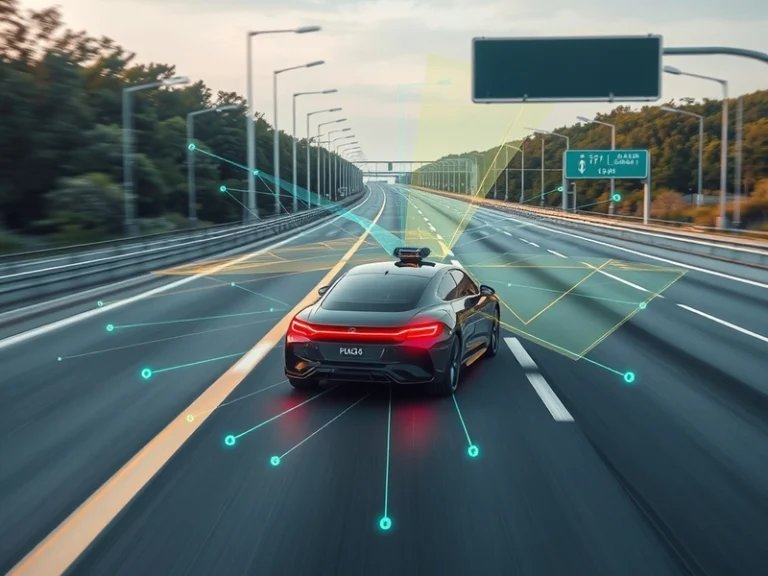
While a specific model named ‘GPT-6 Astra’ has not been publicly announced, the concept it evokes – an exceptionally advanced AI system underpinning autonomous driving – serves as a crucial lens through which to examine the current capabilities and future trajectory of artificial intelligence in real-world automotive applications and their inherent safety considerations.
The journey towards fully autonomous vehicles (AVs) is fundamentally an AI challenge, demanding robust perception, predictive modeling, and sophisticated decision-making in highly dynamic environments. Modern autonomous driving stacks already leverage various AI paradigms, ranging from deep learning for perception to reinforcement learning for planning. The aspiration for systems like a hypothetical ‘GPT-6 Astra’ lies in pushing these capabilities further, potentially integrating more generalized reasoning and a deeper understanding of human behavior and complex social contexts into the driving process.
The Current AI Landscape in Autonomous Driving
Today’s leading autonomous driving systems, developed by companies like Waymo, Cruise, Mobileye, and Tesla, rely on a layered approach to AI, each component addressing specific aspects of the driving task:
- Perception Systems: These are the “eyes and ears” of the AV, processing data from an array of sensors including cameras, lidar, radar, and ultrasonic sensors. Deep neural networks, particularly convolutional neural networks (CNNs), are central to identifying objects (vehicles, pedestrians, cyclists, traffic signs), lane markings, and road conditions in real-time.
- Sensor Fusion: Raw data from disparate sensors is fused to create a comprehensive and robust 3D model of the vehicle’s surroundings. This mitigates the limitations of any single sensor type – for instance, lidar excels in depth perception, radar in adverse weather, and cameras in semantic understanding. AI algorithms are used to align, filter, and integrate these data streams.
- Prediction Algorithms: Understanding the intent and probable future actions of other road users is critical. Recurrent neural networks (RNNs) and transformer models are increasingly employed to predict the trajectories of pedestrians and other vehicles based on their past movements, environmental context, and learned behavioral patterns.
- Path Planning and Control: Once the environment is understood and future states predicted, AI algorithms determine the optimal path and speed for the AV. This involves balancing safety, efficiency, and compliance with traffic laws. Techniques like model predictive control (MPC) and various search algorithms are often used, with machine learning models sometimes optimizing parameters or policy decisions.
The Promise of Advanced AI Integration
The hypothetical ‘GPT-6 Astra’ suggests an AI system with capabilities beyond specialized perception or planning modules. This could imply a more generalized AI, potentially incorporating principles seen in large language models (LLMs) or multimodal AI, to enhance the AV’s cognitive functions. Such an integration might offer:
Enhanced Contextual Understanding
Current AVs excel at reacting to immediate stimuli but can struggle with nuanced social cues or ambiguous situations. A more advanced AI could interpret complex human gestures, understand implicit traffic negotiations, or even process natural language commands or warnings from passengers. For example, understanding that a pedestrian lingering at a crosswalk while looking at their phone is less likely to step out immediately than one making eye contact and stepping forward.
Improved Decision-Making in Edge Cases
Edge cases – rare, unusual, or complex scenarios not frequently encountered in training data – remain a significant challenge. An AI with broader reasoning capabilities could potentially extrapolate from diverse experiences, apply common-sense logic, and make more robust decisions in unforeseen circumstances, rather than defaulting to a conservative but potentially inefficient or disruptive maneuver.
Adaptive and Human-Like Driving Behavior
While safety is paramount, an overly cautious or robotic driving style can be unsettling for passengers and disruptive to traffic flow. An advanced AI could learn to adapt its driving style to local norms, road conditions, and passenger preferences, potentially offering a smoother and more intuitive ride while maintaining safety standards. This might involve understanding the unspoken rules of a congested urban environment versus a highway.
Safety Considerations and Real-World Challenges
The deployment of any advanced AI in real-world driving scenarios brings profound safety considerations. The complexity of the driving environment, coupled with the potential for catastrophic failure, necessitates rigorous testing and validation.
Data Scarcity and Edge Cases
Training advanced AI models requires vast amounts of diverse data. While billions of miles of simulated and real-world driving data have been collected, rare edge cases – such as a child chasing a ball into the street, an unexpected animal crossing, or a multi-vehicle pile-up in adverse weather – are inherently difficult to capture sufficiently for robust training. Ensuring an AI can reliably handle these infrequent but high-impact scenarios is paramount.
Explainability and Trust
As AI models become more complex, their decision-making processes can become opaque (“black boxes”). For safety-critical applications like autonomous driving, understanding *why* an AI made a particular decision is crucial for debugging, auditing, and building public trust. Regulatory bodies and the public demand transparency and accountability, especially when accidents occur.
Robustness to Adversarial Attacks and Sensor Failures
AI systems, particularly those based on deep learning, can be vulnerable to adversarial attacks where subtle, imperceptible perturbations to inputs can cause misclassification. Similarly, sensor failures, occlusions, or extreme weather conditions can degrade perception. Advanced AVs must be designed with redundancy and robust fallback mechanisms to ensure safety even when components fail or inputs are compromised.
Human-AI Interaction
In partially autonomous vehicles (Level 2/3), where human drivers are expected to take over, the hand-off process is a critical safety point. AI must effectively communicate its limitations or need for intervention to the human driver. For fully autonomous systems, the interaction shifts to passenger confidence and the AI’s ability to navigate unforeseen social dilemmas, such as choosing between two unavoidable collision scenarios, a decision that often falls into ethical gray areas.
The Path Forward: Rigorous Testing and Regulation
The development of AI for autonomous driving is an iterative process involving extensive simulation, closed-course testing, and supervised public road operations. Companies continuously refine their AI models based on new data and insights from these tests. Regulatory frameworks, such as those being developed by the National Highway Traffic Safety Administration (NHTSA) in the United States and the United Nations Economic Commission for Europe (UNECE), are evolving to provide guidelines for safe deployment, focusing on performance metrics, cybersecurity, and data recording.
While the vision of a ‘GPT-6 Astra’-level AI seamlessly navigating our roads is compelling, the practical implementation demands an unwavering commitment to safety, continuous technological advancement, and a robust regulatory environment. The industry’s focus remains on proving the reliability and trustworthiness of these complex systems through meticulous validation before widespread adoption can be realized.