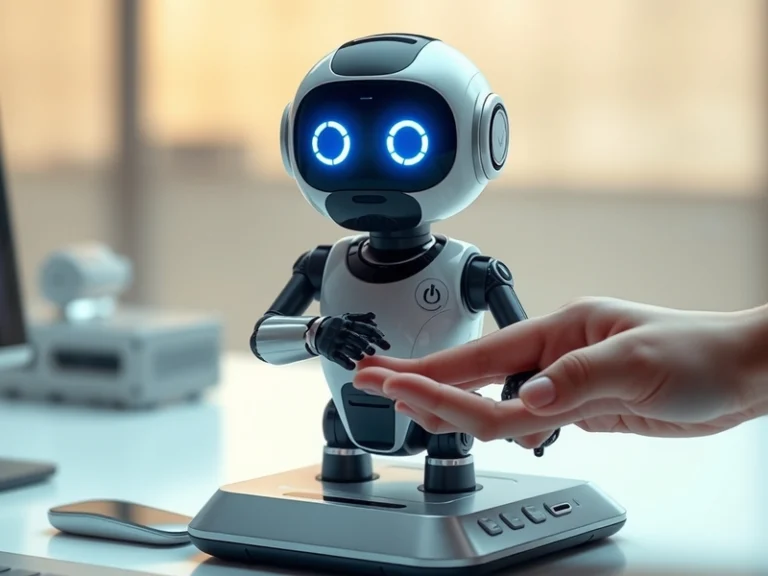
A new frontier in human-robot interaction is emerging as tiny AI robots are demonstrating the ability to develop distinct, learned personalities through continuous interaction with their environments and users.
This development moves beyond pre-programmed responses and static behaviors, indicating a significant step toward more dynamic and engaging robotic companions. Rather than merely executing commands, these devices are designed to learn, adapt, and exhibit consistent behavioral patterns that users perceive as unique characteristics, much like a personality.
Defining “Personality” in an AI Robot
For an AI robot, “personality” does not imply consciousness or human-like emotions. Instead, it refers to a cohesive and evolving set of behavioral traits, interaction styles, and adaptive responses that emerge over time. Key aspects of this emergent personality include:
- Consistency: The robot maintains a predictable, yet adaptive, style of interaction across different scenarios. For instance, a “playful” robot might consistently use more energetic movements and vocalizations, while a “calm” one might prefer subtle cues.
- Adaptability: The robot learns from user feedback and environmental changes, modifying its behavior to better suit preferences or situations. This might involve adjusting its response latency, tone, or physical gestures.
- Memory: The system retains information about past interactions, user preferences, and environmental conditions, informing future responses and contributing to a sense of continuity.
- Expressiveness: Through a combination of movement, light patterns, sound, and potentially synthesized speech, the robot conveys states or intentions that users interpret as emotional or dispositional.
This dynamic persona is not hardcoded but rather a product of sophisticated machine learning algorithms processing real-time data.
The Technical Underpinnings of Emergent Behavior
The ability of these desk companions to “learn” and express personality relies on a confluence of advanced AI and robotic technologies. At their core, these systems integrate multi-modal sensing with sophisticated processing capabilities, often leveraging on-device or edge AI for immediate responsiveness.
Sensory Perception and Data Input
To understand their environment and users, these robots typically employ a suite of sensors:
- Microphones: For natural language processing (NLP), detecting voice commands, speech patterns, and ambient sounds.
- Cameras: For computer vision tasks such as facial recognition, gesture detection, object tracking, and understanding user attention.
- Touch Sensors: Enabling tactile interaction, allowing the robot to respond to petting, tapping, or being picked up.
- Proximity Sensors: To detect nearby objects or people, informing spatial awareness and movement.
Data from these sensors is continuously streamed and processed, forming a rich contextual understanding of the interaction.
Machine Learning for Adaptation and Response Generation
The “learning” aspect is predominantly driven by various machine learning paradigms:
- Reinforcement Learning (RL): This is crucial for behavioral adaptation. The robot receives positive or negative feedback (either explicit from the user or implicit from interaction success/failure) and adjusts its internal policies to maximize “rewards.” For example, if a user responds positively to a certain type of playful movement, the robot might be reinforced to repeat or vary that behavior.
- Deep Learning (DL) for NLP and Computer Vision: Neural networks, particularly transformer-based architectures for language models and convolutional neural networks (CNNs) for image processing, enable the robot to understand complex spoken commands, interpret visual cues, and generate contextually appropriate verbal or non-verbal responses.
- Personalization Algorithms: These algorithms track individual user preferences over time, tailoring the robot’s responses and behavioral patterns to create a unique bond with each person. This might involve remembering favorite topics, preferred interaction styles, or even specific user routines.
The robot’s physical embodiment—its motors, actuators, speakers, and LED displays—then translates these learned behaviors into tangible actions, expressions, and sounds, completing the interaction loop.
The Interaction Loop: From Perception to Personality
The development of personality in these robots is an iterative process, much like how humans develop through experience. It follows a continuous interaction loop:
- Perception: The robot takes in data from its sensors about the user and the environment.
- Processing: AI models analyze this data to understand context, intent, and user state.
- Action Generation: Based on its current “personality” parameters, learned policies, and perceived context, the robot decides on an appropriate response (e.g., speaking, moving, changing light patterns).
- Execution: The robot performs the chosen action.
- Feedback and Learning: The user’s reaction to the robot’s action (e.g., a smile, a frown, a verbal command, or lack thereof) serves as feedback, which the robot incorporates into its learning models to refine its future behavior and further shape its personality.
This ongoing cycle allows the robot to evolve its interaction style, building a more nuanced and seemingly personalized relationship with its owner over weeks and months.
Implications and Future Directions
The emergence of AI robots with adaptive personalities holds significant implications for various fields. In personal companionship, it promises devices that are more engaging and less repetitive, fostering a deeper sense of connection. In educational settings, a robot that adapts its teaching style to a child’s learning pace and preferences could be a powerful tool. Similarly, in therapeutic contexts, a companion robot capable of developing a consistent, reassuring persona might offer significant benefits.
However, this advancement also introduces new challenges. Ethical considerations around data privacy, the potential for manipulation if personalities are designed to be overly persuasive, and managing user expectations about the robot’s sentience are paramount. As these tiny companions become more sophisticated, the focus will likely shift not just to what they can do, but how they can integrate into human lives responsibly and beneficially.