
Tokyo Startup Claims First True AGI: Former Google veteran’s neocortex-inspired model allegedly learns without human supervision
In a quiet laboratory tucked away in Tokyo’s bustling Shibuya district, a small team of researchers led by former Google DeepMind veteran Dr. Kenji Nakamura claims to have achieved what many considered impossible: the world’s first true Artificial General Intelligence (AGI). Their creation, dubbed “Project NeoCortex,” allegedly learns and adapts without any human supervision, marking a potential watershed moment in the history of artificial intelligence.
The announcement, made during an exclusive demonstration for select industry leaders and researchers, has sent ripples through the global AI community. While skepticism remains high—given the numerous false AGI claims in recent years—the technical details revealed by Nakamura’s team suggest they may have indeed cracked one of AI’s most persistent challenges.
The Neocortex Breakthrough
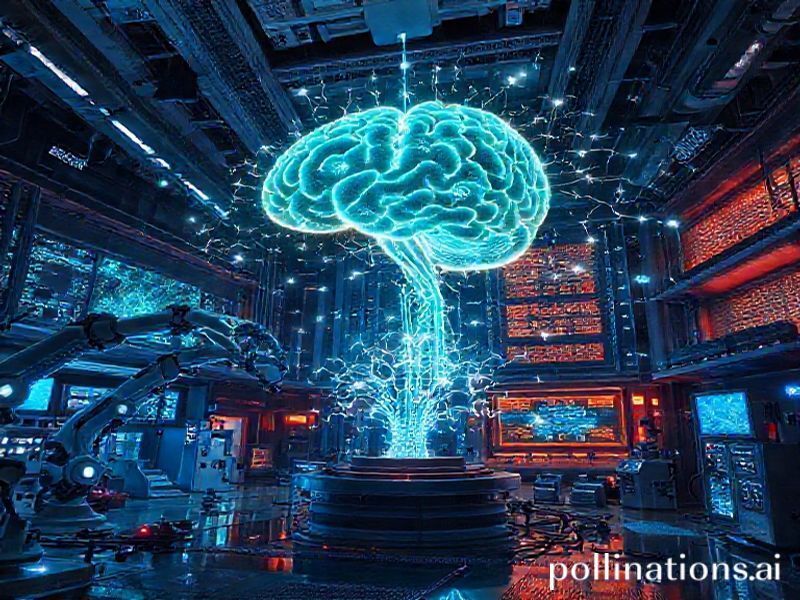
At the heart of Project NeoCortex lies a revolutionary architecture inspired by the human brain’s neocortex, the six-layered structure responsible for higher-order functions like perception, cognition, and language. Unlike traditional neural networks that require massive datasets and extensive human-labeled training, NeoCortex allegedly develops understanding through pure observation and interaction with its environment.
“We didn’t teach it anything in the traditional sense,” explains Dr. Nakamura, who left Google in 2022 to pursue independent research. “We created an environment rich with sensory inputs—visual, auditory, and textual—and allowed the system to develop its own understanding of how the world works, much like a human infant would.”
The implications of such technology are staggering. If verified, this would represent a fundamental shift from narrow AI systems—excellent at specific tasks but helpless outside their training domain—to a truly general intelligence capable of learning anything from advanced mathematics to creative writing without explicit programming.
Technical Architecture and Learning Mechanisms
Self-Organizing Neural Hierarchies
The NeoCortex system employs what researchers call “Self-Organizing Neural Hierarchies” (SONH), a novel approach that allows the AI to build its own understanding layers. Traditional deep learning models require architects to manually design network layers and connections. In contrast, NeoCortex’s architecture evolves organically based on the patterns it discovers.
Key technical features include:
- Adaptive Synaptic Plasticity: Connections between artificial neurons strengthen or weaken based on usage patterns, mimicking biological learning
- Emergent Categorization: The system naturally forms categories and concepts without predefined labels
- Cross-Modal Integration: Information from different sensory inputs automatically combines to form unified understanding
- Temporal Memory Networks: Long-term memory formation that persists across sessions without human intervention
Unsupervised Learning at Scale
Perhaps most remarkably, NeoCortex achieved these capabilities using only unsupervised learning techniques. The system was exposed to:
- Raw video feeds from cameras observing laboratory activities
- Unlabeled audio streams including conversations, music, and environmental sounds
- Plain text documents without any annotations or explanations
- Real-time sensor data from robotic interactions with physical objects
Within weeks, researchers observed the system developing what appeared to be genuine understanding. It began asking questions about inconsistencies in data, proposing hypotheses about physical phenomena, and even demonstrating what could be interpreted as curiosity—seeking out new types of information independently.
Industry Implications and Transformative Potential
Immediate Applications
If NeoCortex’s capabilities prove genuine and scalable, numerous industries stand poised for disruption:
Healthcare and Drug Discovery: An AGI system capable of genuine scientific reasoning could accelerate medical research exponentially. Rather than training separate models for each disease or drug target, a single AGI could approach medical problems with the holistic understanding of a trained physician combined with perfect recall and rapid calculation abilities.
Autonomous Systems: Current self-driving cars and robots excel in controlled environments but struggle with novel situations. An AGI-powered system could handle unexpected scenarios with human-like adaptability while maintaining machine precision and reaction times.
Scientific Research: The ability to form hypotheses, design experiments, and interpret results without human bias could revolutionize fields from climate science to particle physics. NeoCortex could potentially identify patterns humans have missed due to cognitive limitations or disciplinary silos.
Economic Disruption
The emergence of true AGI would trigger unprecedented economic shifts. Unlike previous automation waves that replaced specific job categories, AGI could theoretically perform any cognitive task better than humans. This raises critical questions about:
- The future of knowledge work across all sectors
- Educational system relevance in an AGI-dominated economy
- Wealth distribution when labor becomes obsolete
- The role of human creativity and purpose in a post-work society
Verification Challenges and Skepticism
The Proof Problem
Despite the compelling demonstration, the AI research community remains appropriately skeptical. Dr. Sarah Chen, a neuroscientist at MIT who attended the private showing, voices common concerns: “What we saw was impressive, but claiming AGI requires extraordinary evidence. The system showed remarkable capabilities, but we need to see how it performs across diverse, long-term scenarios without any human guidance or hidden constraints.”
Key verification challenges include:
- Defining True Understanding: How do we distinguish genuine comprehension from sophisticated pattern matching?
- Scalability Questions: Can the system maintain its capabilities as problems become more complex?
- Transfer Learning Tests: Does knowledge truly transfer between domains, or is it domain-specific expertise?
- Consciousness Claims: The team must carefully avoid anthropomorphizing what might be advanced simulation
The Replication Crisis
Adding to skepticism is the team’s reluctance to release full technical details, citing security concerns about potential misuse. This secrecy, while understandable, makes independent verification impossible—raising red flags in a field notorious for overhyped claims.
Dr. Nakamura counters these concerns: “We’re not hiding because we’re afraid of being proven wrong. We’re hiding because we’re afraid of being proven right. The implications of releasing a true AGI without proper safeguards are terrifying.”
Future Possibilities and Ethical Considerations
The Path Forward
Whether NeoCortex represents true AGI or simply an impressive step toward it, the technology demonstrates remarkable advances in unsupervised learning and adaptive intelligence. The coming months will likely see:
- Intensive peer review and independent testing
- Rapid development of similar architectures by major tech companies
- Increased funding for AGI safety research
- Global policy discussions about AGI governance
Preparing for an AGI Future
Organizations and individuals should begin considering how to position themselves for an AGI-enabled world. This includes:
- Developing AGI-Complementary Skills: Focus on uniquely human capabilities like emotional intelligence, ethical reasoning, and creative synthesis
- Building Adaptive Organizations: Create structures that can rapidly pivot as AGI capabilities emerge
- Participating in Policy Discussions: Engage with governance bodies shaping AGI development and deployment
- Investing in AGI Safety: Support research ensuring AGI development benefits humanity broadly
As we stand at this potential inflection point, the Tokyo team’s claims remind us that AGI development may happen gradually, then suddenly. Whether Project NeoCortex proves to be the breakthrough it claims or simply another milestone on the journey, it signals that the age of artificial general intelligence may be closer than we think.
The question is no longer whether AGI will arrive, but whether humanity will be ready when it does.