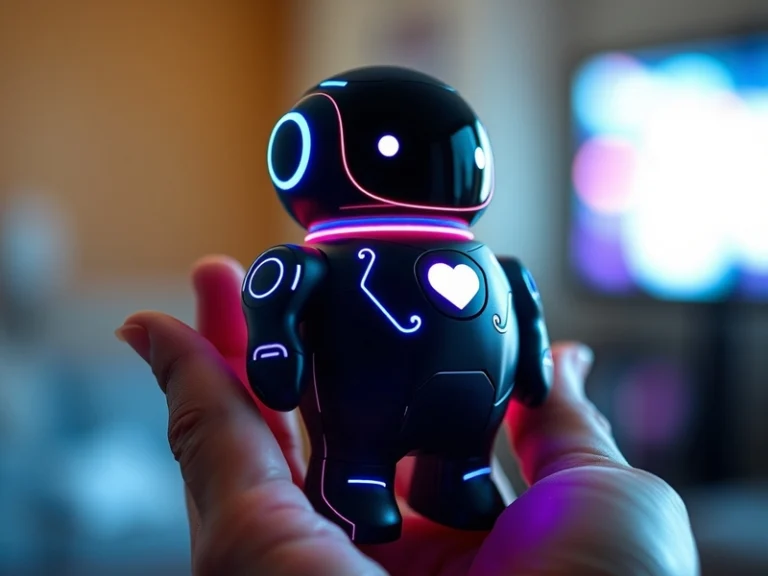
The concept of TruTru, an AI-powered stress relief toy designed to respond to touch and promote calmness, signals a burgeoning interest in leveraging artificial intelligence for personalized wellness, offering a dynamic approach to easing anxiety through responsive tactile interaction. This innovative application positions AI not just as a tool for complex computational tasks, but as a subtle, on-demand companion capable of adapting to individual user states.
At its core, a device like TruTru aims to move beyond the static nature of traditional stress balls or fidget toys. Instead of a uniform response, it proposes an intelligent system that interprets user interaction and adjusts its feedback accordingly. The primary mechanism hinges on sophisticated sensor technology combined with on-device artificial intelligence, creating a feedback loop intended to guide users towards a state of calm.
How AI Powers Personalized Calm
The integration of AI into a stress relief toy is not merely a gimmick; it addresses a fundamental limitation of non-intelligent devices: their inability to adapt. For TruTru, AI’s role can be broken down into several key areas:
- Sensitive Input Interpretation: High-fidelity touch and pressure sensors embedded within the toy gather data on how a user is interacting with it. This isn’t just about detecting contact; it’s about discerning patterns in grip strength, rhythm of squeezing, duration of touch, and even subtle tremors. AI algorithms are crucial for interpreting these nuanced inputs, differentiating between an agitated squeeze and a gentle, contemplative hold.
- Adaptive Haptic Feedback: Based on the interpreted input, the AI system drives an array of haptic actuators. These could be small motors that create varied vibrations, internal mechanisms that subtly change the toy’s firmness or texture, or even thermal elements that adjust its temperature. The AI’s intelligence lies in selecting the most appropriate haptic response in real-time – perhaps a slow, rhythmic pulsation for rapid, anxious squeezing, or a gentle, sustained warmth for prolonged, intense pressure.
- Personalized Learning and Evolution: Over time, a device like TruTru could potentially learn a user’s unique stress patterns and preferred calming responses. Through continuous interaction, the AI model might identify which haptic sequences are most effective for a particular individual during different states of anxiety. This personalization moves beyond a one-size-fits-all approach, aiming to optimize the stress relief experience for each user.
- Edge Computing for Responsiveness and Privacy: To ensure immediate feedback and protect user data, the AI processing would ideally occur directly on the device, leveraging edge computing capabilities. This minimizes latency, making the toy’s responses feel natural and instantaneous, while also ensuring that sensitive interaction data does not need to be transmitted to cloud servers for analysis, enhancing user privacy.
The Technical Underpinnings of Tactile AI
Developing an AI-powered tactile device requires a confluence of hardware and software engineering. On the hardware front, advancements in flexible sensors, micro-actuators, and low-power microcontrollers are essential. These components must be robust enough for repeated physical interaction yet subtle enough to be integrated seamlessly into a soft, ergonomic form factor.
Software-wise, the AI models would likely be compact, optimized machine learning algorithms trained on datasets correlating specific tactile inputs with desired calming outputs. These models could employ techniques like recurrent neural networks (RNNs) or transformer architectures to process sequences of touch data and predict optimal haptic responses. The challenge lies in creating models that are lightweight enough to run efficiently on embedded systems while still delivering sophisticated, adaptive behavior.
Broader Context and Future Implications
The emergence of devices like TruTru fits into a broader trend of leveraging AI for mental wellness, alongside applications in therapeutic chatbots, mood tracking apps, and biofeedback wearables. While these technologies are still in their early stages, they represent a shift towards more personalized, accessible, and proactive approaches to managing stress and anxiety.
The success of an AI-powered stress toy will ultimately depend on its ability to deliver tangible, consistent relief, integrate seamlessly into daily life, and address concerns around data privacy and long-term efficacy. As AI continues to become more miniaturized and efficient, we can expect to see further innovations in this space, blurring the lines between technology and therapeutic tools in novel, tactile ways.