

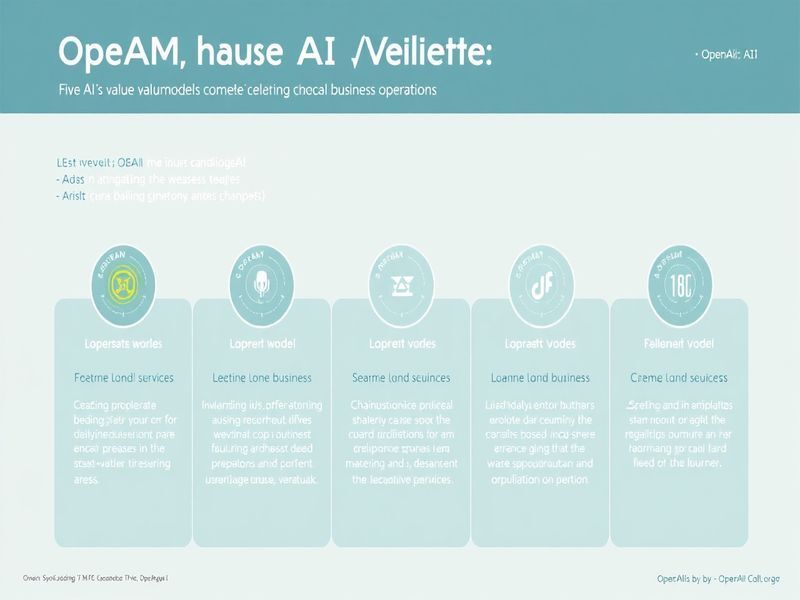
Unlocking Business Potential: OpenAI’s Five AI Value Models
In the rapidly evolving landscape of artificial intelligence (AI), businesses are increasingly seeking ways to leverage innovative technologies to enhance productivity and drive growth. OpenAI’s Five AI Value Models provide a robust framework for organizations to measure and understand the return on investment (ROI) that AI can deliver. By categorizing AI benefits into distinct value models, businesses can tailor their strategies to maximize the impact of AI on their operations.
Understanding the Five AI Value Models
The Five AI Value Models outlined by OpenAI include:
- Cost Reduction
- Revenue Generation
- Enhanced Customer Experience
- Innovation and New Offerings
- Improved Decision-Making
1. Cost Reduction
One of the most immediate impacts of AI in business is its ability to reduce operational costs. By automating routine tasks and optimizing processes, organizations can significantly cut down on labor and resource expenditures. Common applications include:
- Automating data entry and processing tasks
- Streamlining supply chain operations
- Reducing errors through machine learning algorithms
For instance, companies that implement AI-driven chatbots can handle customer inquiries at a fraction of the cost of traditional customer service teams.
2. Revenue Generation
AI can also unlock new revenue streams through enhanced product offerings or increased sales efficiency. Businesses can utilize predictive analytics to identify customer buying patterns, enabling them to tailor marketing strategies effectively. This model includes:
- Personalized product recommendations
- Dynamic pricing strategies based on market demand
- Targeted advertising campaigns driven by AI insights
Organizations that harness these capabilities often see a notable boost in sales and customer loyalty.
3. Enhanced Customer Experience
In today’s competitive market, delivering exceptional customer experiences is vital for retention and growth. AI technologies empower businesses to engage with customers more effectively. Key strategies include:
- Using natural language processing (NLP) to analyze customer feedback
- Implementing AI-powered virtual assistants for 24/7 support
- Utilizing sentiment analysis to gauge customer satisfaction
By focusing on enhancing customer experiences through AI, businesses can build stronger relationships and increase brand loyalty.
4. Innovation and New Offerings
AI not only helps businesses optimize current operations but also paves the way for innovative products and services. This value model encourages organizations to think outside the box and explore new horizons. Some examples include:
- Developing AI-infused products, such as smart appliances or autonomous vehicles
- Creating new business models based on AI capabilities, such as subscription services for AI tools
- Investing in research and development to explore AI applications in various sectors
Companies that prioritize innovation can stay ahead of market trends and meet evolving customer needs.
5. Improved Decision-Making
AI’s ability to analyze vast datasets in real time enables businesses to make informed decisions swiftly. This model emphasizes the importance of data-driven decision-making, which can be achieved through:
- Leveraging AI algorithms for predictive analytics
- Utilizing machine learning to identify market trends and opportunities
- Implementing AI tools for scenario analysis and risk assessment
Improved decision-making fosters agility within organizations, allowing them to respond effectively to changes in the market.
Practical Insights and Industry Implications
Implementing OpenAI’s Five AI Value Models requires a strategic approach. Companies need to assess their current capabilities, identify areas for improvement, and invest in the right technologies. Key considerations include:
- Understanding the specific needs of the business and aligning AI initiatives accordingly
- Training staff to work alongside AI tools and interpret their outputs
- Establishing clear metrics for success and continuously evaluating AI performance
Industries such as finance, healthcare, retail, and manufacturing are already experiencing significant transformations due to AI. For instance, healthcare providers are utilizing AI for diagnostics and patient management, while retail businesses are optimizing inventory management using predictive analytics. As these industries continue to evolve, the implications for AI are profound, indicating a shift toward more personalized and efficient services.
Future Possibilities
The future of AI in business is bright, with numerous possibilities on the horizon. As technology advances, we can expect:
- Increased integration of AI with the Internet of Things (IoT) for smarter operations
- Greater emphasis on ethical AI practices to ensure fairness and transparency
- Enhanced collaboration between humans and AI systems to leverage the strengths of both
As organizations unlock their potential through OpenAI’s Five AI Value Models, they will not only drive their growth but also contribute to shaping the future of industries worldwide.