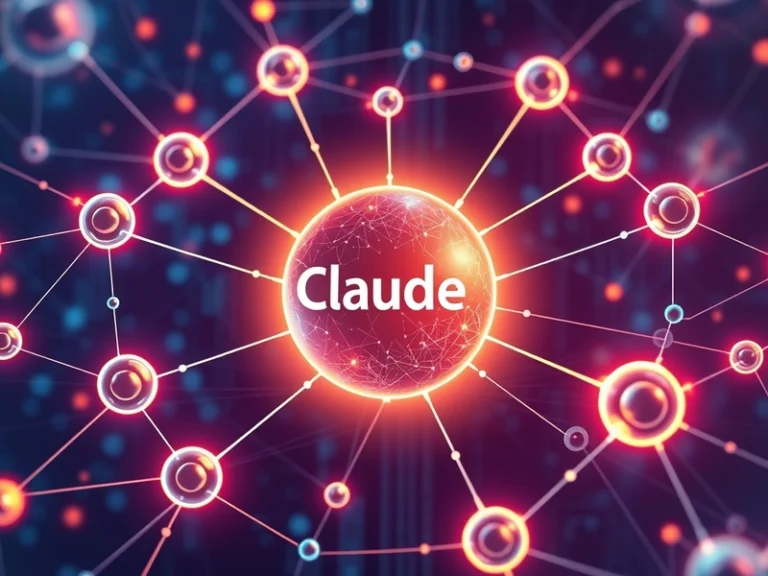
An intriguing report has emerged detailing an experiment where a reported 1,000 AI agents collaborated to construct an operating system in a mere eight days, leveraging the advanced capabilities of Anthropic’s Claude model for task decomposition and productivity enhancement.
This achievement, if widely replicated and verified, underscores a significant leap in autonomous agent systems, moving beyond single-agent task execution to complex, large-scale collaborative development. The core premise revolves around the ability of large language models (LLMs) like Claude to act as sophisticated reasoning engines, enabling individual agents to understand complex instructions, generate code, debug, and communicate effectively within a distributed framework.
The Architecture of Collaboration: How 1,000 Agents Could Function
The concept of 1,000 agents working in concert to build something as intricate as an operating system relies on several foundational AI and software engineering principles. While specific details of this particular experiment are not yet widely available, the general mechanisms for such a feat would likely include:
- Hierarchical Task Decomposition: A master or orchestrator agent, powered by a capable LLM, would break down the monumental goal of “building an OS” into progressively smaller, more manageable sub-tasks. These could range from kernel development and file system design to user interface creation and driver integration. Each sub-task would then be assigned to a team or individual agent.
- Specialized Agent Roles: Not all 1,000 agents would be identical. Some might be specialized in code generation, others in testing and quality assurance, some in documentation, and others in integration or debugging. Their roles would be defined by their prompts and access to specific tools or knowledge bases.
- Communication Protocols: Effective collaboration necessitates robust communication. Agents would need mechanisms to report progress, request assistance, share code modules, and resolve conflicts. This could involve shared memory, message queues, or even dedicated “communication agents” facilitating interactions.
- Iterative Development and Feedback Loops: An operating system is not built in a single pass. Agents would likely engage in iterative cycles of planning, coding, testing, and refining. Feedback from testing agents would inform code-generating agents, leading to rapid bug fixes and feature enhancements.
- Shared Knowledge Base: To avoid redundant work and ensure consistency, agents would likely access a shared, evolving knowledge base containing design specifications, API documentation, code standards, and accumulated learnings from previous tasks.
Claude’s Role in Orchestration and Execution
Anthropic’s Claude, known for its extensive context window and advanced reasoning abilities, would play a pivotal role in empowering these agents. Its capabilities are particularly suited for:
- Complex Reasoning and Planning: Claude’s ability to process and synthesize vast amounts of information allows it to handle the intricate logic required for task decomposition, dependency mapping, and strategic planning across a large team of agents.
- High-Quality Code Generation: Given a clear specification, Claude can generate coherent and functional code in various programming languages, a critical component for building an OS from the ground up.
- Debugging and Refinement: Agents powered by Claude could analyze error logs, identify potential causes of bugs, and suggest or implement corrective code, significantly accelerating the debugging process.
- Understanding and Following Instructions: The clarity and consistency with which Claude can interpret and execute multi-step instructions are fundamental for ensuring that individual agents stay aligned with the overall project goals.
- Natural Language Interaction: While agents might communicate via structured data, the underlying LLM’s capacity for natural language understanding and generation can simplify the design of agent-to-agent communication and human oversight.
Implications for Software Development and AI Autonomy
The reported development of an operating system by 1,000 AI agents in just eight days marks a potential inflection point. The implications are far-reaching:
- Accelerated Development Cycles: If AI agents can indeed handle such complex, multi-faceted projects autonomously, the pace of software development could dramatically increase, reducing time-to-market for new technologies.
- Increased Complexity Handling: This approach could enable the creation of software systems that are too complex or time-consuming for human teams alone, opening doors to entirely new classes of applications.
- Shift in Human Roles: Human developers might transition from writing code line-by-line to higher-level roles, focusing on defining architectures, setting strategic goals, validating AI-generated outputs, and managing agent teams.
- Challenges in Verification and Control: Scaling AI agent collaboration to this degree also introduces significant challenges. Ensuring the security, stability, and ethical alignment of autonomously built systems will require advanced verification techniques and robust human-in-the-loop oversight. The “black box” nature of some LLM decisions could complicate debugging and accountability.
While the full details of this specific experiment are awaited, the concept itself highlights the trajectory of AI agent research. The combination of advanced LLMs like Claude with sophisticated agentic architectures promises to unlock unprecedented levels of autonomous problem-solving and creative output, potentially reshaping the landscape of software engineering and beyond.