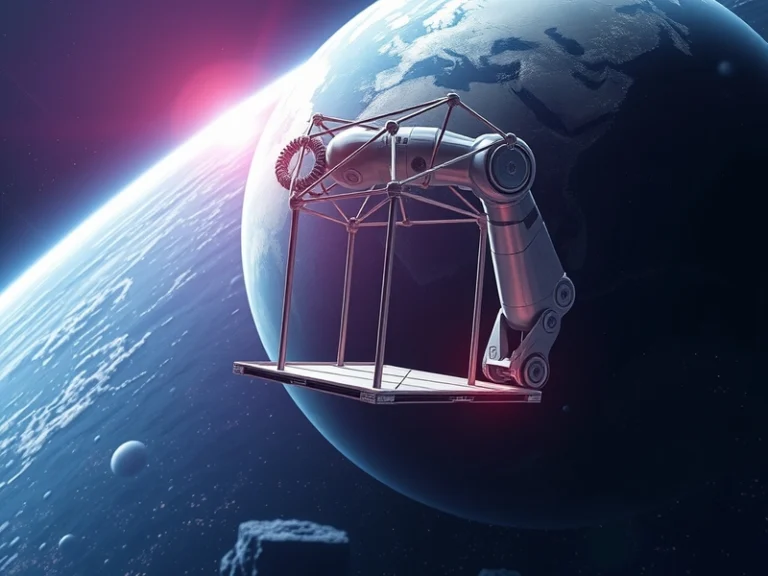
The vision of autonomous robots constructing infrastructure in space is rapidly transitioning from science fiction to engineering reality, with significant progress being made in developing systems capable of operating without direct human intervention.
The drive towards robotic space construction is multifaceted, addressing critical challenges inherent in human spaceflight. Sending astronauts to build or maintain complex structures in orbit or on celestial bodies is prohibitively expensive and carries substantial risks, including exposure to radiation, microgravity-induced health issues, and the inherent dangers of working in a vacuum. Autonomous robots, by contrast, can operate for extended periods, perform repetitive tasks with high precision, and work in environments too hazardous for humans. This capability is crucial for the ambitious goals of establishing lunar bases, building large orbital observatories, or assembling vast solar power satellites that would be impossible to launch in their entirety from Earth.
Core Technologies Driving Autonomous Construction
Several key technological advancements are converging to make autonomous space construction feasible:
- Robotic Manipulation and Assembly: Advanced robotic arms, building upon the legacy of systems like the Canadarm2 on the International Space Station (ISS), are being developed with greater dexterity, autonomy, and the ability to handle a wider range of tools and materials. These systems are designed to perform intricate assembly tasks, connect structural components, and integrate complex subsystems.
- In-Space Additive Manufacturing (3D Printing): This technology allows robots to create components on demand using raw materials, significantly reducing the volume and mass that needs to be launched from Earth. Companies like Redwire (formerly Made In Space) have already demonstrated 3D printing in microgravity aboard the ISS, producing plastic parts and even experimenting with metallic printing. Future applications envision using local resources, such as lunar regolith, as feedstock for building habitats and infrastructure directly on the Moon’s surface.
- Advanced AI for Autonomy: The cornerstone of these systems is artificial intelligence, enabling robots to interpret sensor data, plan actions, adapt to unforeseen circumstances, and perform tasks with minimal or no human oversight. This includes capabilities for object recognition, navigation, error detection and correction, and collaborative robotics, where multiple robots work together on a single project.
- Perception and Sensing: High-fidelity cameras, LiDAR, and other sensors provide robots with a comprehensive understanding of their environment, enabling precise positioning, quality control of manufactured components, and real-time monitoring of construction progress.
Overcoming the Cosmic Gauntlet
Despite rapid progress, deploying autonomous construction robots in space presents formidable challenges. The space environment itself is unforgiving, characterized by extreme temperature fluctuations, vacuum, radiation, and micrometeoroid impacts. Materials must be developed and qualified to withstand these conditions and be amenable to robotic processing and assembly.
Power management is another critical factor. Construction and manufacturing processes are energy-intensive, requiring robust power generation and storage solutions that can operate reliably in space. Communication latency, particularly for missions beyond low Earth orbit, mandates a high degree of autonomy, as real-time human control becomes impractical. Robots must be capable of making decisions and executing tasks independently, reporting only critical progress or anomalies.
Paving the Way for Future Space Infrastructure
The implications of successful autonomous space construction are profound. It opens the door to building structures far larger and more complex than what can be launched from Earth. This includes:
- Lunar and Martian Habitats: Utilizing local resources to construct shelters and infrastructure for long-duration human missions, reducing dependence on Earth-supplied modules. NASA’s Artemis program, aiming to return humans to the Moon, is actively exploring concepts for in-situ resource utilization and robotic construction to support sustainable lunar presence.
- Large-Scale Orbital Platforms: Assembling massive telescopes, communication arrays, or manufacturing facilities that require precise alignment and vast dimensions, enabling new scientific discoveries and economic opportunities.
- Solar Power Satellites: Constructing enormous structures in geosynchronous orbit to capture solar energy and beam it back to Earth, offering a potential solution to global energy demands.
As research and development continue, with both national space agencies and private companies investing heavily, autonomous robots are poised to become indispensable partners in humanity’s expansion into the cosmos. Their ability to build, maintain, and expand infrastructure without constant human intervention is not just an efficiency gain, but a fundamental enabler for the next era of space exploration and utilization.