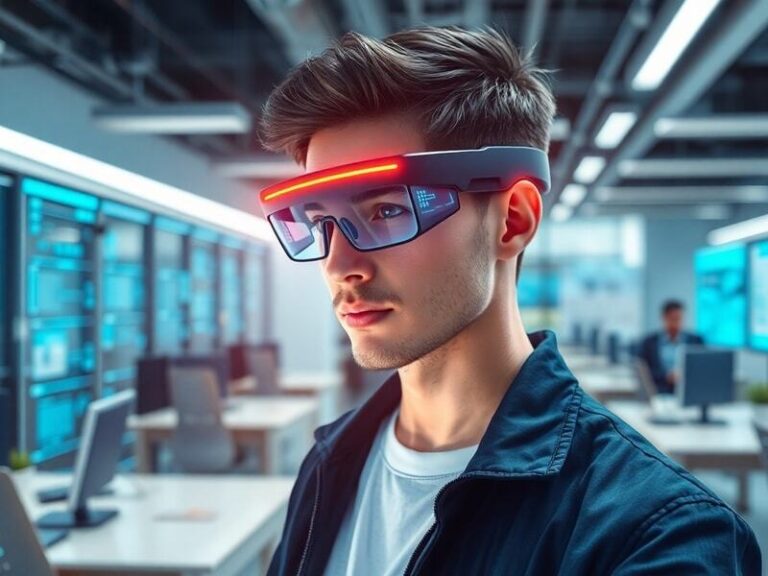
AI Glasses That Build Apps on the Fly: Revolutionizing Productivity
The advent of augmented reality (AR) and artificial intelligence (AI) has set the stage for a groundbreaking innovation: AI glasses that allow users to create applications through voice commands. This technology not only enhances productivity but also offers unprecedented convenience, paving the way for a new era of interaction between humans and machines.
Understanding the Technology Behind AI Glasses
AI glasses are equipped with advanced hardware and software that facilitate real-time processing and execution of commands. Utilizing a combination of natural language processing (NLP), computer vision, and cloud computing, these devices empower users to create applications on the fly. Here’s how they work:
- Voice Recognition: Users can issue commands verbally, which the glasses interpret through sophisticated NLP algorithms.
- Contextual Awareness: Equipped with sensors and cameras, AI glasses can understand the user’s environment, adapting applications based on real-time context.
- Cloud Integration: The processing power often relies on cloud-based solutions, enabling complex computations and app development without heavy local processing.
Practical Applications of AI Glasses
The implications of AI glasses extend across various industries, offering practical solutions that enhance productivity. Here are some notable applications:
- Healthcare: Medical professionals can rapidly create and access applications for patient management, diagnostics, and treatment plans while remaining hands-free.
- Education: Students can develop interactive learning tools in real-time, facilitating collaborative projects and enhancing engagement.
- Manufacturing: Workers can generate applications tailored to specific tasks, improving workflow efficiency and safety protocols.
- Remote Work: Teams can collaborate on app development from different locations, streamlining processes and boosting productivity.
Industry Implications
The introduction of AI glasses that build apps on the fly is poised to disrupt several sectors:
- Enhanced Collaboration: With real-time app development capabilities, teams can collaborate more effectively, breaking down communication barriers.
- Increased Efficiency: Reducing the time it takes to create applications can lead to significant productivity boosts, allowing companies to respond faster to market needs.
- New Business Models: The ease of app creation could foster innovation, leading to the emergence of new business models and services.
Future Possibilities
Looking ahead, the future of AI glasses holds immense potential. Here are some possibilities:
- Personalization: As AI technology evolves, these glasses could learn user preferences, tailoring app functionalities to individual needs.
- Integration with IoT: Future iterations may seamlessly connect with IoT devices, creating a more cohesive ecosystem that enhances user experience.
- Advanced Security Features: With the rise of data privacy concerns, future models may incorporate advanced security protocols to protect user data.
- Broadened Accessibility: As technology becomes more affordable, AI glasses could become commonplace, democratizing access to advanced productivity tools.
Challenges to Overcome
Despite the exciting possibilities, several challenges must be addressed:
- Technical Limitations: Current hardware may struggle with extensive processing tasks, necessitating improvements in battery life and computational power.
- Privacy Concerns: The ability to capture real-world data raises significant privacy issues that developers must navigate carefully.
- User Adoption: For widespread acceptance, there must be a concerted effort to educate users on the benefits and functionalities of AI glasses.
Conclusion
The potential of AI glasses that build apps on the fly is immense, promising to transform how we interact with technology. By leveraging voice commands and contextual awareness, these devices not only enhance productivity but also redefine the future of application development. As the technology continues to evolve, it will be intriguing to see how industries adapt and innovate in response to this game-changing advancement.