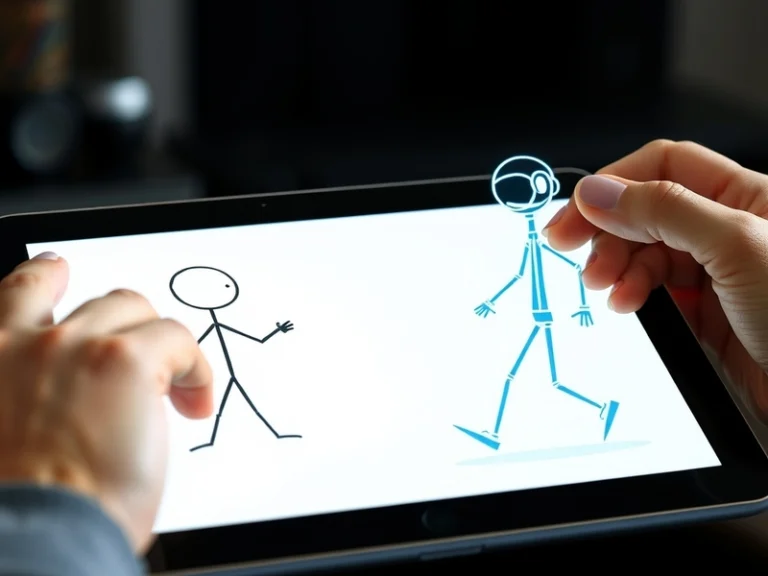
New artificial intelligence capabilities are now allowing users to transform simple sketches into personalized animated GIFs, democratizing animation creation for a broader audience. This marks a significant leap from traditional animation workflows, which typically demand specialized skills and software, by abstracting complex motion generation into an intuitive, sketch-based interface.
The core technology behind this innovation leverages advancements in generative AI, particularly sophisticated diffusion models and their extensions. These models, trained on extensive datasets of images and videos, have developed a nuanced understanding of visual concepts, object dynamics, and temporal coherence. When a user provides a sketch, it acts as a foundational visual prompt, guiding the AI’s generation process. This static input is then combined with textual prompts or additional parameters that dictate movement, style, and environmental context, enabling the AI to infer and synthesize an animated sequence.
From Static Line to Dynamic Loop
The workflow for creating these AI-powered animations typically involves several key stages:
- Sketch Input: Users begin by drawing a simple sketch. This can range from a stick figure performing an action to a basic landscape with elements intended for animation. The fidelity of the sketch often influences the AI’s interpretation, but the emphasis is on conveying core shapes and intended motion rather than artistic perfection.
- Textual Prompting: Alongside the sketch, users provide descriptive text prompts. These prompts specify the desired action (e.g., “a character walking,” “a ball bouncing,” “a cloud moving across the sky”), artistic style (e.g., “cartoon style,” “watercolor animation,” “pixel art”), and environmental details (e.g., “sunny day,” “nighttime city”). This dual input of visual and textual information provides the AI with rich context.
- AI Processing: The AI model interprets these inputs. Advanced control mechanisms, often conceptually similar to techniques like ControlNet, play a crucial role here. They allow the AI to adhere closely to the structural and compositional elements of the input sketch while generating novel content and motion. The model then synthesizes a series of frames that maintain visual consistency with the sketch and execute the described animation.
- GIF Output: Once the animation frames are generated, they are compiled into a short, looping GIF file, ready for sharing or further integration into digital content.
The ability of these models to maintain a consistent subject identity and environment across frames, even as elements within the scene move or transform, is a testament to their increasingly sophisticated understanding of temporal dynamics. Early generative models often struggled with coherence between frames, leading to flickering or disjointed animations. Recent iterations, however, have made significant strides in generating smooth, logical motion paths and consistent visual attributes.
Underlying Technological Principles
The technical underpinning of sketch-to-GIF generation relies on a fusion of several AI paradigms:
- Diffusion Models: These generative models are adept at creating highly realistic and diverse images from noise, guided by text or image prompts. For animation, they are extended to generate sequences of images, often conditioned on previous frames to ensure continuity.
- Conditional Generation: The “sketch” aspect is a powerful form of conditioning. Instead of generating an image from scratch based solely on text, the AI is constrained by the user’s drawing, ensuring the output aligns with the user’s initial vision. This significantly enhances user control and reduces the unpredictability often associated with purely text-to-image generation.
- Motion Synthesis: Specialized components within these models are responsible for understanding and generating motion. This can involve learning optical flow patterns, predicting object trajectories, or interpolating between key poses derived from the prompt. Some systems may even incorporate elements of neural radiance fields (NeRFs) or similar 3D-aware techniques to ensure spatial consistency during movement.
- Fine-tuning and Adaptation: Many of these capabilities emerge from models that have been fine-tuned on datasets specifically curated for animation, or that leverage architectural innovations designed to handle sequential data more effectively.
Applications and Creative Potential
The implications of this technology span various fields, from casual content creation to professional design:
- Rapid Prototyping for Animators: Professional animators can quickly visualize concepts and test motion ideas without committing to extensive manual drawing. A rough sketch can become an animated storyboard in minutes.
- Educational Tools: Students can animate scientific processes, historical events, or literary scenes, making learning more interactive and engaging.
- Social Media and Casual Content: Users can effortlessly create personalized, unique GIFs for messaging apps, social media posts, or short video content, adding a dynamic flair to their digital communication.
- Game Development: Indie game developers can generate placeholder animations or even final assets for simple characters and environmental effects, accelerating the development pipeline.
- Interactive Storytelling: Authors and educators can bring static illustrations to life, providing a new dimension to digital books and presentations.
While still an evolving field, the ability to translate rudimentary sketches into compelling animations signifies a notable step towards making sophisticated creative tools accessible to everyone. As these AI models continue to advance in coherence, detail, and control, the barrier to entry for animation will likely continue to fall, fostering a new wave of digital creativity.