The aspiration to translate human thought directly into speech is rapidly progressing from concept to tangible research, with advanced AI technology demonstrating the potential to unlock new forms of communication for individuals with severe speech impairments through innovations often envisioned as a “ThinkVoice” system.
At its core, the goal of such a system is to bypass traditional speech mechanisms, which can be compromised by conditions like amyotrophic lateral sclerosis (ALS), stroke, or locked-in syndrome. Instead of relying on muscle movements for vocalization or typing, “ThinkVoice” aims to interpret the neural activity associated with the intention to speak or the internal monologue itself, and then synthesize that into audible speech.
The Technological Foundation: Bridging Brain and AI
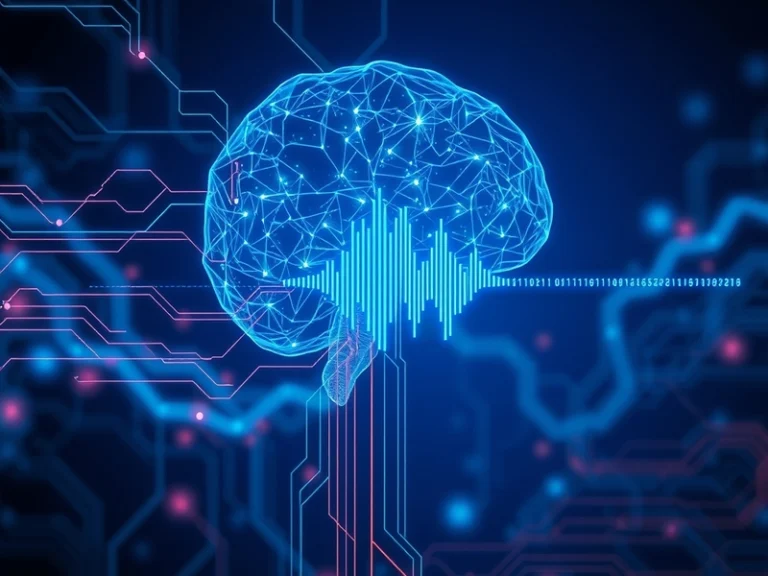
Achieving this remarkable feat relies on a sophisticated fusion of neuroscience and artificial intelligence, primarily involving Brain-Computer Interfaces (BCIs), advanced machine learning, and natural language processing (NLP).
The process generally unfolds in several key stages:
-
Neural Signal Acquisition: The first step involves capturing neural activity. This can be done through various BCI methods:
- Non-invasive techniques like Electroencephalography (EEG) involve placing electrodes on the scalp to detect electrical signals. While convenient, EEG offers lower spatial resolution, making it challenging to pinpoint precise neural activity related to speech.
- Invasive techniques, such as Electrocorticography (ECoG) arrays placed directly on the brain’s surface or microelectrode arrays implanted within the brain tissue, provide much higher resolution and fidelity. These methods offer superior signal quality but require surgical intervention. Research has shown promising results in decoding speech motor intentions from these more precise signals.
- Signal Decoding via Machine Learning: Once neural signals are acquired, the most critical phase begins: decoding. This is where advanced AI, particularly deep learning models like recurrent neural networks (RNNs) and transformer architectures, plays a pivotal role. These models are trained on vast datasets of neural activity recorded while a person attempts to speak, imagines speaking, or listens to speech. The AI learns to identify patterns within these complex signals that correspond to specific phonemes, words, or even higher-level linguistic intentions.
- Speech Synthesis: After the neural patterns are decoded into a linguistic representation (e.g., text, phonemes, or acoustic features), the final step is to convert this into audible speech. This is achieved using sophisticated text-to-speech (TTS) synthesis engines. Modern TTS systems, often powered by neural networks, can generate highly natural-sounding speech, complete with intonation, rhythm, and speaker-specific characteristics, based on the decoded input.
Current Progress and Significant Hurdles
While the concept is powerful, the journey to a fully functional “ThinkVoice” system is complex. Current research has made impressive strides, particularly in decoding intended speech from motor cortex activity. For instance, studies have demonstrated the ability to reconstruct speech by analyzing signals from brain regions involved in planning and executing vocal movements, achieving notable accuracy in limited vocabularies or phonetic sets.
However, significant challenges remain:
- Decoding Complexity: The human brain’s activity is incredibly complex and nuanced. Differentiating between an internal thought, an intention to speak, and other cognitive processes is a formidable task. Current systems are often trained on specific tasks (e.g., imagining speaking a set of words) and generalizing to spontaneous, unconstrained thought remains a major hurdle.
- Data Scarcity: Obtaining high-quality, labeled neural data for training robust AI models is difficult, especially for invasive BCIs. Each individual’s neural patterns can vary, necessitating extensive personalization.
- Speed and Naturalness: For practical communication, the system must operate in real-time, translating thoughts into speech with minimal delay. The synthesized speech also needs to sound natural, conveying emotion and nuance, rather than a robotic monotone.
- Invasiveness: While non-invasive methods like EEG are safer, their signal quality often limits decoding accuracy. More accurate invasive methods come with inherent surgical risks and ethical considerations regarding long-term implantation.
Transformative Impact on Assistive Communication
Despite the challenges, the potential impact of “ThinkVoice” technology is profound. For individuals who have lost the ability to speak due to neurological conditions, it offers a pathway to regain autonomy and connection. Imagine someone with locked-in syndrome, currently relying on slow eye-gaze communication, being able to communicate at near-conversational speeds simply by thinking. This could dramatically improve quality of life, mental health, and social integration.
Beyond direct speech, the underlying technology could also enable brain-controlled interfaces for computers, allowing individuals to write emails, control smart home devices, or navigate the internet purely through thought, opening up a world of possibilities currently inaccessible.
The Road Ahead
Research continues globally, with various academic institutions and private companies investing in BCI and AI technologies. The future will likely see continued refinement of neural decoding algorithms, improved signal acquisition techniques (potentially less invasive yet high-resolution), and more robust, personalized AI models. As these technologies mature, the vision of turning thoughts into speech, exemplified by the “ThinkVoice” concept, moves steadily closer to becoming a widespread reality, offering unprecedented communication freedom to those who need it most.