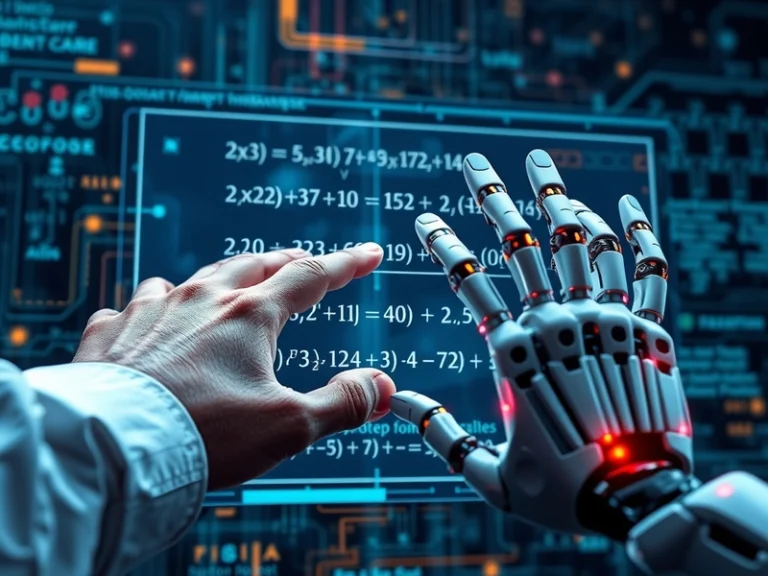
Artificial intelligence is increasingly demonstrating its capability to assist in the discovery and verification of complex mathematical proofs, ushering in an era where human intuition is powerfully augmented by computational rigor.
For decades, the dream of automated theorem proving has captivated computer scientists and mathematicians alike. Early efforts focused on symbolic AI, developing algorithms capable of systematically searching vast logical spaces to construct proofs. While these systems, such as those integrated into proof assistants like Coq, Lean, and Isabelle/HOL, have been instrumental in formal verification and ensuring the correctness of intricate mathematical arguments, their reliance on explicit rules and human-defined heuristics often limited their scalability and autonomy.
The advent of modern machine learning techniques, particularly deep learning and reinforcement learning, has fundamentally shifted this landscape. AI is no longer merely a tool for checking human-generated proofs but is evolving into a proactive partner in the mathematical discovery process. This new paradigm is not about replacing human mathematicians, but about creating a symbiotic relationship that pushes the boundaries of mathematical understanding.
AI’s Multifaceted Role in Mathematical Proofs
The ways in which AI systems are contributing to advanced mathematics are diverse, spanning multiple stages of the proof-finding process:
- Automated Proof Search and Generation: Modern AI, especially through reinforcement learning, can be trained to navigate the complex state space of mathematical proofs. By learning from existing proofs and exploring potential new steps, these systems can suggest valid logical deductions, complete partial proofs, or even generate entirely new proofs for conjectures. Google DeepMind’s AlphaGeometry, for instance, demonstrated the power of combining a neural language model with a symbolic deduction engine to solve challenging geometry theorems at an Olympiad level.
- Assisting Interactive Proof Assistants: Tools like Lean’s theorem prover, which has a vibrant community working on formalizing advanced mathematics, are being augmented by AI. Machine learning models can suggest relevant lemmas, tactics, or definitions from a vast library, significantly reducing the cognitive load and time required for human users to construct formal proofs. This bridges the gap between the intuitive, informal reasoning of mathematicians and the rigorous, formal demands of proof assistants.
- Conjecture Generation: Beyond proving existing statements, AI can analyze mathematical data, identify hidden patterns, and propose novel conjectures. While these conjectures still require human scrutiny and proof, AI’s ability to sift through complex datasets and find unexpected correlations can accelerate the pace of mathematical discovery, guiding researchers toward fertile areas of investigation.
- Formalization of Informal Proofs: Much of advanced mathematics exists in textbooks and papers as informal proofs, relying on human understanding and common knowledge to fill in logical gaps. AI, particularly large language models (LLMs), is showing promise in translating these informal arguments into fully rigorous, machine-checkable formal proofs. This process, while challenging, could significantly expand the corpus of formally verified mathematics.
Enabling Technologies
Several key AI technologies are driving these advancements:
- Reinforcement Learning (RL): By treating proof finding as a game, RL agents can learn optimal strategies for applying logical rules and constructing deductions. They are rewarded for valid steps that lead closer to a proof, enabling them to discover complex proof paths that might be non-obvious to humans.
- Large Language Models (LLMs): Trained on vast corpora of text, including mathematical papers and formal proofs, LLMs can understand and generate mathematical language. Their ability to reason about text, identify semantic connections, and even perform symbolic manipulation makes them valuable for suggesting proof steps, translating between formal and informal representations, and aiding in formalization.
- Graph Neural Networks (GNNs): Mathematical objects and their relationships can often be represented as graphs. GNNs excel at learning from graph structures, making them suitable for tasks like predicting properties of mathematical objects, identifying connections between different parts of a proof, or suggesting relevant theorems.
The Path to Mathematical Superintelligence
The term “mathematical superintelligence” in this context refers not to an AI that independently surpasses human mathematicians in all aspects of mathematical thought, but rather to a powerful synergy. It describes an augmented intelligence where human creativity, intuition, and high-level strategic thinking are combined with AI’s unparalleled capabilities in systematic search, pattern recognition, logical deduction, and formal verification. This collaboration promises to unlock new frontiers in mathematics, enabling the resolution of long-standing open problems and the discovery of entirely new mathematical theories.
However, challenges remain. The interpretability of AI-generated proofs is crucial; understanding why an AI made certain deductions is as important as the proof itself. Ensuring the absolute correctness of AI-assisted proofs requires robust verification mechanisms, often still relying on human oversight or independent formal systems. Furthermore, true mathematical creativity, involving the invention of entirely new concepts or frameworks, remains largely a human domain, with current AI excelling more in exploration within existing frameworks.
Despite these hurdles, the trajectory is clear: AI is becoming an indispensable partner in mathematical research. The ongoing advancements in machine learning, coupled with increasing computational power, are steadily paving the way for a future where the most profound mathematical mysteries may well be unraveled through the collaborative efforts of human and artificial intelligence.