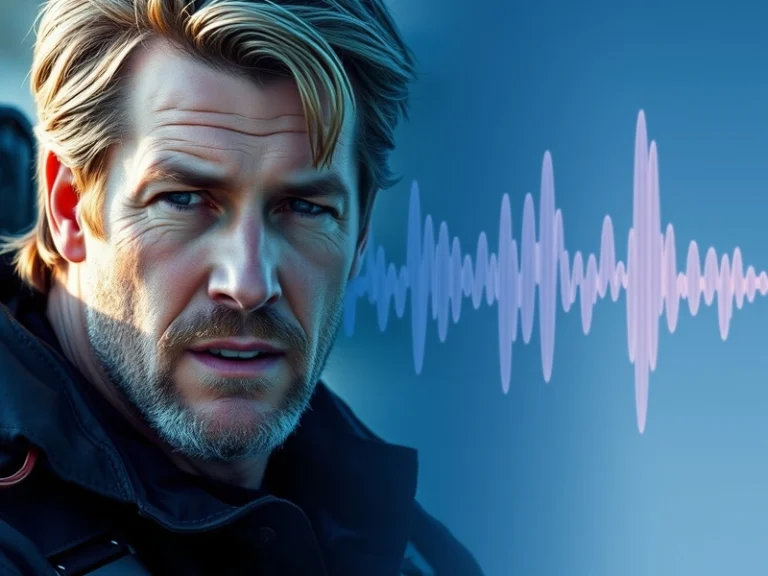
Val Kilmer’s iconic voice, a casualty of throat cancer, was resurrected by artificial intelligence for his return as Tom “Iceman” Kazansky in the 2022 blockbuster film Top Gun: Maverick.
The actor, known for his distinctive vocal range in films like Top Gun (1986), The Doors (1991), and Batman Forever (1995), underwent a tracheostomy in 2014 as part of his treatment for throat cancer. This procedure, while life-saving, significantly impaired his ability to speak, leaving him communicating primarily through a voice box and written notes.
For his reprisal of the beloved Iceman role, the filmmakers faced a unique challenge: how to allow Kilmer to deliver lines authentically, preserving the character’s voice and his own legacy. The solution came from AI voice technology developed by the UK-based company Sonantic, which was later acquired by Spotify in 2022.
The AI Behind the Voice
Sonantic specializes in creating realistic, high-quality synthetic voices using advanced machine learning techniques. For Val Kilmer’s project, the team faced the complex task of generating a voice that not only sounded like him but could also convey the emotional nuance required for a dramatic film performance.
The process involved several key steps:
- Archival Audio Collection: Sonantic gathered a vast library of Kilmer’s past recordings. This included dialogue from his films, interviews, and personal audio archives, amounting to many hours of his natural speaking voice from before his illness.
- Voice Model Training: This extensive audio dataset was fed into Sonantic’s proprietary AI algorithms, which are based on deep neural networks. The AI learned the intricate patterns of Kilmer’s speech – his cadence, pitch, tone, and unique vocal characteristics.
- Text-to-Speech Synthesis: Once the model was trained, it could generate new speech from text inputs. The AI effectively learned to mimic Kilmer’s voice, allowing new lines of dialogue to be typed and then spoken in his synthesized voice.
- Emotional Nuance: A crucial aspect was ensuring the voice could convey emotion. Sonantic’s technology allows for control over various vocal parameters, enabling the team to fine-tune the delivery to match the emotional context of the scene, moving beyond flat, robotic speech.
The result was a remarkably natural and expressive synthetic voice that allowed Kilmer to “speak” his lines in Top Gun: Maverick. Kilmer himself was deeply involved in the project, giving his full consent and collaboration, which was paramount for the ethical application of such technology.
“I’m grateful to the entire team at Sonantic who masterfully restored my voice in a way I’ve never imagined possible,” Kilmer shared at the time. “As human beings, the ability to communicate is the core of our existence. The impact of this is incredibly meaningful to me.”
Implications for Accessibility and Entertainment
The successful application of AI voice synthesis for Val Kilmer highlights the profound potential of this technology, extending far beyond the realm of blockbuster films.
- Accessibility: For individuals who have lost their voice due to illness, injury, or medical procedures, AI voice technology offers a powerful tool for communication, potentially restoring a part of their identity.
- Digital Avatars and Legacy: The ability to recreate a person’s voice opens avenues for preserving the vocal legacies of performers and public figures, allowing them to continue to “speak” in various digital contexts or even after their passing, always with appropriate consent and ethical guidelines.
- Creative Production: In entertainment, it offers new creative freedoms for filmmakers, game developers, and content creators, enabling them to realize visions that might otherwise be impossible due to physical limitations or logistical challenges.
The collaboration between Val Kilmer and Sonantic stands as a landmark achievement in AI-powered voice technology. It not only enabled a beloved actor to reprise an iconic role but also showcased the empathetic and transformative power of artificial intelligence when applied with care and purpose, offering a glimpse into a future where technology helps us overcome personal challenges and enrich human experience.