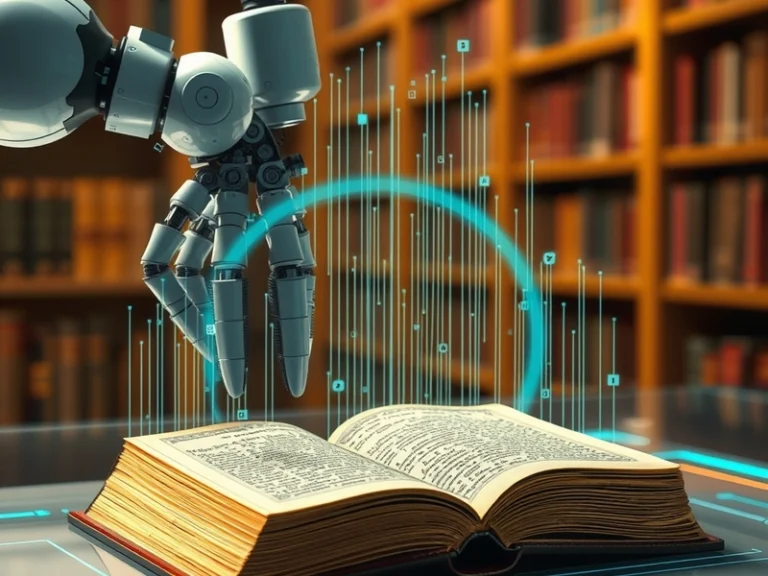
The alarming prospect of rare and historically significant books being deliberately destroyed to generate training data for artificial intelligence models has emerged as a serious concern within discussions surrounding AI ethics and data sourcing. While specific instances of such practices remain unconfirmed as a widespread trend, the mere hypothetical raises profound questions about the value we place on cultural heritage versus the relentless demand for data to fuel advanced AI.
The insatiable demand for vast, diverse, and high-quality textual data is a foundational driver for the rapid advancements seen in large language models (LLMs) today. Models like OpenAI’s GPT series, Google’s Gemini, and Meta’s Llama rely on ingesting petabytes of text to learn the nuances of human language, reasoning, and knowledge representation. While the internet, with its billions of web pages, serves as a primary source, developers constantly seek out unique, less-common, or domain-specific corpuses to enhance model capabilities, prevent overfitting to common internet prose, and address specific biases.
The Theoretical Appeal of Rare Books as Data
In this context, the theoretical appeal of rare books to AI developers becomes evident. These texts often contain attributes that could be highly valuable for training sophisticated AI models:
- Unique Linguistic Styles: Language usage, grammar, and vocabulary from different historical periods or niche communities, which can broaden an AI’s understanding of linguistic evolution and diversity.
- Domain-Specific Knowledge: Specialized information not widely available online, found in treatises, scientific records, local histories, or specific cultural documents.
- Cultural Context: Insights into past societies, beliefs, and artistic expressions, providing a richer, more nuanced understanding of human culture that might be absent from contemporary digital archives.
- Scarcity and Authenticity: Content that has not been widely digitized or duplicated, offering a potentially ‘fresh’ and uncorrupted data stream, free from the repetitive or low-quality content often found on the open web.
Current Data Practices Versus Hypothetical Destruction
However, the leap from valuing these texts to physically destroying them for data is where the ethical alarm bells ring loudest. Current practices for acquiring text data from physical books typically involve careful, non-destructive digitization. This process includes high-resolution scanning, optical character recognition (OCR) to convert images of text into machine-readable text, and subsequent digital processing.
Initiatives such as the Internet Archive’s book scanning projects, Google Books, and various university library digitization programs have collectively scanned millions of volumes, making them accessible both to human readers and, often, to AI models under specific licensing agreements. The idea of ‘shredding’ implies a bypass of these careful, preservation-minded processes, potentially for reasons of speed, cost, or to circumvent copyright and access restrictions without the intent of preserving the original artifact.
Ethical and Cultural Ramifications
The destruction of rare books, irrespective of the motive, represents an irreversible loss of cultural heritage. Each rare book is not merely a collection of words, but a tangible artifact embodying centuries of human endeavor, craftsmanship, and intellectual history. Their material form, annotations, binding, and provenance often hold as much historical value as their textual content. To reduce them solely to raw data for computational processing would be to disregard their multifaceted significance and erase a part of our shared human story. It raises profound questions about the ethics of data acquisition and the balance between technological progress and the preservation of irreplaceable cultural assets.
Practicalities and Alternatives
From a purely practical and economic standpoint, the systematic shredding of rare books for AI training data seems highly improbable as a widespread, sustainable practice for most legitimate AI development:
- High Cost: Rare books command significant prices, making their acquisition for destructive purposes economically unviable compared to licensing existing digital corpuses or scanning readily available, non-rare materials.
- Logistical Challenges: Sourcing, acquiring, transporting, and then physically processing large volumes of rare books would be an immense logistical undertaking, requiring specialized knowledge and infrastructure.
- Ethical Backlash: Any organization discovered engaging in such practices would face immediate and severe public condemnation, reputational damage, and potential legal repercussions from cultural institutions and governments worldwide.
While the demand for diverse training data for AI models will only intensify, the hypothetical scenario of rare book destruction serves as a stark reminder of the ethical boundaries that must be upheld. The pursuit of advanced artificial intelligence should not come at the cost of erasing human history or sacrificing irreplaceable cultural artifacts. Instead, AI developers and cultural institutions must continue to collaborate on responsible digitization efforts, ensuring that the wealth of human knowledge contained within physical libraries can enrich AI without diminishing our shared heritage.